


Nutrients for Soil
Nitrogen (N)
Nitrogen is considered the most important component for plant growth, being a core element of many plant structures and for both their internal and external metabolic processes.
There are two forms of nitrogen: organic and inorganic. Organic forms are found in the soil and need to be converted into the inorganic forms ammonium or nitrate for plant use. This process is called mineralisation, which represents about 98% of soil nitrogen.
Legume crops fix large quantities of organic nitrogen that become available to future crops as it mineralises during the season. However, as most legume crops are grown for seed, much of the nitrogen fixed is removed from the soil. As a rough rule, the nitrogen remaining after a harvested legume crop is usually less than half the requirement of the subsequent cereal crop.
As demonstrated in this nutrient removal table, nitrogen contained in residual plant material (stubble) is readily recycled into the soil.
Forms of nitrogen
Plants take up most nitrogen in the ammonium (NH4+) or nitrate (NO3-) form. Urea is the most common form of fertilizer nitrogen used in Australia, but it needs to be converted before plants can take it up. The rate of conversion depends on the same processes which control the mineralisation of organic nitrogen forms, however, urea needs special attention. Under the correct conditions of pH, temperature and moisture, urea will rapidly convert to ammonia gas and can be lost to the atmosphere if not applied correctly.
The other common form of nitrogen is ammonium (Amsul, DAPSZC®, MAPSZC®, VIGOUR). Ammonium does not have the same application restrictions as urea as it is not as subject to volatilisation (Table 1).
Table 1. Possible loss if urea is left on the soil surface
| Product | Autumn Application After 4 weeks | Autumn Application After 7 weeks | Winter Application After 4 weeks | Winter Application After 7 weeks |
|---|---|---|---|---|
| Amsul | 3.7 | 6.9 | 1.0 | 2.5 |
| Urea | 59.9 | 58.4 | 36.8 | 38.9 |
Table 1. % N lost by volatilisation from surface applied nitrogen on pH 7.0* soil (courtesy CSIRO) *NB Volatilisation of N increases when pH increases (i.e. when soils are more alkaline) It reduces when soils are more acidic.
Nitrogen in soil
The form in which nitrogen is present in the soil is also an important consideration. Urea, ammonium and nitrate all express differences in soil mobility. Urea and nitrates are very mobile in the soil and can be readily leached on lighter soils, whereas ammonium is relatively immobile in the soil and generally will not leach. As a general rule, a split application of urea is suitable in the high rainfall regions (>500mm) to minimise the loss of urea and nitrate out of the root zone, before a crop can utilize it. The ammonium nitrogen in products such as DAPSZC and MAPSZC® are generally stable until they are converted to nitrate.
Importance of nitrogen to cereals
The availability of nitrogen to cereals is critical for setting yield potential in the first six weeks of growth. It’s important that the correct amount of nitrogen for the expected yield result is available to the plants within this time period, as an inadequate nitrogen supply can result in the loss of tillers. As a general rule, each tiller aborted reduces yield by approximately 200kg/ha.
Nitrogen deficiency
Nitrogen deficiencies are usually easy to identify as nitrogen is very mobile in plants. Symptoms may include:
- Pale colouring on the oldest leaves, which moves down the leaf blade.
- Older leaves turning very pale and dying.
- Tiller abortion.
Nitrogen Products
| Product | % N |
|---|---|
| Urea | 46.0 |
| MAXam / Amsul | 21.0 |
| UreaPlus | 37.1 |
| NitroPlus | 33.4 |
Compounds
| Products | % Ammonium-N |
|---|---|
| DAPSZC | 17.0 |
| MAPSZC | 10.3 |
| AllStar | 13.6 |
| Vigour | 10.0 |
Phosphorus (P)
The addition of phosphorus fertilizer (plus other nutrients) has become essential for agriculture in Western Australia to remain sustainable. It’s a known fact that WA soils are some of the poorest in the world when it comes to phosphorus, however, our native plants have evolved and adapted to survive in these conditions.
Introduced plants, including agricultural crop and pasture species, have no such adaptations. As a result, they will not produce to their maximum potential or even survive without the addition of phosphorus in the form of fertilizer.
Phosphorus in soils
Phosphorus is very mobile once within the plant, yet immobile in the soil. Once phosphorus from water-soluble fertilizers is dissolved into the soil solution, it quickly becomes ‘bound’ by iron, aluminium and calcium particles, rendering it less available to the plants for which it was intended. For this reason, crops sown with phosphorus-containing fertilizer are placed as close to the seed as possible to enable seedling uptake before adsorption into the soil particles takes place.
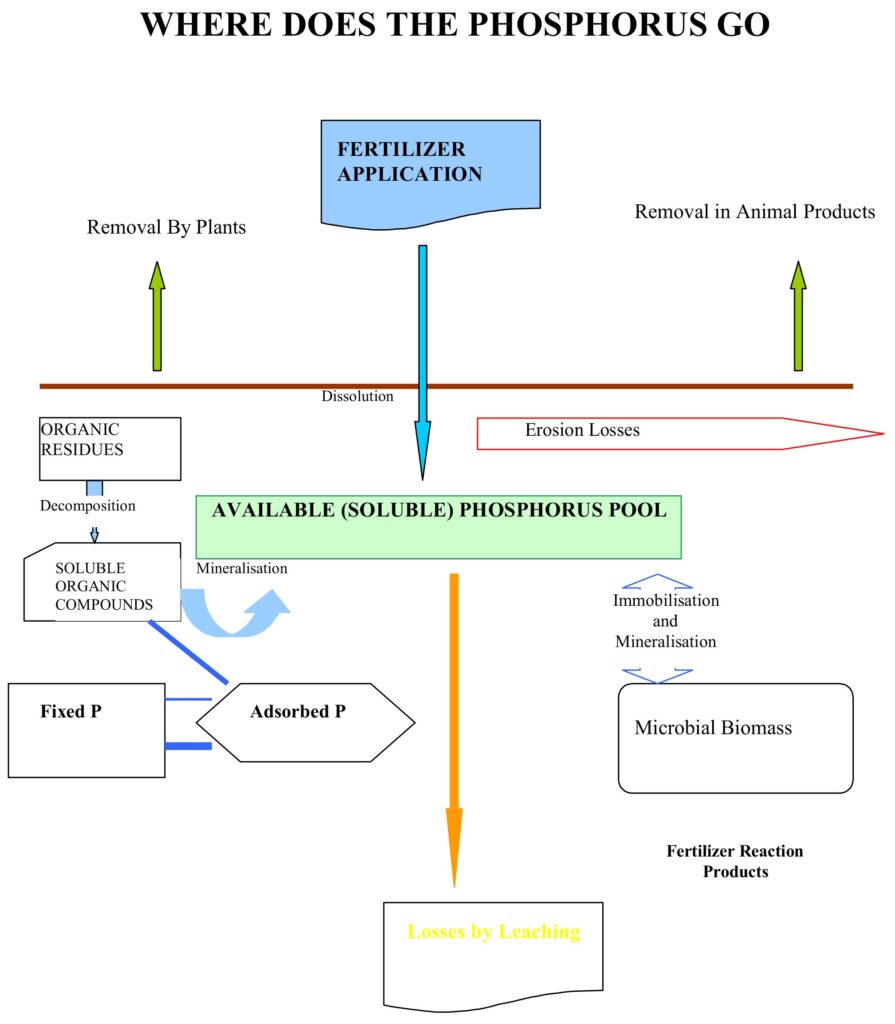
The addition of phosphorus fertilizer (plus other nutrients) has become essential for agriculture in Western Australia to remain sustainable. It’s a known fact that WA soils are some of the poorest in the world when it comes to phosphorus, however, our native plants have evolved and adapted to survive in these conditions.
Introduced plants, including agricultural crop and pasture species, have no such adaptations. As a result, they will not produce to their maximum potential or even survive without the addition of phosphorus in the form of fertilizer.
Role of phosphorus in plants
Phosphorus is essential to the health of plants. This mineral is a major component of the genetic material DNA, plus it’s involved in many of the biochemical processes critical for plant metabolism, such as photosynthesis and energy production. Its critical role in early growth is demonstrated by the lack of root growth seen in phosphorus deficient plants.
As demonstrated in this nutrient removal table, relatively small amounts of phosphorus are removed in grain.
Phosphorus deficiency
Given the major role phosphorus plays in plant metabolism, a deficiency will affect all aspects of growth. Plants lacking phosphorus will appear stunted, often with a reddish colouration on the stems. They will also have dark green leaves and dying leaf tips.
Preventing phosphorus deficiency
To prevent crop or pasture deficiencies, apply adequate rates of phosphorus-containing fertilizer either at seeding or prior to germination. An adequate rate can be established from a soil analysis, in conjunction with tissue testing.
Correcting phosphorus deficiency
Correcting a deficiency in an established crop is very difficult. This is due to the immobility of applied phosphorus, which would be bound by soil before getting into the root zone.
Supplying adequate phosphorus to the plant can be difficult in some soil types and some seasons. Recent research has highlighted the problem in soils with high phosphorus buffering index (PBI), particularly during dry seasons where the surface of the soil dries out early in the plants’ life.
To find out more about preventing or correcting a phosphorus deficiency, speak to your local Area Manager.
Potassium (K)
Potassium is an essential plant nutrient that is commonly in short supply in Western Australian soils. This nutrient is critical for plant growth as it is involved in most of the biological processes of plants. It’s classified as a macronutrient because plants take up large quantities of potassium throughout their life cycle. As a result, limited supply of potassium can limit crop yields.
As demonstrated in this nutrient removal table, only small amounts of potassium are removed in grain. The majority of potassium is held in the leaves and stems.
Example of grain removal
A wheat crop which yields 3.0t/ha would have a mature weight of around 10.0t/ha (roots, leaves, stem and grain). At 2.0% potassium, the crop has to access 200kg/ha of potassium (equivalent to 400kg/ha of muriate of potash). Out of this potassium, only 12 to 15kg/ha would be removed in the grain. The rest is available to be returned to the soil, removed by livestock or lost through stubble burning or erosion. Greater losses will occur if the ash is removed by wind, rain or soil erosion. When soil sampling, much of the potassium may be still in the plant at the time of sampling as it will be leached into the soil with rainfall. Marginal levels in November may be adequate in May.
If removing large amounts of plant material, as in hay and silage production, some grazing systems and chaff carts behind headers, removal of potassium can be large. Replacement of potassium is essential, using muriate or sulphate of potash.
Role of potassium in plants
- Vital for photosynthesis and protein synthesis.
- Helps to breakdown carbohydrates to provide energy for growth.
- Assists in movement of metal ions such as iron (Fe).
- Helps control ionic balance.
- Helps the plant resist disease and withstand drought, cold and frost.
- Essential for fruit and grain formation.
- Aids in osmoregulation: the process of opening and closing the stomata (pores in the surface of the leaf) to control the amount of water lost to the atmosphere.
- Affects the quality of grain protein, efficiency of nitrogen uptake, baking quality and yield (seed weight and numbers).
Potassium deficiency
Potassium is a mobile nutrient within the plant. When deficiencies occur, the plant will remove potassium from the older leaves and pump it into the younger leaves, therefore the symptoms will appear on older leaves first. Plants lacking potassium will have speckling along the leaves, spreading quickly to the tip and the margin. Complete senescence (death) of the older leaf may occur.
Soil Tests
Generalised guide to soil test levels and potassium requirements
| Soil Test Level (K - ppm or mg/kg) | Cereals | Lupins Canola* Pulses | Pasture Low Rainfall | Pasture Medium Rainfall | Pasture High Rainfall |
|---|---|---|---|---|---|
| >120 | 0 | 0 | 0 | 0 | 0# |
| 80 - 120 | P.T. | 0 | 0 | 10-20 | 20-30 |
| 60 - 80 | 15-20 | 0 | 10-20 | 20-30 | 30-40 |
| 40 - 60 | 20-25 | P.T. | 20-30 | 30-50 | 40-60 |
| <40 | 25-35 | 20-25 | 30-50 | 40-6- | 50-60 |
P.T. = Plant Test. Levels are marginal, but may not respond to applied K.
*Canola does not appear to respond to low potassium levels. However, data is very scarce. To help the following years crop, and to cover all eventualities, it is suggested that up to 50kg/ha muriate of potash be applied pre-sowing.
# Balansa: Balansa clover is a vigorous growing clover often used for hay making. Observations from the Great Southern and South Coast regions indicates that Balansa is more sensitive to potash deficiency than other pasture legumes. If soil tests indicate levels around the 120 to 150ppm then use of potash would be a wise precaution.
Leaching
One of the myths about potassium is that it leaches rapidly. In fact, potassium is a cation and binds quite strongly to the soil particles. Leaching may be a problem in high rainfall, deep sands. However, in lower rainfall areas where the soil has a reasonable clay or gravel content, or in duplex sand on top of clay/gravel, leaching is not a major concern. In waterlogged clays, or soils where surface erosion is likely to be a problem, then delayed or split applications may be beneficial.
Lime and Potash
Applying lime to soils with lower potassium levels (up to 140ppm) can have a detrimental effect on the availability of potassium to the plant. This is particularly prevalent in lupins. The application of lime applies large amounts of calcium. Calcium and potassium appear to be absorbed through the same part of the root, so the plant will absorb the nutrient in abundance. The other possibility is that the calcium (also a cation) will replace the potassium on the soil colloid, releasing the potassium for ready leaching.
To find out more about preventing or correcting a potassium deficiency, speak to your local Area Manager.
Sulphur (S)
Sulphur is an essential plant nutrient. It’s required for the production of amino acids, which make up the proteins critical to plant growth. Sulphur deficiency can significantly reduce yield in pastures on sandy soils in wet years, when the sulphate form of sulphur leaches below the root zone of pasture plants.
Role of sulphur in soils
Varying degrees of sulphur are present in nearly all soils. Clay and gravel soils generally have more sulphur present, which is due in part to the composition of the original parent rock. Organic sulphur, which is mineralised into plant-available sulphate sulphur, is more prevalent in soils with high clay and gravel content. Sandier soils from higher rainfall areas do not have any ability to restrict the leaching of water-soluble sulphate sulphur.
As demonstrated in this nutrient removal table, sulphur remaining in plant residues is readily recycled into the soil.
Sulphur Deficiency
Cereals: Sulphur deficiency symptoms in cereals will often resemble nitrogen deficiency with pale green/yellow leaves. To determine the cause of the deficiency, closely inspect the plant. In sulphur deficient plants, the youngest leaves will turn yellow, unlike nitrogen deficiency which affects the oldest leaves.
Clover Plants: Similar symptoms are present in clover plants in that yellow leaves are present. In severe cases, the leaves will stand upright with a ‘cupped’ appearance.
Canola Plants: These plants have a high requirement for sulphur. When deficient, the leaves will ‘curl’, turn yellow and the veins will show a marked red/purple colouration.
Preventing Sulphur Deficiencies
Modern, high analysis fertilizers such as MAPSZC and DAPSZC can supply sufficient levels of sulphur to cereal crops. Canola crops will require more than can be safely or conveniently applied using a seeding fertilizer. As such, extra sulphur must be applied either before seeding (gypsum), or post seeding (Amsul).
If a deficiency manifests in an established crop, this can be easily corrected with an application of sulphate of ammonia.
Supplies of Sulphur
Sulphate Sulphur
- Immediately available to the plant
- Water soluble
- Quick acting
- Leachable
- Can be lost with one heavy rainfall event
Elemental Sulphur
- Sustained release
- Not lost by leaching
- More available when maximum plant growth occurs in spring
- Will build up a sulphur ‘bank’
- Slow to break down
- Not suitable to correct a visual deficiency in plants
To find out more about preventing or correcting a sulphur deficiency, speak to your local Area Manager.
Calcium (Ca) & Magnesium (Mg)
Role of calcium in plants
While calcium is considered a secondary plant nutrient, it plays a very important role in plant growth and nutrition, as well as in cell wall deposition. Calcium is necessary for the proper growth and functioning of root tips and meristems. It activates many plant enzyme systems, neutralises organic acids in the plant and increases the mechanical strength of the plant.
Calcium deficiency in wheat
- Stunted roots (particularly lateral) that turn a dark colour and rot.
- Leaves will not turn yellow, instead, old leaves will maintain dark green colour.
- Necrotic spotting in the middle of the youngest leaf, leading to leaf collapse and unrolling.
- Gelatinous wheat leaf tips and growing points.
Calcium deficiency in lupins
- Shortening of lateral roots which then turn brown.
- Leaflets of new leaves remain tightly closed.
- Petioles of new leaves bend and collapse (leaves may only show a few chlorotic areas).
- Bending of the main stem.
- Necrotic tipping of unopened leaflets followed by the collapsing of the petioles.
- New growing tips decay before any elongation of the petioles can occur.
- Old and middle leaves become mottled and chlorotic, then die and shed.
Calcium deficiency in field peas
- Stunted shoot and root growth.
- Chlorotic crescent with small pink spots may appear at base of leaflets.
- Young tendrils may wilt and collapse close to the junction of the main stem and the tendril.
- Collapsing of petioles and leaves.
- New leaves do not fully open and will curl along the margins with sharply pointed tips.
- Old leaves remain healthy, dark green and fully formed.
Calcium deficiency in faba beans
In faba beans, a calcium deficiency affects the newest growth of the plant. Symptoms include:
- Stems subtending new growth and the petiole of the youngest emerged leaf blade will collapse, then slowly turn black.
- Leaf edges at the bottom end of very young leaves will curl inwards and exhibit a purplish necrosis, contrasting with the dark-green apex sections in the open region of the leaf.
- Fully developed leaves feature purpling on the bottom end of the leaf, midrib and veins.
Role of magnesium in plants
Magnesium is an essential plant nutrient that plays a central role in plant photosynthesis. Without magnesium, chlorophyll cannot capture sun energy needed for photosynthesis. It also plays a significant part in transporting phosphorus, phosphate metabolism, plant respiration, protein synthesis, and the activation of several enzyme systems in the plant.
Causes of magnesium deficiency
An imbalance between calcium and magnesium in soils of low cation exchange capacity can worsen an existing magnesium deficiency. If the Ca:Mg ratio becomes too high in these soils, then plants may take up less magnesium. This may happen when a grower has used lime or gypsum on a soil relatively low in magnesium. Magnesium deficiency may also be worsened by high rates of potassium or high availability of ammonium-N.
Magnesium deficiency in wheat
- New leaves will have a faded appearance followed by abnormal yellowing and twisted looking leaves (also seen in water stress).
- Entire length of the leaves, including new shoots, may remain folded or rolled.
- Blotches on yellowed new leaves, followed by death.
- Mottled chlorosis and possibly reddish colouration around the outside of older leaves.
Magnesium deficiency in lupins
When magnesium deficiency symptoms first show up in lupins, no damage has yet occurred to the plant. Symptoms include:
- Light green plants with some mild interveinal yellowing on old and new leaves.
- Small bronze spots distributed randomly over the leaflet (spots do not merge to form necrosis).
- Old leaves turn a dull greyish green, while new leaves arrange into clusters with dead tips.
- Entire plant turns a dull green colour.
Magnesium deficiency in faba beans
Magnesium deficiency in faba Beans causes a variety of symptoms that cover leaves of all ages, after an initial stunting of growth. Symptoms include:
- ‘Rolling in’ of the youngest leaves, persisting for the duration of the deficiency.
- Umbrella-like folding back of middle leaflets.
- Purple spotting on leaves.
- Mottled chlorosis progresses into yellowing of area in between veins.
- Reddish colour appearing on mottled leaves (middle – older leaves).
- Dull red colour and pale necrosis appearing around leaf edges (younger leaves).
Magnesium deficiency in field peas
- Presence of pink necrotic lesions between the midrib and the margins of leaves (old leaves will roll over the margins).
- New leaves develop a pale green colour and plant growth is soon reduced.
- Large areas of new leaves turn white and develop small pink necrotic spots.
- New leaves lose all of their chlorophyll, are stunted and change to a narrow and pointed shape.
- Old leaves take on a speckled chlorosis appearance with traces of pink areas.
- Edges of all leaves, especially at the tip, roll over considerably.
- Roots of plant remain healthy with good lateral root and root hair extension.
To find out more about preventing or correcting calcium or magnesium deficiency, speak to your local Area Manager.