


Field Research Trials
For more information on specific Field Research Trials please contact your local Area Manager.
Pasture, Wagerup
LTS Pasture, Serpentine
LTS P, LTS K in Canola, Dalyup
EEF in Canola, Woogenellup
NxP in Barley, Nyabing
NxK in Canola, Kojonup
Wheat, Kojonup
NxP in Oats, Cuballing
NxP in Wheat, Moorine Rock
PK in Wheat, Yelbeni
LTS N in Wheat and Canola, Dandaragan
N x P in Wheat, Wubin
NS Ratio in Wheat, Mingenew
NS Ratio in Wheat, Mullewa
SUM23.25: P Rates in Barley, Narrogin
AIM
To provide yield and profitability results from a phosphorous (P) rate trial in the Narrogin area to assist local growers in optimising their fertilizer programs. This is particularly important given the high fertilizer prices that the industry is experiencing currently.
KEY MESSAGES
- Narrogin experienced a decile 2 growing season in 2023, with a drier than average finish to the season.
- Plant emergence was satisfactory with all treatments achieving at least 106 plants/m2 with 30 kg P/ha achieving higher emergence compared to the other treatments.
- In-season biomass shows slight increase in biomass with increasing rates of applied P up to 20kg P/ha.
- Yield ranged from 2.3t/ha where no P was applied to 3.6 t/ha where 25kg P/ha was applied.
- There was a significant difference in yield between P rates, however only between Nil and 25kg P/ha.
- Grain quality was consistent with all treatments graded as MALT1.
- Gross margins followed the same trend as the grain yield as increased yield was more than enough to cover the extra cost of fertiliser input, up to 25kg P/ha
- The highest yielding treatment where 25kg P/ha was applied was also the most profitable, returning $1,021/ha.
Contact your Local Area Manager for more information
SUM23.20: P Strategies, Kojonup
AIM
Assessing more standardised crop nutrition practices against new strategies is important in maximising potential of newer crop varieties. In this trial, we investigated the merits of using several plant nutrition strategies on growing wheat: SSP vs MAP as phosphorus (P) source, all P at seeding vs split timing, 2 different rates of P, and 2 different rates of nitrogen (N). These were assessed on a gravelly loam in Scotts Brook near Kojonup.
KEY MESSAGES
- This trial had problems with wetting, resulting in patchy emergence and unstable growth, along with management errors that could have influenced the results.
- Scotts Brook had decile 6 growing season rainfall in 2023.
- Emergence was poor across all treatments, but with no significant differences.
- NDVI at mid-tillering showed no significant biomass differences between any treatments
- Yields were higher in MAP treatments compared to SSP treatments, although this was not statistically significant. Yield was not influenced by the other 3 factors.
- Grain protein was higher with the higher application of N.
- Gross margins showed that on average, the most profitable strategies were 70kg N/ha, with the P source being MAP. P rate and P timing did not produce different gross margins.
Contact your Local Area Manager for more information
SUM23.19: Apex NPK, Kojonup
AIM
Assessing more standardised crop nutrition practices against new strategies is important in maximising potential of newer crop varieties. In this trial, we investigated the maximum yield potential of Planet barley by removing nutrient limitations in nitrogen (N) and potassium (K), with two rates of potassium (P), on a gravelly loam in Scotts Brook near Kojonup.
KEY MESSAGES
- This trial had a lot of missing data due to various problems in the field, so there weren’t the intended data repetitions in all treatments, so keep that in mind when assessing this trial’s data.
- Scotts Brook had decile 6 growing season rainfall in 2023. Emergence was satisfactory across all treatments, with no significant differences.
- NDVI at mid-tillering showed increased biomass from applying increased N and K.
- Yields significantly increased with additional rates of N, up until 150kg N/ha, as did higher rates of both P and K, to the highest rates tested in the trial.
- Grain protein increased with higher N rates but decreased with higher P and K rates. This resulted in most treatments making malt barley grade, but others not receiving the large premium in receival prices.
- Gross margins showed that on average, the most profitable rates were 150kg N/ha, 75kg K/ha and 40kg P/ha.
Contact your Local Area Manager for more information
SUM23.18: Nitrogen Source and Timing, Woogenellup
AIM
To determine the yield and profitability of wheat with the application of different sources of nitrogen (N), as well as different N timing strategies used, in the Woogenellup area.
KEY MESSAGES
- For each N application it rained shortly after, minimising risk of ammonia volatilisation.
- In-season crop biomass showed no differences between N sources, but all N upfront treatments did have less biomass compared to split applications, despite having more units of nitrogen at both NDVI readings.
- Protein was consistent across all N sources, all above 12.5%.
- High screenings limited receival grade with most treatments’ receivable as Utility Hard 2, UAN applied at seeding and post had low hectolitre weight limiting it to feed grade, decreasing its gross margin.
- Urea at seeding with MAXamFLO applied post was the most profitable treatment with an indicative gross margin of $1,656/ha. The least profitable treatment was UAN at seeding and post, with a gross margin of $1,086.
Contact your Local Area Manager for more information
SUM23.17: Nitrogen Sources & NBPT urease inhibitor, Dumbleyung
AIM
This trial is part of a series comparing the available nitrogen (N) products, all at one rate, to evaluate any differences and potential benefits in the Dumbleyung area. A urease inhibitor product was also included in this trial to assess any production advantages or disadvantages from the application of this product.
KEY MESSAGES
- Biomass readings showed no significant differences between N sources.
- Yield showed no significant differences between N sources, but urea and UreaGlaze yielded slightly lower than the other sources.
- Protein ranged from 11.1% to 12.1%, with all N sources achieving AUP1 receival standard.
- Conditions around in-season N application did not favour ammonia volatilisation.
- Gross margins ranged from $377/ha to $468/ha and UreaPlus was the most profitable treatment
Contact your Local Area Manager for more information
SUM23.16: Potassium Source, Timing & Rate for Wheat, Dumbleyung
AIM
As annual crop yields increase, growers are increasingly seeking best practice use of potassium (K) for optimal returns. The aim of this trial is to assess the importance of K source and timings at two K rates on wheat, in 2023 at a site near Dumbleyung, in terms of how these factors affect yield and profitability.
KEY MESSAGES
- Calibre wheat was sown at 89kg/ha on the 16th May 2023.
- Dumbleyung experienced decile 6 growing season rainfall in 2023 – with a dry end to the season.
- Emergence was consistent across the trial, with an average of 96 plants/m 2 (close to the target density).
- Biomass readings at both early and late-tillering were consistent between treatments.
- Yields ranged from 2.1t/ha to 2.5t/ha, but were not significantly affected by K source, timing, or rate.
- A small yield increase between nil K and 15kg K/ha was not significant.
- Protein ranged from 10.2% to 11.1%.
- 15kg K/ha IBS MOP was the most profitable treatment, returning a gross margin of $670/ha.
- Gross margins varied between treatment combinations, but the highest was 20% above the nil K treatment.
Contact your Local Area Manager for more information
LTSUM23.14.23: N Strategies for wheat 2023, Ogilvie
KEY MESSAGES
- Ogilvie experienced decile 1 growing season rainfall in 2023, with less than 18mm after the 3rd August.
- In-season biomass assessments indicated that plant growth was unaffected by different N strategies.
- Yields ranged from 1.2t/ha to 1.6t/ha, with significant differences between only the lowest and each of the two highest N strategies.
- Increasing N rates up to 120kg N/ha decreased yields, but increased grain protein (range 12% to 12.8%).
Contact your Local Area Manager for more information
LTSUM23.14.23: N Strategies for wheat 2023, Yuna
KEY MESSAGES
- No nitrogen responses were seen, contributed by low rainfall year but primarily due to the site chosen found to be following a lupin crop in 2022.
- Yields ranged from 1.8t/ha to 2.1t/ha, with no significant differences between individual treatments, so most detailed aspects of the strategies could not be conclusively analysed.
- Increasing N rates decreased yield up to 120kg N/ha, but increased grain protein (range 14.5% to 17.1%).
- Under the 2023 conditions, decreasing current N practice would have been more profitable.
Contact your Local Area Manager for more information
SUM23.10: Nitrogen, Phosphorus & Potassium in wheat, Kellerberrin
AIM
Assessing more standardised crop nutrition practices against new strategies is important in maximising potential of newer crop varieties. In this trial, we investigated the maximum yield potential of Rockstar wheat by removing nutrient limitations in nitrogen (N) and phosphorus (P), both with and without potassium (K), on a loamy sand in North Kellerberrin.
KEY MESSAGES
- Kellerberrin had decile 1 growing season rainfall in 2023, with a particularly dry finish to the year.
- The yield at this trial was not representative of the decile 1 season, but was sown into moisture with some early rains and grew quickly due to the warmer temperatures.
- Biomass and harvest yield significantly increased with increasing applications of N, although biomass at flag -1 reached a maximum at 80kg N/ha.
- Biomass and harvest yield increased with a application of P, but did not increase further with more than 6kg P/ha applied.
- Biomass increased with an application of K when measured at flag -1, but did not increase at mid-tillering, and harvest yields did not increase with applied K.
- Grain protein reached a maximum of 9.3%, but increased with increasing rates of N.
- Under 2023 conditions, the most profitable treatment was 80kg N/ha, 12kg P/ha and no K, returning a gross margin of $1120/ha. These were also the most profitable average rates across the trial.
Contact your Local Area Manager for more information
SUM23.09: N&P, Bodallin Wheat
AIM
Assessing standard crop fertiliser practice against new strategies is important to determine best practice agronomy for various crop varieties. This trial assesses the response of Vixen Wheat under a factorial nitrogen (N) and phosphorus (P) fertilizer application trial design in the Bodallin area, to improve understanding of the value of optimal N and P for wheat yield, grain quality and profitable returns.
KEY MESSAGES
- Bodallin experienced a decile 1 rainfall season in 2023, with an especially harsh finish.
- There were no significant differences in emergence between treatments, but average emergence was lower than preferred.
- In-season biomass was not significantly different between rates of N or P.
- Yields was not significantly different between treatments, although nil N and P did provide lower actual yields compared to treatments with any application of N or P.
- Grain protein increased with higher rates of N application.
- Gross margins decreased with the addition of more nutrients, with nil N and 25kg N/ha providing more profitability than higher rates under 2023 conditions.
Contact your Local Area Manager for more information
SUM23.08: N&P, Mukinbudin
AIM
Assessing standard crop fertiliser practice against new strategies is important to determine best practice agronomy for various crop varieties. This trial assesses the response of Buff barley under a factorial nitrogen (N) and phosphorus (P) fertilizer application trial design in the Mukinbudin area, to improve understanding of the value of optimal N and P for wheat yield, grain quality and profitable returns.
KEY MESSAGES
- Mukinbudin experienced a decile 1 growing season with only 118mm of rainfall.
- Emergence was low due to the poor break of the season, with no differences or trends between treatments.
- In season biomass showed some differences between treatments however these were not significant and appeared to be no pattern.
- Harvest yield showed increasing yield with increasing rates of applied N, but not P. The highest yielding treatment was where 18kg P/ha with 125kg N/ha was applied yielding 1.2t/ha.
- The high price of fertiliser along with the decile 1 season meant that applying phosphorus was not profitable on this soil in 2023. Nitrogen application did however prove profitable as it increased the grade from feed to malt.
- The most profitable treatment was where no phosphorus and 50kg N/ha was applied due to the low cost of fertiliser and decent yield.
Contact your Local Area Manager for more information
SUM23.07: N&P, Korbel
AIM
Assessing standard crop fertiliser practice against new strategies is important to determine best practice agronomy for various crop varieties. This trial assesses the response of Rockstar Wheat under a factorial nitrogen (N) and phosphorus (P) fertilizer application trial design in the Korbel area, to improve understanding of the value of optimal N and P for wheat yield, grain quality and profitable returns.
KEY MESSAGES
- Korbel experienced decile 3 growing season rainfall in 2023.
- Emergence was impacted by urea toxicity in the treatments that had 25kg N/ha applied at seeding.
- In-season biomass at flag-1 was not significantly different between treatments.
- Yields significantly increased with increased N applications but were maximised at 50kg N/ha. Applying P at rates higher than 6kg P/ha also significantly increased yields.
- Grain protein increased with higher N applications.
- The most profitable individual treatment, and also the most profitable average rates, were 50kg N/ha and no P under 2023 conditions.
Contact your Local Area Manager for more information
SUM23.06: N&P, Muntadgin
AIM
Assessing standard crop fertiliser practice against new strategies is important to determine best practice agronomy for various crop varieties. This trial assesses the response of Buff barley under a factorial nitrogen (N) and phosphorus (P) fertilizer application trial design in the Muntadgin area, to improve understanding of the value of optimal N and P for wheat yield, grain quality and profitable returns.
KEY MESSAGES
- Muntadgin experienced decile 2 growing season rainfall this season with an exceptionally dry finish.
- There was a positive biomass response to increasing rates of nitrogen.
- Grain yield increased with increasing rates of N.
- Yields did not significantly increase with higher rate of P, except for when 125kg N/ha was also applied, where the extra N went towards yield rather than protein.
- Most treatments were receivable as BFED1, limited by hectolitre weight, except nil P with 50kg N/ha which made MALT1.
- The nil P with 50kg N/ha was the most profitable treatment due to the increase in grain value over other treatments.
- The dry season along with the high price of fertilizer in 2023 meant that gross margin had a negative trend with increasing rates of applied nutrients.
Contact your Local Area Manager for more information
SUM23.05: Nitrogen Strategies, Muntadgin
KEY MESSAGES
- Use of Glaze Extend NBPT inhibitor had no significant impact on yield and therefore urea utilisation.
- Muntadgin experienced well below average, decile 2 growing season rainfall in 2023, with less than half (43%) of the long-term average rainfall for the July-October period.
- In-season NDVI indicated that plant growth was unaffected by the different N strategies.
- Yields ranged from 1.2t/ha to 1.5t/ha with no significant differences between any treatments.
- Despite minimal yield differences, calculating a gross margin indicated the most profitable treatment was Nil N up-front and 60kg N/ha as Urea+Glaze at early-tillering, and the least profitable was 80kg N/ha of from UAN in split post-emergent applications.
Contact your Local Area Manager for more information
SUM23.02: Potassium Rates & Timing, Badgingarra
AIM
Extend and modify the approach of LTSUM20.02 to assess varying the strategy for applied K rates and application timings for yield and profitability of canola on sandy soil in the Badgingarra area.
KEY MESSAGES
- Plant establishment was not affected by K rates or timings and met target rates for canola.
- In-season plant biomass was uniform and unaffected by K rates or timings.
- Canola yields averaged 1.7t/ha across all treatments and there were no differences between K rates or application timings.
- Oil content was consistent across the trial.
- The most profitable treatment under 2023 conditions was 15kg K/ha applied upfront, at $957/ha, which was 10% higher than nil K.
- Profitability was unaffected by whether the timing of application was upfront or split.
Contact your Local Area Manager for more information
SUM23.01: P Source on Barley, Boyup Brook
AIM
This trial is assessing the impact of using different forms of phosphorus (P) fertilizer on the yield, profitability and grain P content of barley, on a forest gravel in Boyup Brook.
KEY MESSAGES
- Boyup Brook had a decile 3 growing season in 2023.
- In-season biomass assessment indicated that growth was not significantly affected by P sources.
- Tissue tests at jointing indicated that there was higher total P in TSP and SSP compared to MAP and DAP treatments.
- Yields were not significantly affected by P sources, despite higher average yields for DAP and MAP.
- Profitability was mostly influenced by the variability in the yields in the trial.
- A grain analysis of the 2023 harvest grain showed that P source did not significantly affect the total P in the grain.
Contact your Local Area Manager for more information
SUM23.02.23: Sulphur Supply & Leaching, Bunjil
KEY MESSAGES
- Difficulties at sowing and a very dry season made interpreting 2024 crop response data trends difficult.
- Plant emergence was adequate for a low rainfall season, with no differences between treatments.
- Crop biomass responded to increasing S rates up to 90kg S/ha when supplied by SoA, , and responded better to SoA than gypsum and elemental S.
- Soil tests indicated that SoA application had increased available S in the topsoil
- Plant tissue samples showed S from SoA and Gypsum was being taken up by plants but elemental S was not supplying adequate S.
- Yields ranged from 0.50t/ha with 35 kg/ha DAPSZC (4kg S/ha) to 0.62t/ha with 375 kg/ha SoA (90kg S/ha).
- No treatment produced a positive return in 2023.
Contact your Local Area Manager for more information
SUM23.01.23: Sulphur Supply & Leaching, Mingenew
KEY MESSAGES
- Difficulties at sowing and a very dry season made interpreting 2024 crop response data trends difficult.
- After resowing, crop emergence was sufficient across all treatments, with no differences between treatments, but not ideally placed seed relative to establishment fertiliser.
- There were no differences in crop biomass yield or oil content between any of the 2024 treatments.
- Plant tissue showed S uptake relative to form in the order sulphate of ammonia (SoA) > gypsum > elemental S.
- In-season soil samples indicated that applied S led to increased S reserves in the topsoil, but did not move down the profile with the limited growing season rainfall received at the site.
- No treatment produced a positive return in 2023.
Contact your Local Area Manager for more information
SUM20.02.23: Long-term Potassium Rates, Source & Placement, Badgingarra – 2023 results
AIM
Continuing from 2020, 2021 and 2022, this trial assesses the importance of K placement as either MOP or SOP on canola in 2023, at a sandy site east of Badgingarra at rates designed to run-down, maintain and build K soil reserves over time. The trial commenced in 2020 and follows the paddock rotation for multiple years.
KEY MESSAGES
- 2023 pre-sowing soil test results indicated that 75kg K/ha for the previous three seasons was maintaining the topsoil K at 2020 levels, and increased subsoil K reserves, while 15kg K/ha was not.
- Emergence was depressed by nil K, but otherwise was not affected by K rate, source, or placement.
- In-season biomass and harvest yields increased from nil K to 15 kg K/ha, but not to higher rates.
- Yields averaged 2.1t/ha across the trial.
- Although MOP yielded slightly higher than SOP, and banding below yielded higher than with the seed, neither were significant.
- The long-term nature of this trial with repeated K rates has not yet had a significant impact on yield.
- The most profitable treatment was 30kg K/ha of MOP banded below the seed, at $1213/ha.
- MOP remained more profitable than SOP in 2023 conditions.
Contact your Local Area Manager for more information.
SUM24.07: Nitrogen & Phosphorus Rates in Wheat, Mukinbudin
AIM
This trial aims to investigate the optimal and most cost-effective rates of nitrogen (N) and phosphorus (P) for wheat in Mukinbudin.
KEY MESSAGES
- The site had a significant response to N, with all rates yielding significantly higher than N0.
- P rates did not have any significant differences either in-season or at harvest.
- The most economical treatment was 25 units of N and nil P, though P may be depleted at this site for future seasons with no further applications.
- The lack of rain in the latter half of the season limited the yield potential of earlier applied N.
Contact your Local Area Manager for more information
SUM24.06: N, P & K Rates in Wheat, Muntadgin
AIM
To assess the maximum yield potential of wheat by removing nutrient limitations in nitrogen and phosphorus, both with and without potassium, on a loamy sand in Muntadgin.
KEY MESSAGES
- A significant positive response was observed to both N and P at all rates above 0.
- The site was unresponsive to K, with no yield or financial gains noted in 2024.
- The most profitable application rates were N50, P12 and K0.
- Diminishing financial returns existed at rates above N50 and P12.
Contact your Local Area Manager for more information
SUM24.04: P & K Rates in barley, Nyabing
AIM
This 2024 trial in barley aimed to identify optimal application rates for phosphorus (P) and potassium (K) to maximise returns in a sandy soil ‘leased land’ situation at Nyabing.
KEY MESSAGES
- There was a significant yield increase observed by applying P, with the optimum rate being 12kg P/ha.
- A plateau effect presented over 12 units of P.
- The site best responded to K, with a plateau effect above 25 kg/ha.
- The best return on fertilizer investment came from 12kg P/ha and 25kg K/ha
Contact your Local Area Manager for more information
SUM24.03: N, K & S Rates, Frankland River
KEY MESSAGES
- Due to lodging of the crop, yield and economic data is unfortunately missing from this trial.
- In-season NDVI data revealed a significant response to N, with all treatments having significantly greater biomass than N0 and N175 having significantly higher biomass than N50.
- No K or S rate response was observed in the data available.
- A repeat or extension of the trial may reveal valuable yield and economics data in future seasons.
Contact your Local Area Manager for more information
SUM24.01: Nitrogen and potassium rates for wheat, Maya
AIM
To improve our understanding of optimal nitrogen (N) and potassium (K) applications for wheat yield, grain quality and the most profitable returns.
KEY MESSAGES
- In 2024 the Maya site received decile 9 GSR (above average rainfall in June, July, August and below average in September)
- Vixen wheat showed increased yields with higher nitrogen rates – up to 60kg N/ha. Grain protein increased significantly with higher rates of applied N. The highest yielding treatment was 60kg N/ha and 30kg K/ha.
- Yields did not increase significantly with increased potassium rates, although 30kg K/ha did result in a higher average gross margin than nil K, due to a minor (200 kg/ha) yield benefit.
Contact your Local Area Manager for more information
K Rates, Dalyup
Contact your Local Area Manager for more information
P Rates, Dalyup
Contact your local Area Manager for more information.
SUM23.01.24: S Supply & Leaching, Mingenew
AIM
To investigate S supply to modern cropping systems through multi-year trials assessing crop S requirement, different sources of S and it’s leaching potential near Mingenew on a clay-loam soil.
KEY MESSAGES
- Decile 10 rainfall resulted in relatively high yields across most treatments
- Yield results were considered inconclusive at this site in 2024
- Despite significant yield differences, nil S yields were not significantly worse than applying S
- S leaching did occur, but less so than at the sandy Bunjil site, primarily observable in the top 50cm
- Post-trial soil tests identified applying SOA resulted in more plant available S than gypsum and elemental S
Contact your Local Area Manager for more information
LTSUM23.02.24: S Supply & Leaching, Bunjil
AIM
To investigate S supply to modern cropping systems through multi-year trials assessing crop S requirement, different fertilizer sources of S, and it’s leaching potential near Perenjori on a sandy loam soil.
KEY MESSAGE
- There were no significant differences between the yields of S rates (including nil S), but the low average yield across the trial were not conducive to detecting this.
- Elemental S yielded lower in 2024, and significantly lower in 2023, than SOA and gypsum.
- A high amount of leaching occurred in Bunjil’s sandy soil, with higher rates of S experiencing greater leaching.
- Comparative leaching differed between products and rates past 30cm depths.
Contact your Local Area Manager for more information
LTSUM20.02.24: LT K, Badgingarra
AIM
This trial aimed to assess crop production over five seasons with various potassium (K) application rates, sources (either muriate of potash (MOP) or sulphate of potash (SOP)) and placement (with or below seed).
KEY MESSAGES
- Over the 5 years in this Badgingarra sand, the optimal K rate for yield and profitability was 30kg/ha/year.
- Application of MOP and SOP resulted in similar yields, with MOP more profitable due to it’s lower cost.
- Lupins had a lower emergence with MOP compared to SOP in 2022, although with decile 10 GSR, this did not result in a yield penalty.
- K placement at seeding generally resulted in no difference.
- Soil K rundown was evident in the lower rates of K, as well as in the nil fertilizer treatment.
Contact your Local Area Manager for more information.
SUM24.NSH11: Enhanced Efficiency Fertilizer for Pasture, Serpentine
AIM
This trial aimed to identify the efficacy of two N-Shield urea coating products and BiOWiSH, a biological EEF in a sown clay loam pasture near Serpentine during the grazing season, using a top-dressing method.
KEY MESSAGES
- Neither N-Shield NBPT or N-Shield DUAL increased pasture biomass. However, conditions for nitrogen loss were not present at this site in 2024.
- BiOWiSH was also tested as there is not much information on whether it has a place in a pasture system. There was no biomass increase from BiOWiSH; this may be because the decile 10 rainfall introduced other limiting factors which capped the yield potential.
Contact your Local Area Manager for more information
N-Shield, Frankland River
Contact your local Area Manager for more information.
N-Shield, Wandering
Contact your local Area Manager for more information.
N-Shield Small, Nyabing
Contact your local Area Manager for more information.
N-Shield & K Timing, Corrigin
Contact your local Area Manager for more information.
N-Shield, Badgingarra
Contact your local Area Manager for more information.
N-Shield, Goomalling
N Shield, Mukinbudin
Contact your local Area Manager for more information.
N-Shield, Dalyup
Contact your local Area Manager for more information.
N-Shield & K Rates, Jerramungup
Contact your local Area Manager for more information.
N-Shield, Eradu
Contact your local Area Manager for more information.
N-Shield, Maya
Contact your local Area Manager for more information.
N-Shield, Mingenew
Contact your local Area Manager for more information.
SUM22.24: P & Mn for Wheat, Tenterden
AIM
Investigate local P requirements in wheat and reinforce the importance of P for a profitable crop. Determine if increasing P rates influences crop Mn status. Assess yield and quality benefits from various P rates +/- Mn.
KEY MESSAGES
- Not all forest gravels are responsive to manganese, particularly when moderate acidity is present.
- Plant tissue tests are an important tool in evaluating manganese status.
- The highest gross margin was achieved at 20kg/ha of P, minus Mn, and optimising P had up to $200/ha benefit.
- Growers that require a greater level of accuracy in predicting phosphorus (P) responses in forest gravel soils should consider the DGT-P test.
Contact your Local Area Manager for more information.
SUM23.02: Potassium Rates & Timing, Badgingarra
AIM
Extend and modify the approach of LTSUM20.02 to assess varying the strategy for applied K rates and application timings for yield and profitability of canola on sandy soil in the Badgingarra area.
KEY MESSAGES
- Plant establishment was not affected by K rates or timings and met target rates for canola.
- In-season plant biomass was uniform and unaffected by K rates or timings.
- Canola yields averaged 1.7t/ha across all treatments and there were no differences between K rates or application timings.
- Oil content was consistent across the trial.
- The most profitable treatment under 2023 conditions was 15kg K/ha applied upfront, at $957/ha, which was 10% higher than nil K.
- Profitability was unaffected by whether the timing of application was upfront or split.
Contact your Local Area Manager for more information
SUM23.11: Factorial Nitrogen x Potassium Rates for Wheat, Wubin
AIM
To assess the response of Calibre Wheat under a factorial nitrogen (N) and potassium (K) fertiliser application trial design in the Wubin area. To improve understanding of the value of optimal N and K for wheat yield, grain quality and profitable returns.
KEY MESSAGES
- Wubin experienced decile 1 growing season rainfall in 2023, with continually low rainfall throughout.
- Wheat establishment was impacted by urea banded at seeding, but all plant counts were low.
- Vegetative growth and grain yield responded significantly only to increasing N from nil to 30 kg/ha.
- Yield results indicate no response to applied K, reflecting low growth and high K status soil.
- Yields averaged 0.7t/ha, illustrating the limited effect of N and K in such extreme low rainfall years.
- Protein increased with increasing N rates, influencing receival grades along with varied screenings.
- Gross margins were only positive at N rates below 90 kg/ha.
- The most profitable treatment was nil K and 30 kg N/ha, but only with a gross margin of $145/ha.
Contact your Local Area Manager for more information.
SUM23.12: Nitrogen & Potassium Rates in Wheat, Dandaragan
AIM
To investigate wheat yield and quality responses to increasing rates of nitrogen (N) and potassium (K) in the field, with the further aim of optimising yield and quality to maximise returns in the Dandaragan area.
KEY MESSAGES
- Mid-season biomass indicated crop vegetative growth response to increasing rates of N, but not to K.
- Yield was very high for rainfall received, averaging 4.7 t/ha across the site treatments.
- Grain yield increased up to a rate of 50kg of applied N/ha (5t/ha), but no further response to higher rates.
- Grain protein responded to increasing rates of N.
- Neither yield nor protein responded to K.
- 50kg N/ha with nil K resulted in the highest indicative gross margin of $1775/ha.
Contact your Local Area Manager for more information
SUM18-GP2: GRDC NPK Project – P Rates Trial, Mingenew
AIM
To assess the response of wheat to phosphorus (P) fertilizer application at a clay site north of Mingenew. This trial is a part of a series of trials in conjunction with GRDC looking at ‘increasing profit from N, P and K fertiliser inputs into the evolving cropping sequences in the Western Region.
KEY MESSAGES
- There was no significant biomass or yield response to applied P at this high pH, clay site with Colwell P of 11 and DGT P of 9 in the top 10cm.
- The mean yield across the site was 2.7t/ha and there was no difference between P rates.
- The rate of P to optimise yield and economic return is 0 kg P/ha.
Contact your Local Area Manager for more information.
Watheroo 2014 to 2017
A long term trial looking at the annual yield response to K applied before and after mouldboard ploughing. Contact the local Area Manager, Brett Beard, for more trial details and results.
SUM20.27: Establishment Phosphorus Compounds and Nutrient Supply for Wheat Crop Production – Large Plot Trial, Yornaning
AIM
This trial compared 3 different cropping fertilizers that vary significantly in their phosphorus (P) content. MAPSZC (at 19.8% P), Vigour (12% P) and AllRich (with only 8.7% P) were applied at a range of different P rates and the impact on Magenta Wheat yield (and gross margin returns) investigated.
This trial also aims to assess the effectiveness of trial methodology of sowing a cereal crop through pre-placed strips of P compounds, as well as comparing remote and on-ground biomass measurements for in-paddock variability in growth and yield.
KEY MESSAGES
- In-season biomass readings done by hand using a handheld Greenseeker® and through high-resolution satellite imagery indicated that biomass was not significantly affected by increasing P rates but was primarily influenced by variations insoil type across the trial.
- Yield increased with increasing rates of P, ranging between 2.73t/ha and 3.06t/ha.
- The most profitable treatment was 12kg P/ha applied as MAPSZC, indicatively returning $805/ha.
- The higher-analysis products, MAPSZC and Vigour, had higher yields and higher gross margins than the low analysis product AllRich, however differences between products was not significant.
- Using lower analysis products (such as AllRich) can have logistical disadvantages, in terms of increased storage demand and higher freight costs. In addition, blockages to seeding equipment can become more likely when using lower analysis products, due to the higher rates required.
Contact your Local Area Manager for more information.
SUM20.28: Nitrogen x Phosphorus Rates to Support Scepter Wheat Production, Tammin
AIM
Assessing standard crop fertiliser practice against new strategies. This trial assesses the response of wheat under a factorial nitrogen (N) and phosphorus (P) fertilizer application trial design in the Tammin area to increase recognition of the value of optimal N and P to wheat yield, grain quality and profitable returns.
KEY MESSAGES
- Plant growth significantly increased with both applied N and P.
- Yield increased with increasing rates of both N and P, ranging between 1.28t/ha and 2.45t/ha.
- The most profitable treatment was 12kg P/ha and 75kg N/ha, returning $625/ha.
- The trial data indicates there are significant increased profits to be made by small investment in establishing a strong foundation crop P status at sowing.
Contact your Local Area Manager for more information.
SUM20.30: Form and Efficacy of Manganese Supply to Coromup Lupins, Regans Ford
AIM
This trial aims to assess the long-term response and carryover effect of manganese (Mn) fertiliser at a sandy soil site north of Regans Ford. With uncertainty surrounding best practice Mn fertiliser strategies, this trial has incorporated a number of combinations of common practice Mn and phosphorous (P) rates, with hopes to provide further insight into the decision making when using Mn sources at seeding while also assessing the efficacy of various chemical forms of Mn fertilizer.
KEY MESSAGES
- Whole top plant sampling testing showed Mn concentration was significantly affected by the rate and form of applied manganese.
- Yield was not significantly affected by the different forms and rates of Mn fertilizer. Yields ranged between 3.2-3.5 t/ha.
- Under 2020 conditions at this site, the most profitable treatment was applying 3kg Mn/ha as a MAP:MnSO4 blend, returning $1340/ha.
Contact your Local Area Manager for more information.
SUM20.32: Apex Yield Series – Strategic Nitrogen Rates & Timing for Wheat on Sandy Soil, Mingenew
AIM
Managing wheat nutrition in the Mingenew area has implications for sustainable and profitable production. This trial assesses a number of nitrogen application strategies with increasing rates to match site conditions and Scepter wheat yield potential at a sandy site south west of Mingenew.
KEY MESSAGES
- Plant biomass responded strongly to increasing N. Differences became greater as the season progressed.
- Plant tillers were collected at Z61 and Z99. Early counts showed maximum tiller numbers at 100kg N/ha, whereas late counts showed higher tiller numbers at 55kg N/ha.
- There was higher N uptake in early N application treatments than in the later applications.
- Close to nil rainfall outside a 25 May – 17 August period, meant biomass growth differences from N were unable to support grain production and the site average yield was only 1.1 t/ha.
- Under 2020 growing season conditions the most profitable treatment was applying 15kg N/ha upfront with a return of $225/ha.
Contact your Local Area Manager for more information.
SUM20.33: Apex Yield Series – Strategic Nitrogen Rates & Timing for Wheat on Heavy Loam Soil, Mingenew
AIM
This trial assesses a number of nitrogen application strategies with increasing rates to match site conditions and Scepter wheat yield potential at a loamy site south east of Mingenew. Nitrogen was applied at different rates and timings; either early (at 5 and 8 weeks after emergence) or late (at 8 and 12 weeks after emergence).
KEY MESSAGES
- Plant biomass responded strongly to increasing N. Growth differences became greater as the season progressed.
- Grain yield averaged 3.1t/ha, with a 1.5t/ha variation across applied N rates.
- The importance of avoiding ‘hidden hunger’ was evidenced in significantly higher yields and returns from early applications of nitrogen compared to late applications.
- Applying N at 5 and 8 weeks after emergence indicatively returned an average $80/ha more profit than application at 8 and 12 weeks. Late applications require more N to catch yield from earlier applications, putting them at an input disadvantage.
- Under 2020 growing season conditions the most profitable treatment was applying 85kg N/ha early with a return of $950/ha.
Contact your Local Area Manager for more information.
SUM20.GK1: GRDC NPK Projects – K Rates, Source and Placement for Canola, Muntadgin
AIM
This trial, managed in collaboration with Murdoch University, is part of a series of trials contributing to GRDC Project UWA1801-002RTX looking at ‘increasing profit from N, P and K fertilizer inputs into the evolving cropping sequences in the Western Region’. Here we assess the importance of potassium (K) placement as either MOP or SOP at increasing rates on canola at a sandy clay loam site east of Muntadgin.
KEY MESSAGES
- Canola utilized high applied K rates with plant K status in the youngest mature leaf ranging from marginal to adequate.
- Yield averaged 1.9t/ha, fertilizer placement had a greater effect on yields than source, with banding below the seed producing higher yields at rates greater than 30kg K/ha.
- Top dressing MOP and SOP had higher seed oil concentrations than banding with or below the seed.
- There is a 12% higher return additional to nil fert when 15kg K/ha MOP was top dressed, and a 15% loss when 75kg K/ha MOP was top dressed.
- The most profitable treatment was top dressing 15kg K/ha as MOP, returning $1140/ha.
Contact your Local Area Manager for more information.
SUM20.GP1: GRDC NPK Projects – P Rates in Scepter Wheat, Moorine Rock
AIM
This trial is part of a series of trials contributing to GRDC Project UWA1801-002RTX looking at ‘profit from N, P and K fertilizer inputs into the evolving cropping sequences in the Western Region.
KEY MESSAGES
- Plant growth significantly increased with phosphorus rates.
- Yield was maximised at 40kg P/ha, ranging between 1.36t/ha and 4.04t/ha.
- The most profitable treatment was $1100/ha when 40kg P/ha was applied.
- Applying a low analysis product as an alternative source of P to MAP had no significant effect on emergence, in-season biomass or yield.
Contact your Local Area Manager for more information.
SUM22.06: Factorial Phosphorus x Potassium for Wheat, Yuna
AIM
Improve understanding of the value of optimal P and K applications for wheat yield, grain quality and profitable returns following soil amelioration.
KEY MESSAGES
- Crop establishment averaged 86 plants/m2, but low emergence was not related to P & K fertiliser.
- Yield ranged from 3.14 to 4.15t/ha and increased significantly with P rate, but was unaffected by K rate.
- The most profitable treatment of 20kg P/ha and 20kg K/ha was only 5% more profitable than the control.
- Average gross margins when 20kg P/ha were $140/ha higher (+11%) than where no P was applied.
- Profitability suggests important emphasis be placed on adequate P at seeding after amelioration, whereas K continues to show variable responses even in sandy soils deemed very low K status.
Contact your Local Area Manager for more information.
SUM22.08: P & K for wheat under different N regimes, Mingenew
AIM
This trial assesses the response of wheat under with phosphorus (P) and potassium (K) fertilizer application in a split-plot trial design under moderate or high nitrogen (N) application rates in the Mingenew area.
KEY MESSAGES
- Yield was extremely high across the trial, with an average of 6.0t/ha.
- Yields ranged from 5.1-6.8t/ha, but variation was not linked to nutrient application and no adequate nutrient response curve fits were achieved.
- Protein was higher in grain from high N treatments, by an average of 0.9%. As a result, most high N treatments were receivable as APW1, while most low N treatments were receivable as ASW9.
- Profitability was high due to yields, with delivery premiums from higher grades marginally compensating for increased input costs of high N rates.
Contact your Local Area Manager for more information.
SUM22.23: P & K Requirements for Barley, Corrigin
AIM
To test Phosphorus (P) and Potassium (K) response in Maximus barley, as well as the interaction between the two in order to optimise production and profitability. The trial will provide valuable local knowledge to the Corrigin region growers on how best to spend their fertiliser budget for maximum returns. This is particularly important given the high yields produced by the record-breaking season of 2020, where a lot of soil nutrients were removed.
KEY MESSAGES
- Corrigin had decile 10 growing season rainfall in 2022, with a very wet August and soft finish.
- Emergence was satisfactory across the trial increasing with increasing rates of P and K.
- Plant counts were consistently lower where no K was applied compared to 30kg K/ha.
- Late tillering biomass readings show increased biomass with increasing rates of P, but not K.
- Yields were high with the trial averaging 5.1t/ha and had a significant yield response to increasing rates of applied P, but no response to K.
- Grain quality was low due to low protein across the trial. This may be due to the limited N application, however we cannot confirm this.
- All treatments were receivable as BFED1 which meant yield and fertilizer price drove gross margin. 6kg P/ha with nil K achieving the highest gross margin and 12kg P/ha with 60kg K/ha having the lowest.
Contact your Local Area Manager for more information.
SUM20.17: Nitrogen x Phosphorus Rate Interactions in Winter Wheat (Illabo), Muntadgin
AIM
Winter wheats show promise as a management tool for grazing and grain, and is advantageous in early sowing conditions. This trial investigates the interactions between increasing nitrogen (N) and phosphorus (P) interactions on Illabo wheat. At a sandy loam site south east of Muntadgin we aim to improve understanding of N and P importance in yield and grain quality and begin to elucidate nutrient response behaviour in winter wheats with their distinct growth habits.
KEY MESSAGES
- May storm surface water movement caused both burial of seed and erosion and combined with difficult seeding depth control on the ripped and ploughed soil, contributed to low emergence.
- Applying AllRich as a P source at 6 and 12kg P/ha significantly affected emergence, N concentration and P concentration.
- Plant vigour significantly increased as rates of P applied increased, but profile moisture limited the effect of higher rates of N.
- Yield increased with increasing rates of both N and P, ranging between 2.19t/ha and 3.32t/ha.
- The most profitable treatment was 60kg N/ha and 18kg P/ha, returning $850/ha.
- Illabo has significant yield potential for the region that should be supported by sufficient nutrition but monitoring protein may need consideration.
Contact your Local Area Manager for more information.
SUM20.23: Apex Yield Series – High end Nitrogen, Phosphorus and Potassium Rates for Wheat, Corrigin
AIM
Summit have instigated a trial series to allow maximum yield potential expression of contemporary crop varieties by removing all nutrient limitations. This trial investigates the interactions between nitrogen (N), phosphorus (P) and potassium (K) rates on Scepter wheat grain production at a sandy clay loam site north west of Corrigin, with aims to challenge old-school conventions of nutrition standards.
KEY MESSAGES
- Increasing N rates significantly affected plant vigour at both assessment times, with the earlier time of assessment also affected by P rates.
- Yield and protein concentrations were both significantly affected by N and P rates, with K having no significant influence.
- Yield ranged between 2.55t/ha and 4.51t/ha.
- The most profitable treatment was with 16kg P/ha, 60kg N/ha and 20kg K/ha returning $1095/ha.
- Returns additional to nil control for increasing P rates was maximised when 16kg P/ha was applied, with a return of 26%.
Contact your Local Area Manager for more information.
SUM20.25: Implications of P for Barley on High PBI Soil, Year 1 – Yield Response and Seed Nutrient Accumulation, Boyup Brook
Aim
The importance of seed quality at planting is often overlooked and seed nutrient content receives little considerations. It is opportune to evaluate the impact of varying phosphorus (P) supply and trace elements on retained Planet Barley seed performance at a high P fixing forest gravel site. Varying levels of nutrition were applied so that seed can be analysed and retained for use next year to assess the performance of varying seed nutrition levels. This trial hopes to provide further insight for improving on-farm P management.
Trial Details
Location: Rylington Park, Boyup Brook
Trial Size: 1.53m x 8m, 8 treatments x 3 reps = 24 plots.
Soil Type: Loamy sand.
Crop Sown: Planet Barley, sown 22/05/2020 at 80kg/ha.
Season Rainfall: 527 mm, BOM Newbicup, 54 mm above long-term average.

Results
Key Messages
- Plant growth significantly increased with applied P.
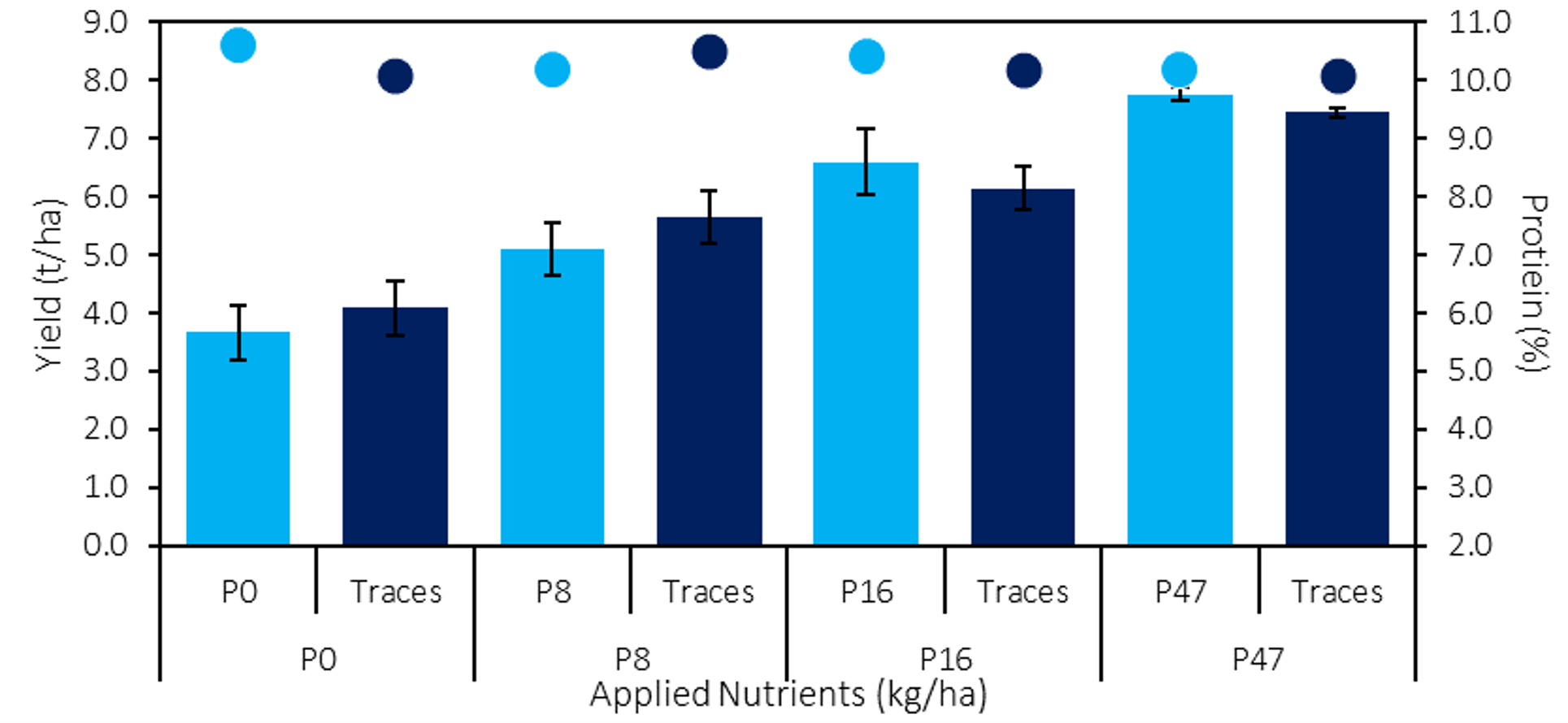
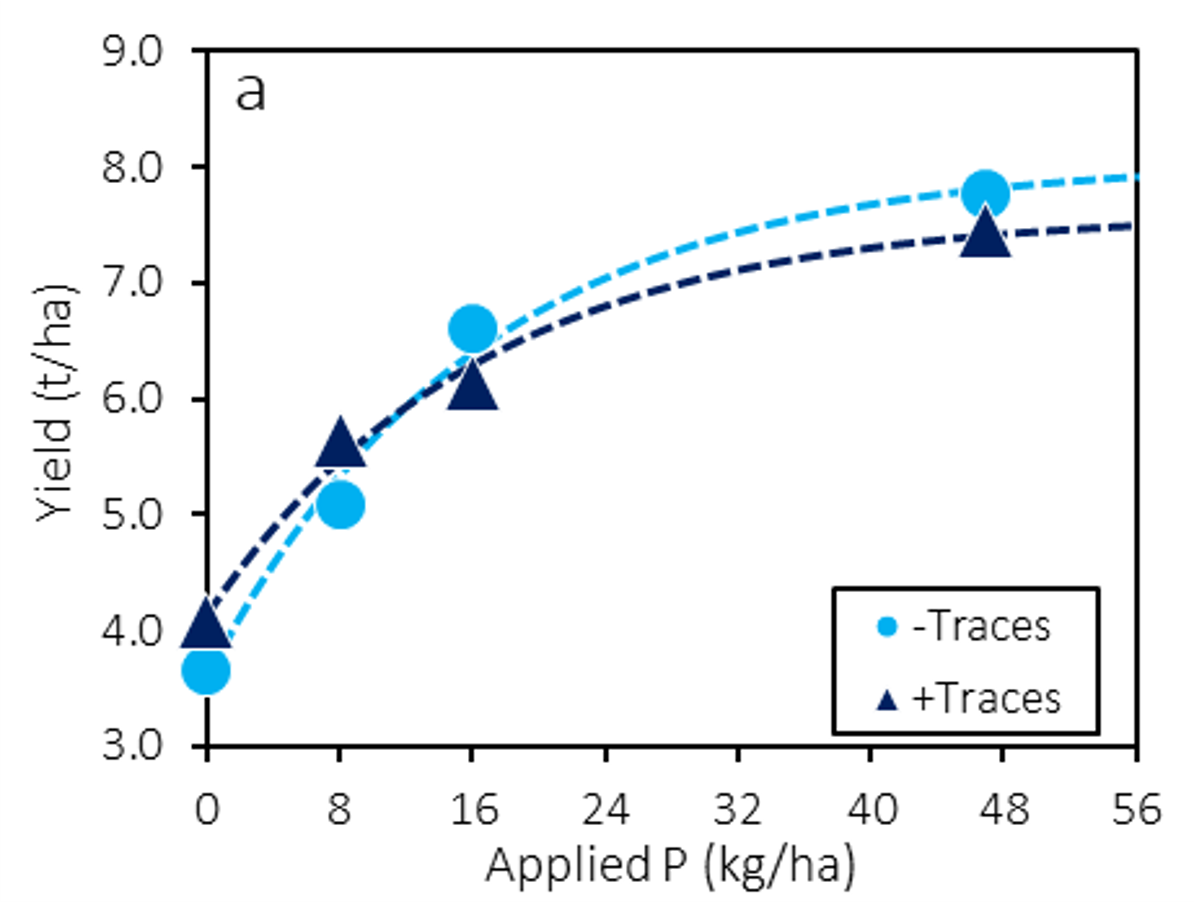
- Yield increased with increasing rates of P, ranging between 3.66t/ha and 7.77t/ha.
- The application of trace elements had no significant impact on emergence, biomass or yield.
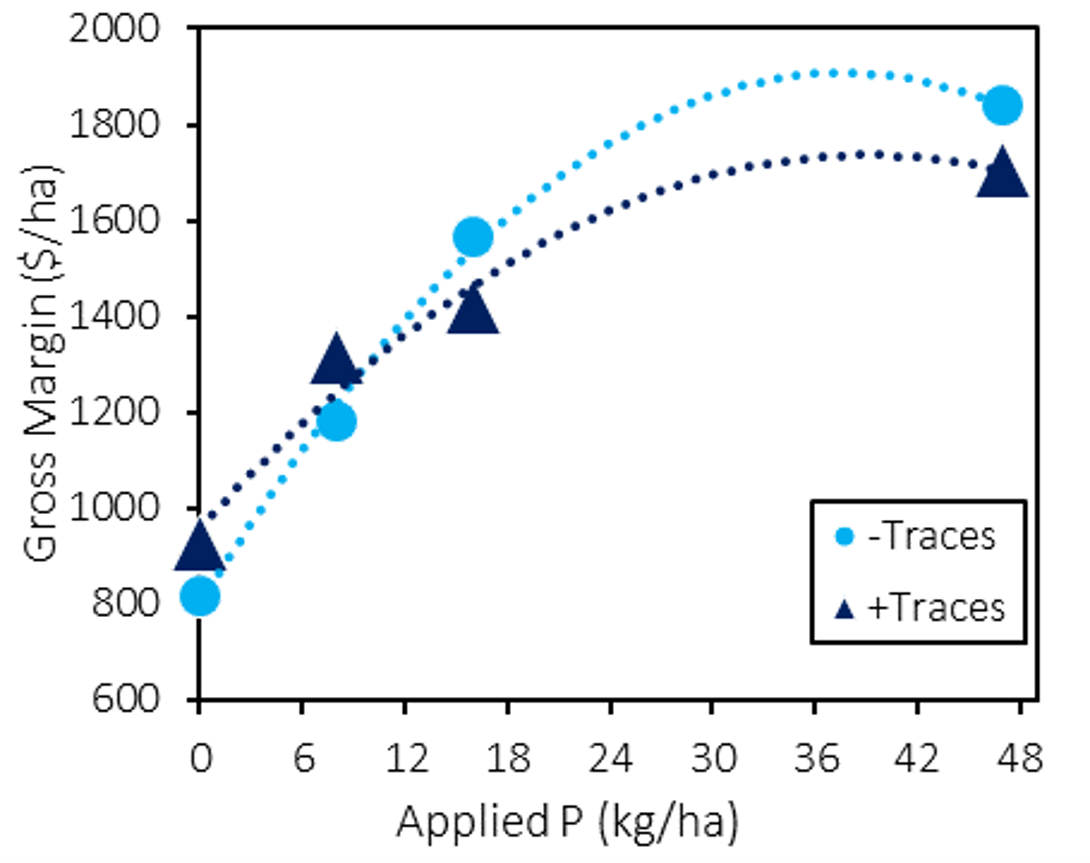
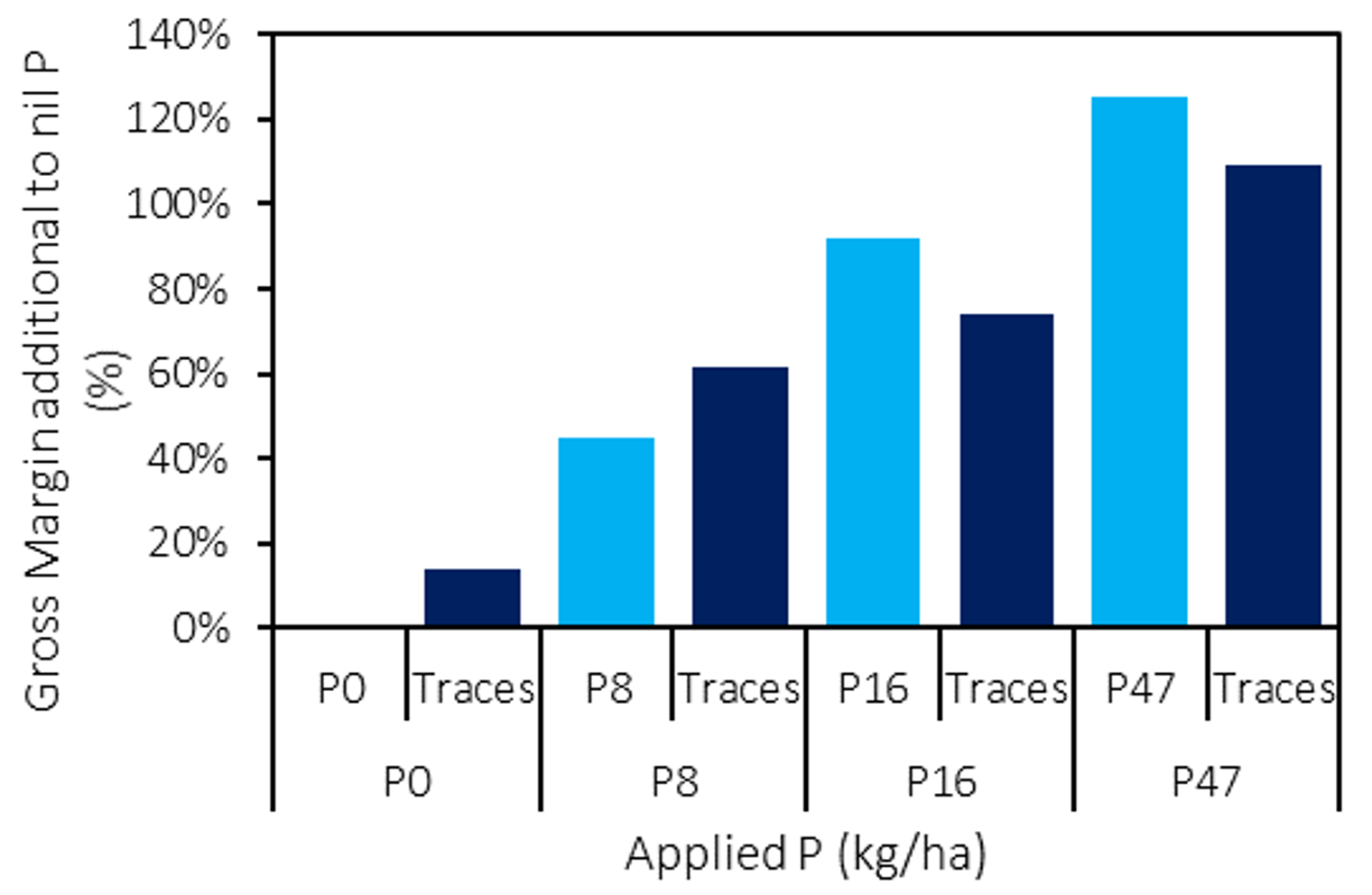
- The most profitable treatment was 47kg P/ha applied without trace elements, returning $1840/ha.
- The trial data indicated there are significant increases in profits to be made by a small investment in establishing strong foundation crop P status at sowing.
- Seed will be retained, analysed for nutrient content and sown in 2021 to assess subsequent crop impacts.
For further information about this trial please get in touch with local Area Manager Chloe Turner Cturner@summitfertz.com.au.
SUM20.14: Potassium and Phosphorus Rate Interactions for Noodle Wheat production, Nungarin
AIM
Assessing standard crop fertilizer practice against new strategies. This trial investigates the interactions between increasing phosphorus (P) and potassium (K) interactions on a noodle wheat at a sandy clay loam site southwest of Nungarin. With hope to increase knowledge of P and K importance in wheat yield and grain quality.
KEY MESSAGES
- Plant vigour significantly increased as rates of P and K applied increased.
- Yield increased with increasing rates of both P and K, ranging between 1.34t/ha and 2.08t/ha.
- The most profitable treatment was 40kg K/ha and 12kg P/ha, returning $520/ha.
- The trial data indicates there are significant increased profits to be made by small investment in establishing a strong foundation crop P status at sowing.
Contact your Local Area Manager for more information.
SUM20.15: Nitrogen x Phosphorus rates to support Spartacus Barley Production, Merredin
AIM
Assessing standard crop fertilizer practice against new strategies. This trial assesses the response of barley under a factorial nitrogen (N) and phosphorus (P) fertilizer application trial design in the Merredin area to increase recognition of the value of optimal N and P to barley yield, grain quality and profitable returns. The trial provides an important focal point for investigating P response, particularly, due to the soil P analysis indicating luxury soil P status at the surface (0-10 cm) but deficient below.
KEY MESSAGES
- Plant growth significantly increased with increasing rates of N, but not P.
- Yields increased with increasing rates of N but not P, ranging between 1.84t/ha and2.72t/ha.
- The most profitable treatment was 6kg P/ha and 50kg N/ha, returning $610/ha.
- The trial data indicates that there are significant increased profits to be made by a small investment in establishing a strong foundation crop N and P status at sowing.
Contact your Local Area Manager for more information.
SUM20.16: Potassium and Phosphorus Rate Interactions for Wheat Production, Moorine Rock
Aim
Managing wheat nutrition in the eastern wheatbelt has implications for sustainable and profitable production. This trial investigates the interactions between increasing phosphorus (P) and potassium (K) interactions on wheat at a sandy loam site south of Moorine Rock. With hope to increase understanding and refinement of P and K application rates and importance in wheat yield and grain quality.
Trial Details
Location: Moorine Rock.
Trial Size: 2.2m x 10m, 12 treatments x 4 reps = 48 plots.
Soil Type: Sandy loam.
Crop Sown: Scepter Wheat, sown 2/05/2020 at 78kg/ha.
Season Rainfall: 286 mm, Moorine Rock DPIRD, 60 mm below long-term average.

Results
Key Messages
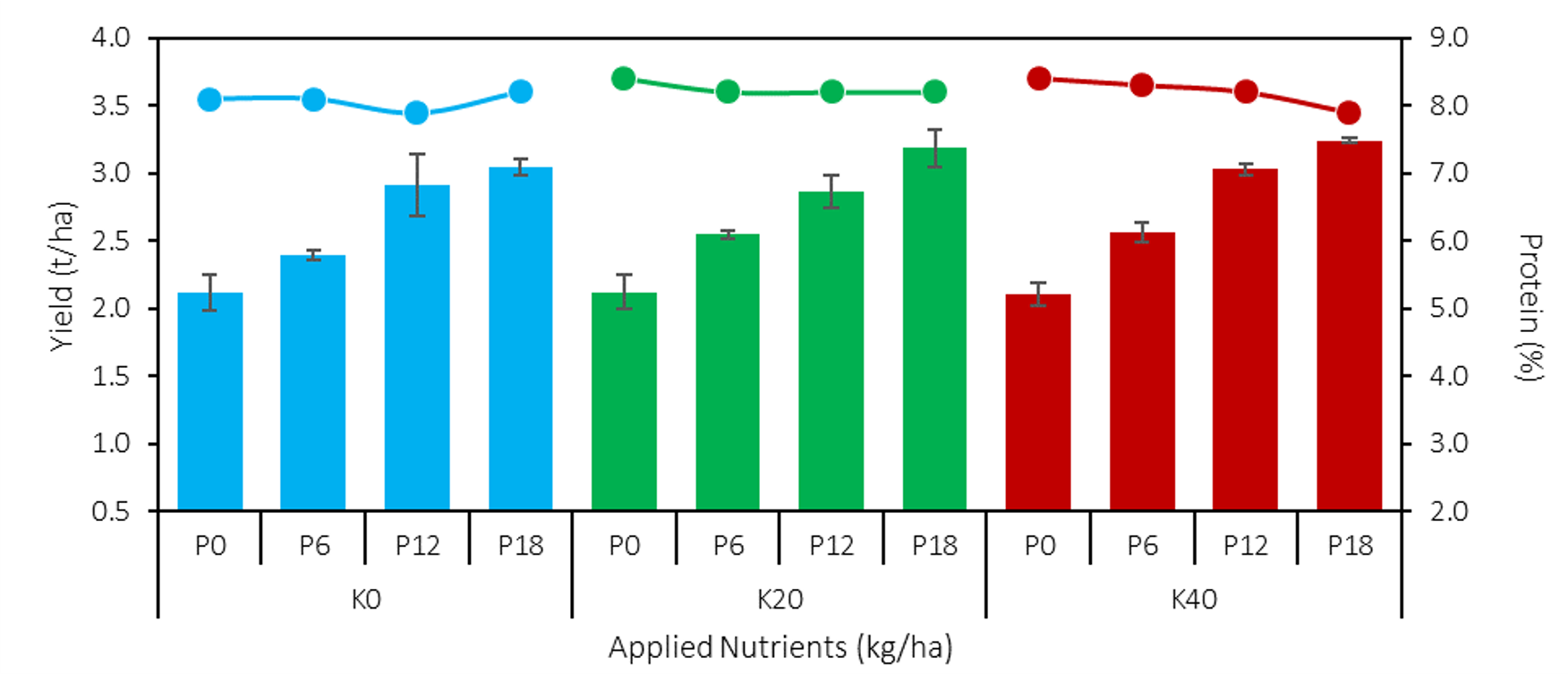
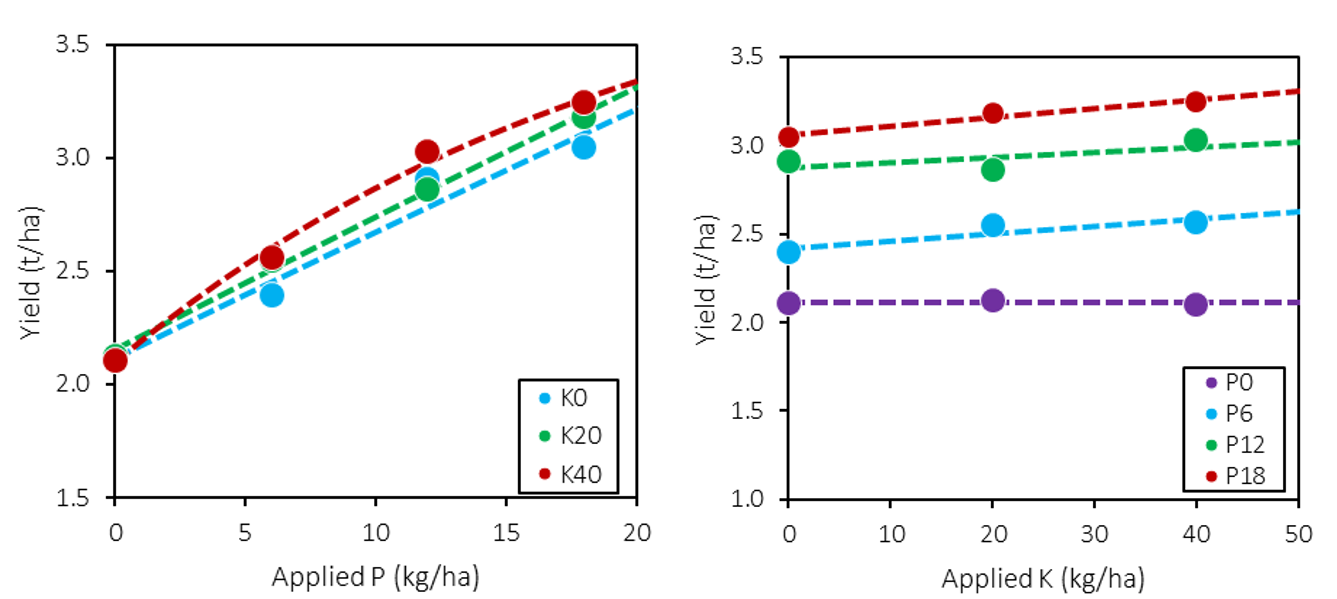
- Plant biomass significantly increased as rates of P applied increased, although higher rates of K did not have the same effect.
- Yield increased with increasing rates of P but not K, ranging between 2.10t/ha and 3.24t/ha.
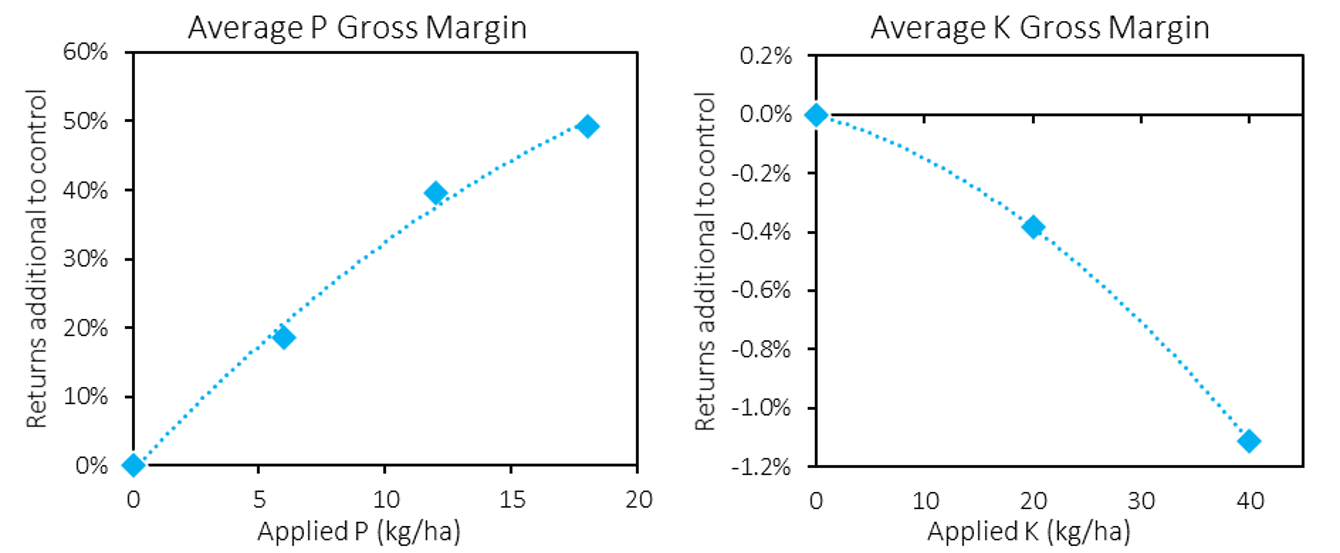
- The most profitable treatment was 20kg K/ha and 18kg P/ha, returning $885/ha.
- The trial data indicates there are significant increased profits to be made by small investments in establishing a strong foundation crop P status at sowing.
For further information about this trial please get in touch with local Area Manager Kobus Marais Kmarais@summitfertz.com.au.
SUM19-08: N x P +/- K in Mace Wheat, South Burracoppin
AIM
To evaluate local wheat response to nitrogen (N), phosphorus (P) and potassium (K) fertilizer application.
KEY MESSAGES
- South Burracoppin experienced a below average growing season rainfall in 2019 with significant dry periods during early April to mid-June, most of July and all September. Following a very dry summer this rainfall patter heavily impacted the yield potential.
- The importance of adequate P nutrition, regardless of rainfall conditions, for crop production was demonstrated.
- Yield trends suggest P had a greater influence on yield than N, with grain quality impacts resulting from the sharp season finish in September.
- Gross margin returns were maximised at $440/ha from a 1.6 t/ha yield where P 12, N 20 kg/ha and nil K were applied.
Contact your Local Area Manager for more information.
SUM19-09: Nitrogen phosphorus and potassium boost for canola after soil amelioration, Merredin
AIM
To assess the combination of pre-drilled phosphorus and potassium rates and in-season nitrogen rates on ameliorated and non-ameliorated soils in the Merredin area.
KEY MESSAGES
- Combinations of pre-drilled phosphorus and potassium and in-season nitrogen rates for canola were applied on deep-ripped and unripped soil areas near Merredin.
- Low replication in design means results should are preliminary and should be applied with caution, but the trial demonstrated what is readily achievable in what were less-than ideal seasonal conditions for canola.
- Ameliorated soil produced yield response to increasing rates of N, P and K applied, whereas non-ameliorated soil did not.
- After addressing the biggest limiting factor – soil compaction – addition of P and K allowed in greater use efficiency of in-season N applications.
- The additive effect of soil amelioration and increasing fertilizer supply was clearly expressed by additional margin returned from nutrient application to ameliorated soil.
- Where ripping may improve profit by around $50/ha on it’s own, the addition of another 10 kg phosphorus, 20 kg potassium and 40 kg nitrogen per hectare to ripped soil suggested a profit lift of up to $140/ha.
- It is important to support soil amelioration with appropriate nutrient range and rates in order to maximise profits from crop production.
Contact your Local Area Manager for more information.
SUM19-11: Factorial Phosphorus x Potassium Rates in wheat, Mukinbudin
AIM
To evaluate the response of wheat to phosphorus (P) and potassium (K) fertilizer application at a sandy loam site south of Mukinbudin.
KEY NOTES
- Mukinbudin experienced a decile 3 growing season rainfall in 2019 with significant dry periods during early April to mid-June, most of July and all September; this rainfall pattern severely impacted the yield potential in this trial.
- Increasing rates of P and K did not affect emergence, with an average of 152 plants/m2
- Plant vigour significantly increased as rates of P applied increased, although higher rates of K did not have the same effect.
- Tissue tests indicated a significant increase in P and K uptake with higher rates of P applied, with K application not having the same effect.
- Yield significantly increased as rate of P applied increased, although grading was limited by high screenings.
- Under 2019 conditions the most profitable treatment was $360/ha when 18kg P/ha and 20kg K/ha was applied.
Contact your Local Area Manager for more information.
SUM19-13: N Rates, N-Calc Recommendations & Cereal Varieties, Morawa Agricultural College Site
AIM
To assess the response of Barley, Oat & Wheat varieties to applied nitrogen (N) fertilizer. To test and calibrate the extension of nitrogen-rich strips(N-gauges), Normalised Difference Vegetation Index (NDVI) measurement and the In-Season Nitrogen Calculator (N-Calc) to assist in mid-season nitrogen decisions and maximise nitrogen efficiency and returns.
KEY MESSAGES
- Morawa experienced a decile 3 growing season in 2019 with significant dry periods during [1] early April to mid-June, [2] most of July and [3] all September. Rainfall pattern affected the yield potential in this trial.
- The N-Calc underestimated yield and the N rate needed to reach 10.5% and 11.5% grain protein, this is most likely due to the below average rainfall experienced in this area.
- There was a strong biomass response to increasing N rates, but the extended dry period at the end of the season (August – October), meant the biomass did not follow through to yield.
- Barley had the highest average yield of 450kg/ha, then wheat with 379kg/ha and oats with 69kg/ha.
- Applying 10kg N/ha upfront maximised both yield and gross margin returns across all varieties.
Contact your Local Area Manager for more information
SUM19-15: Phosphorus Rates in Chickpeas, Yandanooka
AIM
To assess the response of chickpeas to phosphorus (P) fertilizer application on heavy land site SE of Mingenew.
KEY NOTES
- Chickpea yield at the site was lower than anticipated due to dry start and early finish to the growing season.
- There was a small but non-significant yield response to Phosphorous (P) application at this site, and the value of any yield increases could not justify the cost of increased P..
- This was not unexpected given the strong P status of the soil down to 20cm and favourable pH, but the impact of dry seasonal conditions through July and into August cannot be understated.
- Although an anticipated 2t/ha yield was not achieved, the recommendation for nil applied P for chickpeas grown at this site in 2019 was endorsed by the trial results.
- Chickpea may efficiently take up P from healthy soil stores, but any P management should always be done in conjunction with soil testing to determine soil residual P prior to sowing.
Contact your Local Area Manager for more information.
SUM19-16: Nitrogen Strategies for Yield and Grain Quality, Dandaragan (WMG)
AIM
To assess the response of Scepter wheat to applied high nitrogen rates across a range of application timings, with the purpose of comparing strategies to optimise grain yield and quality in the Dandaragan area.
KEY NOTES
- Dandaragan experienced a decile 2 rainfall in 2019, though this was not reflective of the trial productivity due to the water holding capacity and overall quality of the loamy soil at this site.
- Grain yield averaged 4.6t/ha across the treatments at the site and yield responses of up to 2.5 t/ha were seen from N application.
- A significant trend of higher yields and returns was found when N was applied early in the season compared with late application at all rates, reinforcing the importance of avoiding “hidden hunger”.
- Applying N at 5 and 8 weeks after emergence indicatively returned $90 to $150/ha more profit than application at 8 and 12 weeks. Late applications require more N to catch earlier applications in yield but are at an input cost disadvantage.
- Under 2019 conditions the most profitable treatment was early application of 190 kg N/ha by 8WAE with a gross margin of $1360/ha.
Contact your Local Area Manager for more information.
SUM19-19: Form and efficacy of manganese supply to lupin varieties, Eradu
AIM
On light, sandy soils, Mn deficiency can be prevalent. In narrow leafed lupin, Mn deficiencies can cause split seed and reduce grain yield. Split seed occurrence in the Jurien lupin variety has been observed in 2018, but links with Mn are unknown. This trial aimed to assess Mn rates and sources to combat the split seed issues.
KEY NOTES
- Barlock and Jurien lupin varieties appear to respond differently to Mn application.
- Stem samples at flowering showed higher Mn concentration in Barlock than Jurien at rates 3 kg/ha or lower Mn applied.
- Jurien produced higher yields than Barlock, averaging 1.3t/ha compared to 1.0 t/ha respectively, but Barlock had stronger yield responses to increasing Mn rates than Jurien.
- 3 kg/ha Mn was adequate to optimise Jurien yield and profit, whereas >6 kg/ha was required by Barlock.
- Form of Mn applied is important. Supplying Mn in the MnO2 form appears completely ineffective for Barlock lupin production. The impact of MnO2 on Jurien lupin yield was not as pronounced.
- In contrast to yield, MnO2 increased prevalence of split seed in Jurien, not Barlock.
- Split seed was strongly correlated with stem test concentrations below 20 mg/kg.
- Foliar Mn application was effective and highly profitable for Jurien but much less so for Barlock lupins.
- Maintaining adequate Mn status plants is not only important for decreasing incidence of split seed but producing large seed size which translates of higher yield.
Contact your Local Area Manager for more information.
SUM19-24: Potassium Strategies for wheat, Goomalling
AIM
To assess the response of wheat to applied potassium (K) rates, sources and placement.
KEY MESSAGES
- Goomalling experienced a decile 5 growing season rainfall in 2019 with three significant dry periods during the season. This rainfall pattern impacted yield potential in this trial.
- Plant biomass was significantly influenced by K placement, with top-dressing or a combination of banding and top dressing increasing biomass.
- There was a significant yield response to applied K under these rainfall conditions.
- At rates greater than 24kg K/ha, banded K had a lower yield trend compared to other K strategies.
- No significant difference between K supplied as MOP or SOP was found.
- Higher rates of MOP and SOP banded may have been affected by high rates of product struggling to pass through the air-seeder at sowing.
Contact your Local Area Manager for more information.
SUM19-25: Nitrogen x Phosphorus Rates, Goomalling.
AIM
This trial investigates the response of wheat to applied nitrogen (N) and phosphorus (P) rates to determine a recommended fertilizer regime for local growers that maximises yield and profitability
KEY NOTES
- When P supply is limited, plants are unable to utilise additional N for plant growth and yield.
- Harvest yield increased with applied N and P to trial maximum of 2.4 t/ha at 24kg P/ha and 120kg N/ha.
- Grain protein content increased with applied N, with majority of treatments graded as ASW1.
- Economic analysis showed the appropriate recommended fertilizer application rates under decile 5 rainfall conditions on gravelly sandy loam in the Goomalling area are 12kg P/ha and 80-100kg N/ha.
Contact your Local Area Manager for more information.
SUM20.02: Potassium Rates, Source and Placement, Year 1, Wheat, Badgingarra
AIM
Progressively increasing K rates to optimise returns poses questions of contemporary crop tolerance to chloride (Cl-) associated with muriate of potash (MOP) compared with sulphate of potash (SOP) sources. This trial assesses the importance of K placement as either MOP or SOP, on wheat in 2020, at a sandy site east of Badgingarra at rates designed to run-down, maintain and potentially build K soil reserves over time.
KEY MESSAGES
- Plant growth significantly increased with the interaction between K source, rates and placement.
- Yield averaged 3.6t/ha, MOP produced higher yields when banded below the seed while SOP out yielded MOP when banded with the seed.
- Protein averaged 11.3% and the greatest treatment differences were seen when fertilizer is banded below the seed, with MOP producing higher protein than SOP.
- The most profitable treatment was banding 30kg K/ha MOP with the seed, returning $1,060/ha.
- There is a 12% higher return additional to nil fert when 30kg K/ha MOP is banded with the seed, and a 16% loss when 75kg K/ha SOP was banded below.
Contact your Local Area Manager for more information.
SUM20.07a: Form and Efficacy of Manganese Supply to Lupin Varieties, Eradu
AIM
This trial aims to assess the response of Barlock and Jurien lupins to manganese (Mn) fertilizer on sandy soils south-east of Eradu, while also assessing the efficacy of various chemical forms of Mn fertilizer, with hopes to provide further insight into the decision making when using Mn sources at seeding.
KEY MESSAGES
- Whole top plant sampling and stem sampling indicated Mn concentration in lupin tissue was affected by form and rate of Mn fertilizer. Supplying Mn in MnO2 form appears ineffective.
- Plant testing for stem Mn proved reasonably useful in predicting split seed.
- Different forms and rates of manganese fertilizer did not significantly affect yield or split seed counts in Barlock or Jurien.
- Jurien lupins had greater yields than Barlock across the trial.
- Under 2020 growing conditions, the most profitable fertilizer application was 3kg Mn/ha applied as a MAP:MnSO4 blend to Jurien, returning $1350/ha.
Contact your Local Area Manager for more information.
SUM20.07b: Effects of Seed Manganese Concentration in Lupins, Eradu
AIM
This trial aims to utilise seed retained from SUM19.19 to assess the growth and performance of Barlock and Jurien lupin seed with different manganese (Mn) concentrations on a low Mn status sandy soil south of Eradu.
KEY MESSAGES
- Increased Mn concentrations in seed improved germination at 90% confidence level but not 95%.
- Whole top and stem sampling indicated Mn in lupin tissue was not affected by seed Mn concentration.
- Mn in seed as the only non-soil source of Mn to the crop had limited effect on yield or split seed.
- The most profitable seed Mn concentration was 20mg/kg in Jurien, returning $1390/ha.
- Evidence from this trial and the associated 20.07a trial suggests that utilising adequate Mn status lupin seed can improve stored seed viability, improve crop emergence and can have a positive impact on lupin crop profitability.
Contact your Local Area Manager for more information.
SUM20.10: Effect of Sowing Time and Conditions on Wheat P Requirements, Northam
AIM
Recent work from South Australia has shown P requirement for optimum production to vary along with the seasonal conditions of different sowing times. This has not been investigated in Western Australia. We aim to assess the response of Scepter and RockStar wheat to increasing rates of applied phosphorus (P) when sown at different times during the sowing window in the Northam area.
KEY MESSAGES
- Plant growth significantly increased with applied P. Biomass was maximised at 10kg P/ha in April and May sown wheat and was not maximised until 40kg P/ha in June sown wheat.
- Yields were higher in April and May sown wheat than in June sown wheat.
- Yield was more responsive to P fertilizer and required higher rates the later the crop was sown.
- Under 2020 conditions, returns were higher in the earlier sowing times. Scepter outperformed RockStar due to higher quality grain, and the highest return was $345/ha from Scepter sown in April without P.
- Results from this trial, considering the challenging site and season conditions, warrant further investigation with potential for high impact considerations for P fertiliser management.
Contact your Local Area Manager for more information.
SUM20.13: Factorial Nitrogen x Phosphorus rates to support Spartacus Barley Production, Mukinbudin
AIM
Assessing standard crop fertiliser practice against new strategies. This trial assesses the response of barley under a factorial nitrogen (N) and phosphorus (P) fertilizer application trial design in the Mukinbudin area to increase recognition of the value of optimal N and P to barley yield, grain quality and profitable returns.
KEY MESSAGES
- Plant growth significantly increased with both applied N and P.
- Yield insignificantly increased with increasing rates of P, ranging between 1.00t/ha and 1.52t/ha.
- The most profitable treatment was 18kg P/ha and 25kg N/ha, returning $275/ha.
- The trial data demonstrated the value of establishment P, even under the low rainfall season conditions.
Contact your Local Area Manager for more information.
SUM19-04: Nutrition for high-end canola production on ameliorated soil, east of Esperance
AIM
To determine high-end nutrient-growth response capacity after removal of soil constraints. Particularly evaluating how canola responds to nitrogen (N), phosphorus (P) and potassium (K) fertilizer application.
KEY NOTES
- Boyatup experienced a decile 4 growing season rainfall in 2019, despite falling 40mm below the 30 year average, the consistent rainfall was beneficial in producing the high yields.
- Increasing rates of N and P significantly increased production, with yield increases up to 1.5t/ha,
- Oil content ranged between 42.2-46.2%, indicating CAG1 delivery grade across the board.
- Yield response curves for N rates show yield was not maximised at 160kg N/ha, and high-end production driven by N must be supported by adequate P at establishment.
- Under 2019 growing season conditions the most profitable treatment was $1573/ha when 160kg N/ha, 24kg P/ha and no K was applied.
- Nutrient application in line with both genetic potential and site potential post-amelioration supports improved profitability and return on an expensive amelioration operation investment
Contact your Local Area Manager for more information.
SUM19-05: Factorial Nitrogen x Phosphorus Rate Trial in Scepter Wheat, Tammin
AIM
To evaluate the response of wheat to nitrogen (N) and phosphorus (P) fertilizer application at a sandy clay site east of Tammin.
KEY NOTES
- Growth, yield and grain quality performance was relatively poor due to seasonal and site conditions.
- Increasing both N and P rate improved Scepter wheat performance but with an average site yield of 1.0t/ha only N application up to 50 kg/ha was cashflow positive.
- Increasing rates of N applied increased gross margin returns additional to nil control treatments, whereas increasing rates of P alone did not, however without establishment P, profits from N were more than halved.
Contact your Local Area Manager for more information.
SUM19-06: Factorial Nitrogen x Phosphorus Rates in Scepter Wheat, Merredin
AIM
To evaluate the response of wheat to nitrogen (N) and phosphorus (P) fertilizer application at a loamy sand site near Merredin.
KEY NOTES
- The importance of adequate nutrition, especially P, for crop production regardless of rainfall conditions was demonstrated.
- Merredin experienced a decile 2 growing season rainfall in 2019, with significant dry periods during [1] early April to mid-June, [2] most of July and [3] all September, severely impacting plant vigour and yield.
- Yield ranged between 1.02-1.24 t/ha and was severely limited by the low in-season rainfall and the hot dry September.
- The most profitable treatment under 2019 conditions was $355/ha after 12kg P/ha 25kg and N/ha was applied.
Contact your Local Area Manager for more information.
SUM18-13: High Scepter Yield with Nitrogen and Phosphorus Rates, Warradarge (WMG)
AIM
To assess the response of wheat to high nitrogen (N) and phosphorus (P) fertilizer inputs.
KEY MESSAGES
- In-season growth at the site was being driven by N, with little contribution of P, K or Cu.
- At harvest, grain yield was high, 2.2 to 5.5 t/ha, and both N and P were found to have promoted grain yield.
- Application rates of P at 8 to 10 kg/ha and N at 140 to 160 kg/ha optimised yield and profit at the site under the 2018 season conditions.
- Grain protein production for high-yielding Scepter wheat crops continues to be a challenge with maximum protein concentration of 9.4% seen in the trial at 200 kg N/ha.
Contact your Local Area Manager for more information.
SUM18-14: N Rates +/- K & Wetter Coated Seed, Binnu (NAG)
AIM
To evaluate if wetter coated seed improves wheat establishment in drier conditions and if this results in more effective use of nitrogen (N) and potassium (K) fertilizer application.
KEY MESSAGES
- Using wetter coated seed significantly improved germination establishment by 10 plants/m2.
- There was a strong and significant in-season biomass and yield response to N application.
- The highest yield was 3.2t/ha and received 60 kg N/ha.
- K incorporation had no effect on grain yield or quality.
Contact your Local Area Manager for more information.
Sum18-15 P Sources
To assess the response of wheat to P application from two fertilizer sources, MAP and TSP.Also looking at the value of drilling P fertilizer on High PBI soil compared to banding the fertilizer below the seed.
Sum18-16 N x P x K
SUM18-17: Phosphorus placement on High PBI Morrel Soil, Corrigin
AIM
To determine the optimal placement strategy for phosphorus (P) fertiliser at a high PBI clay site. These strategies include P drilled with the seed, banded below the seed and split 75% banded and 25% drilled.
KEY MESSAGES
- There was a strong in-season biomass and yield response to applied P.
- In 2018 there was no difference in yield between P placement strategies.
- Under conditions when soil moisture is limiting drilling P is the optimal placement strategy.
Contact your Local Area Manager for more information.
SUM18-18: Nitrogen Application Timing in Canola, Meckering
AIM
To assess the response of Bonito Canola to applied nitrogen (N) fertilizer and the effect that application timing has on the flowering period, seed yield and quality.
KEY MESSAGES
- Early application of nitrogen resulted in significantly higher flowering percentage, than applying top-up nitrogen later in the season.
- There was no significant difference in timing of nitrogen application on yield or seed oil concentration
- The most fertilizer profitable regime was applying 12 kg P/ha and 33 kg N/ha at seeding, followed by 15 kg N/ha before first flowering, with a return of $1092/ha.
Contact your Local Area Manager for more information.
SUM18-19: P Rates & Sources Trials & DGT Validation, Cordering
AIM
To assess the response of wheat to phosphorus (P) fertilizer application on high PBI forest gravel soil site south of Cordering, while evaluating the effectiveness of using MAP vs TSP as a phosphorus source.
Contact your Local Area Manager for more information.
SUM18-20: P Rates and Sources Trials & DGT Validation, Cordering
AIM
To assess the response of wheat to phosphorus (P) fertilizer application on high PBI forest gravel soil site south of Cordering, while evaluating the effectiveness of using MAP vs TSP as a phosphorus source.
Contact your Local Area Manager for more information.
Sum18-21 Wetter as a seed coating
To assess the germination and yield response of canola seed to coating with increasing wetter concentrations on non-wetting gravel soil.
Sum18-GK 1
Collaborative project with GRDCAssess the relative K requirement and responsiveness of K fertilizer in wheat.
SUM18-GP1: GRDC NPK Project – P Rates Trial, Binnu (NAG)
AIM
To assess the response of wheat to phosphorus (P) fertilizer application at a sandy soil site east of Binnu. This trial is a part of a series of trials in conjunction with GRDC looking at ‘increasing profit from N, P and K fertiliser inputs into the evolving cropping sequences in the Western Region.’
KEY MESSAGES
- There was a strong in-season biomass and yield response to applied P at this sandy site with a Colwell P of 17 in the top 10cm.
- The mean site yield was 2.3t/ha and the highest yield was 3t/ha from applying 20 kg P/ha.
- The rate of P to optimise yield and economic return is 20 kg P/ha.
- A potential toxicity effect from 40 kg P/ha was observed from in-season NDVI readings and followed to yield.
Contact your Local Area Manager for more information.
SUM18-GP3: GRDC NPK Project – P Rates Trial, Yealering
AIM
To assess the response of wheat to phosphorus (P) fertilizer application at a loamy duplex soil site north of Yealering. This trial is a part of a series of trials in conjunction with GRDC looking at ‘increasing profit from N, P and K fertiliser inputs into the evolving cropping sequences in the Western Region.’
KEY MESSAGES
- There was a strong in-season biomass and yield response to applied P at this loamy duplex site with a Colwell P of 16 in the top 10cm.
- The mean site yield was 3.9t/ha with the highest yield at 4.4t/ha from applying 20 kg P/ha.
- The rate of P to optimise yield and economic return is 20 kg P/ha.
Contact your Local Area Manager for more information.
SUM18-GP4: P rates in wheat.
In callaboration with GRDC. Increasing profits with fertilizer
SUM18-GP5: P Rates & Source, Williams
AIM
To assess the response of wheat to phosphorus (P) fertilizer application at a loamy forest gravel soil site south of Williams. This trial is a part of a series of trials in conjunction with GRDC looking at ‘increasing profit from N, P and K fertilizer inputs into the evolving cropping sequences in the Western Region.’ Also assessing the response of wheat to P application from two fertilizer sources, MAP and TSP.
KEY MESSAGES
- Due to the high P content in the soil there was a surprisingly strong in-season biomass and yield response to applied P at this loamy forest gravel site.
- The rate of P to optimize yield and economic return was 40 kg P/ha, with a return of $507/ha.
- No significant difference in yield or in-season biomass when applying TSP or MAP at either 20 kg P/ha or 40 kg P/ha
Contact your Local Area Manager for more information.
Sum18b N x K x Nematodes
To assess the response of wheat to nitrogen and potassium fertilizer on canola stubble and to evaluate the advantage of potassium in promoting plant health and alleviating nematode susceptibility.
SUM19-02: N x P +/- K in Scepter Wheat, Esperance
AIM
To evaluate local wheat response to nitrogen (N), phosphorus (P) and potassium (K) fertilizer application.
KEY NOTES
- Mount Ney experienced a decile 4 growing season rainfall in 2019. Nearby Beaumont fell 77mm below the 30-year average for the growing season, punctuated by very dry July and September months.
- Applying P and N increased yields but K was ineffective at the site.
- Establishment P rate has a strong influence on the ability of a crop to respond to in-season nitrogen application. Inadequate P = decreased N use efficiency.
- Under the 2019 seasonal conditions, applying P at 24 kg/ha and N at 100 – 120 kg/ha represented the best strategy to optimise profit from Scepter wheat.
Contact your Local Area Manager for more information.
SUM19-03: Nutrition for high-end wheat production on ameliorated soil east of Esperance
Aim
To investigate high-end cereal nutrient growth responsecapacity after removal of soil constraints. Particularly evaluating how wheatresponds to nitrogen (N), phosphorus (P) and potassium (K) fertilizerapplication.
Trial Details
Location: Warakirri Lobethal, Boyatup, Esperance Region.
Trial Size: 44 trts x 3 reps = 132 plots.
Soil Type: Sand
Amelioration History: 2018 –2t/ha lime, canola crop.
2017 – Ripped 550-600mm, spaded 250-275mm, 2t/ha lime & 2t/ha gypsum
Crop Sown: Scepter Wheat, 90kg/ha, 17/04/2019

Results
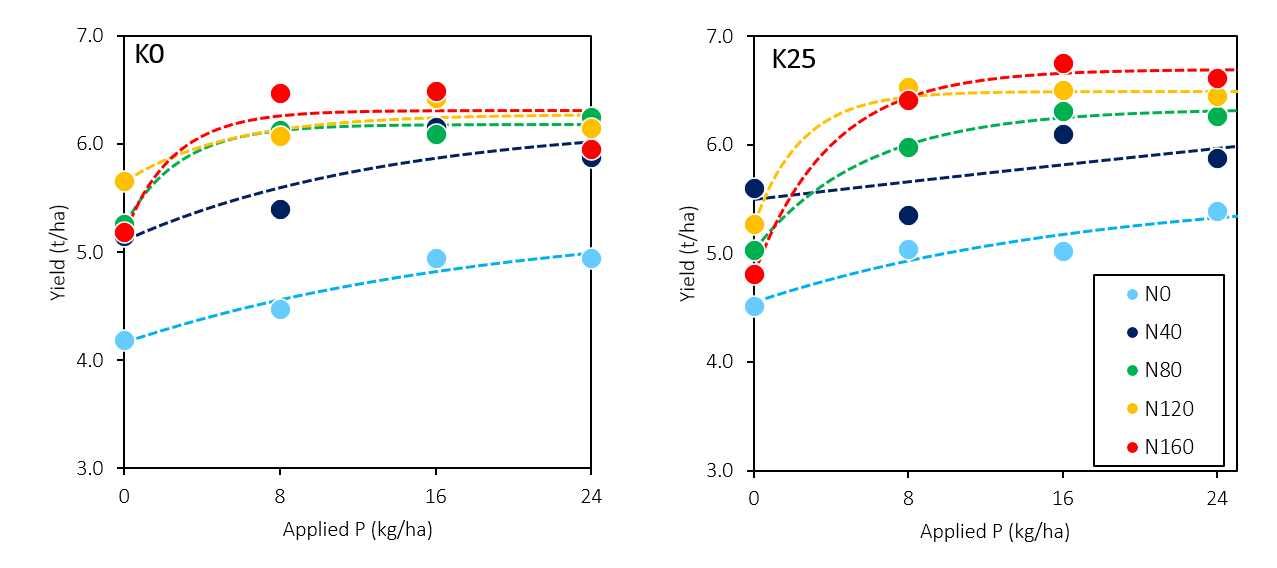
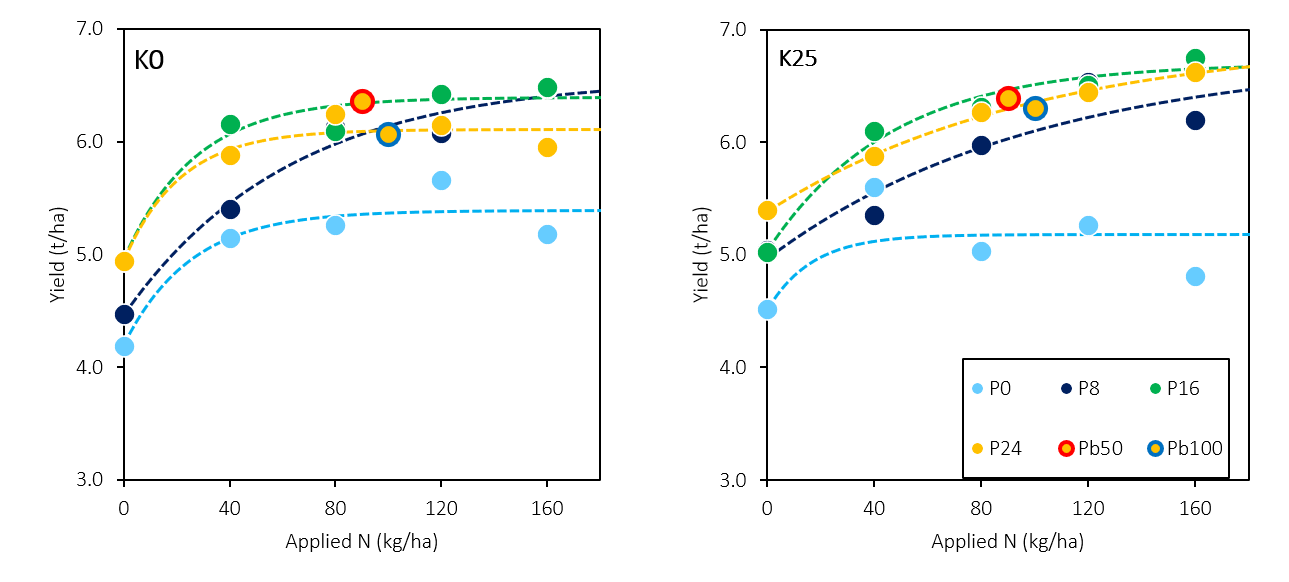
Key Notes
- Boyatup experienced a decile 4 growing season rainfall in 2019, despite falling 40mm below the 30 year average, the consistent rainfall was beneficial in producing the high yields.
- Plant emergence averaged 131 plants/m2 and was significantly influenced by establishment P rates.
- Plant growth and yield responded strongly to P and N application but not K despite low soil K analysis.
- Applying ProBoost at10 and 20 kg N/ha late in the season – bringing total N to 90 and 100kg N/ha – did not increase yield, but did increase protein to levels higher than applying 120 or 160kg N/ha.
- The most profitable treatment under 2019 conditions was $1927/ha when 120kg N/ha, 8kg P/ha and 25kg K/ha was applied.
- ProBoost late in season increased returns from from 25% to 32% additional to nil control.
- Capitalising on removal of soil constraints by appropriate nutrition inputs can vastly improve profitability and return on amelioration investment.
Contact Local Area Manager, Nick Donkin, ndonkin@summitfertz.com.au, 0428 715 045, for more details on this trial.
Sum16-28 Potassium Strategies, Darkan
AIM:
To assess the value of different muriate sources of potassium (K) on growth and yield of oats when applied by banding and topdressing at seeding time or topdressing after emergence.
For further details contact your local Area Manager or the Summit Research Team

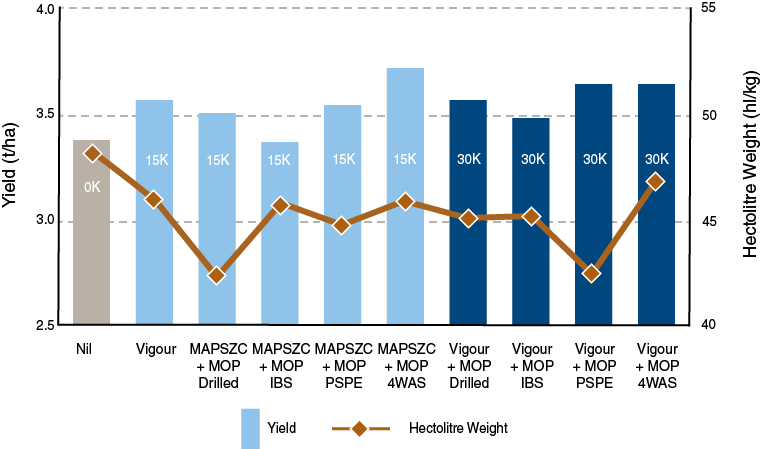
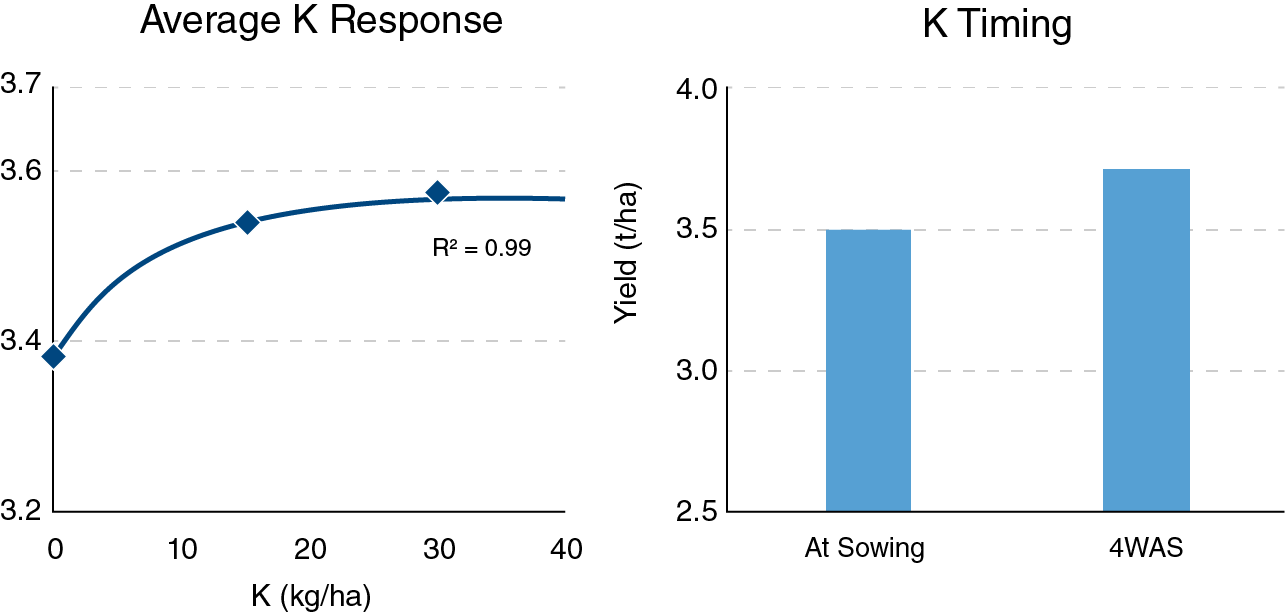
CONCLUSION:
Under these conditions, applying 15kg/ha of K appears to be the best option to optimise yield and maintain soil K levels without decreasing returns.
Sum16-29
Nitrogen and Phosphorus in pasture
Sum16-29 Nitrogen and Phosphorus on Pasture, Darkan
AIM:
To assess the most efficient way to allocate pasture fertiliser spend following a medium term cropping phase
For further details contact your local Area Manager or the Summit Research Team

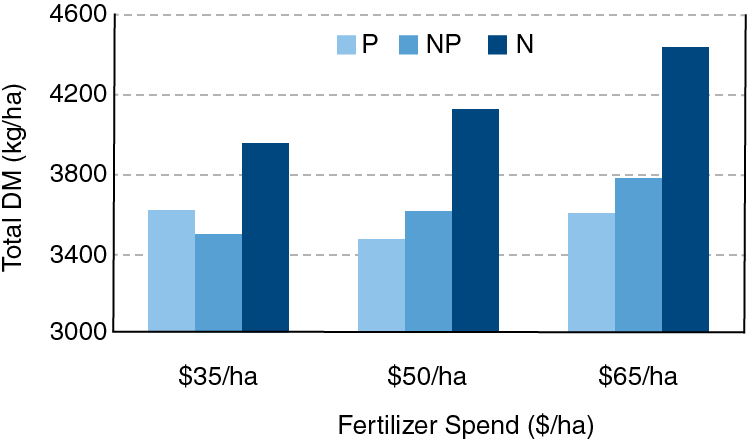
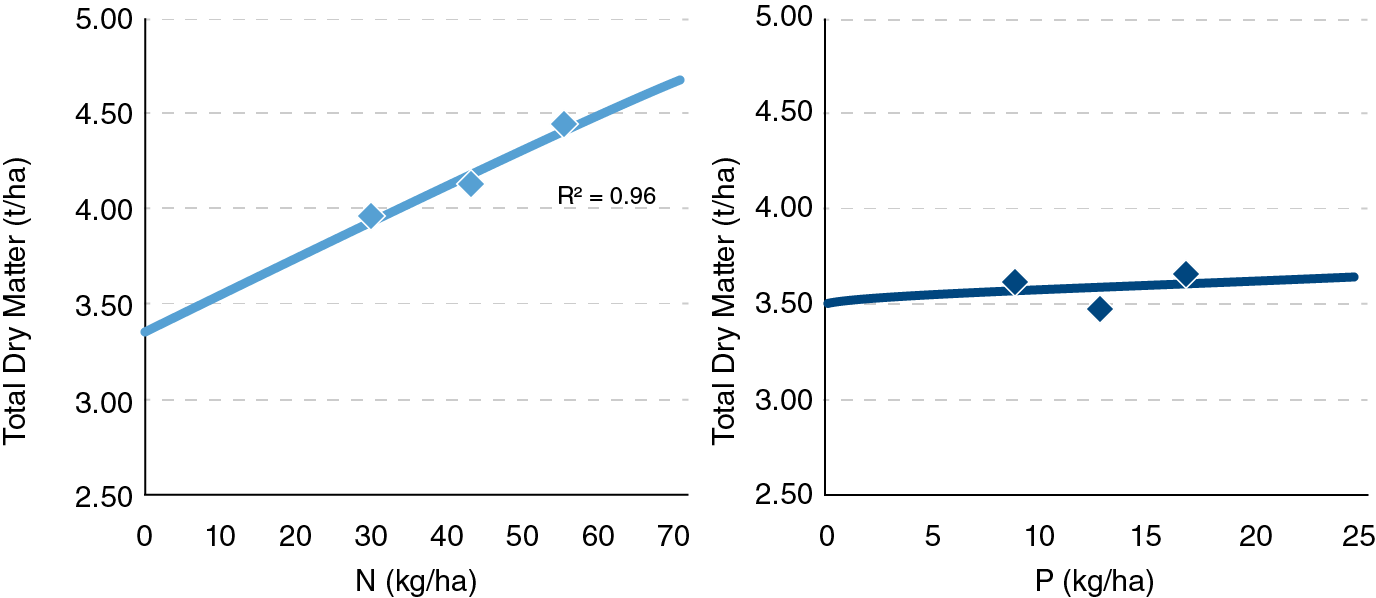
CONCLUSION:
- Under these conditions for pasture grown directly after a medium term cropping phase, 65 $/ha spent on nitrogen generated the highest dry matter and returns.
- For the most profitable N application, a balance between application when the requirement for extra feed is greatest and when growth conditions are more favourable need to be weighed against each other.
- Lower response efficiencies during winter when soils are cold and wet may be offset by the increased value of the feed generated.
- The results reaffirm that in a pasture situation, higher rates of Nirogen over smaller areas are likely to have a greater overall impact than low rates over a larger area
Sum16-30 P rates on high PBI soils, Darkan
AIM:
To assess how barley responds to phosphorus (P) fertilizer applications under high soil phosphorus buffering index (PBI) conditions
For further details contact your local Area Manager or the Summit Research Team

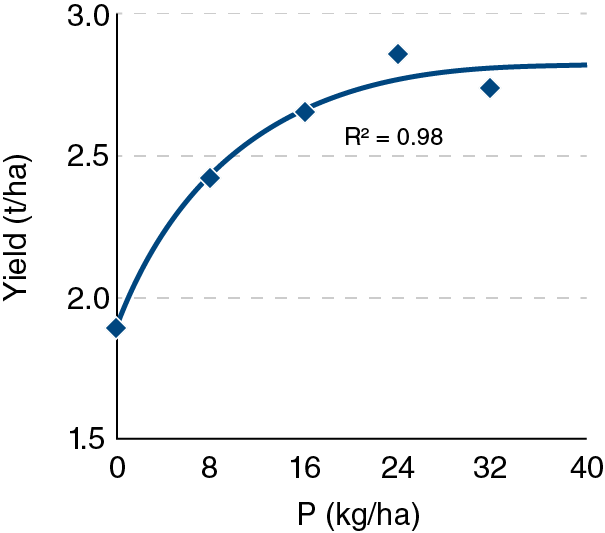
CONCLUSION:
Despite relatively high P in the soil test (61 mg/kg), PBI was high on this forest gravel and 24 kg/ha of P applied at seeding optimised yield and gross margin under these conditions.
Sum16-32 NPK on Oats, Williams
AIM:
Part of a trial series to assess how wheat responds to nitrogen (N), Phosphorus (P) and Potassium (K) fertilizer applications under different conditions, soil P stores and soil Phosphorus Buffer Index PBI across the Wheatbelt.
For further details contact your local Area Manager or the Summit Research Team

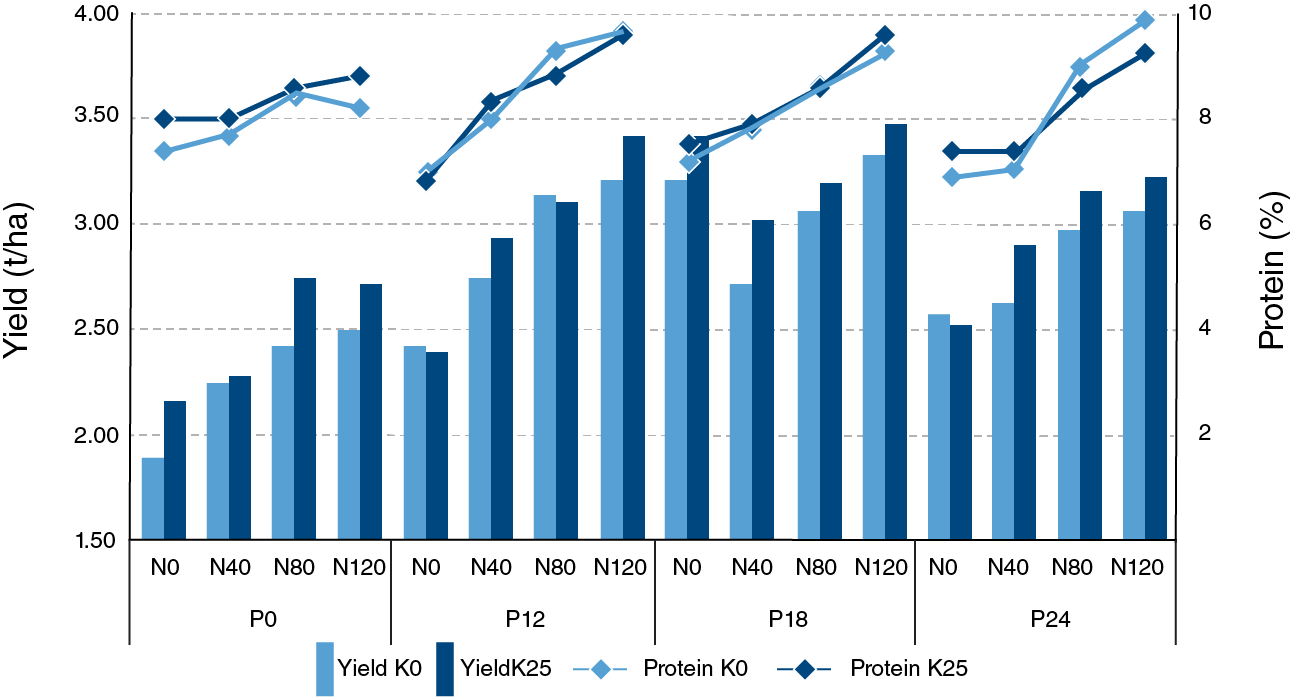
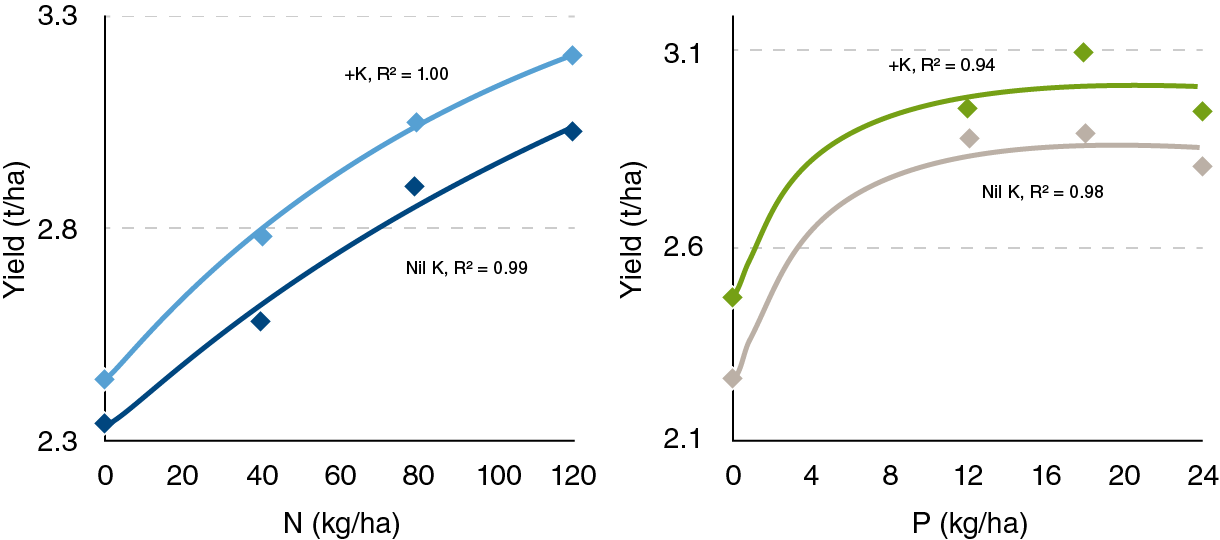
CONCLUSION:
- Application of P and N significantly increased yield in this trial and the addition of K had less of an impact.
- Maximum yield was seen at N 120 kg/ha, P 18 kg/ha with K 25 kg/ha providing a minimal increase.
- Adequate P nutrition is imperative, promoting early growth and setting up the crop to utilise N efficiently and gain maximum value from in-season N fertiliser application.
- Soil testing will assist in fertiliser decisions for P and K and continual local research trials will build a foundation of robust and validated data to support these decisions.
Sum16-33 N & K on Barley, Cranbrook
Response of barley to potassium (K) and nitrogen (N) rates.Yield and grain quality can be limited if either of these macro nutrients is in short supply.
Sum16-36 Phosphorus rates in wheat, Northampton
AIM:
To assess how wheat responds to phosphorus (P) fertiliser applications under different conditions, soil P stores and soil Phosphorus Buffering Index (PBI) across the wheat belt.
Contact your local Area Manager for further details

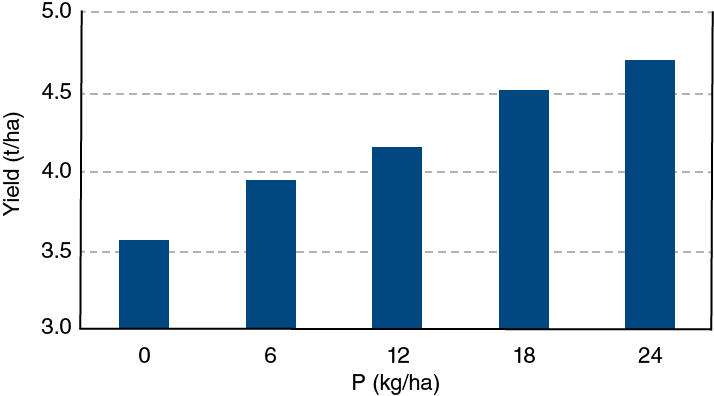
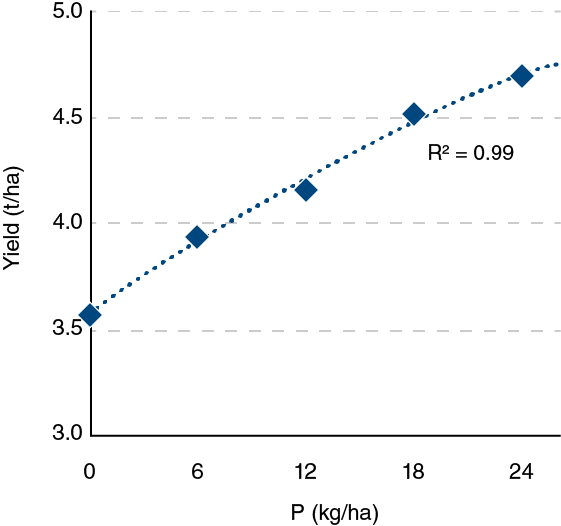
CONCLUSION:
- There was a strong response to applied P under these conditions with a yield gain of 1.13 t/ha from 0 to 24 kg/ha P.
According to nutrient recommendations, the value of P has been slightly underestimated at this site. - Yield was maximised at 4.7 t/ha with 24 kg/ha of applied P.
- The highest returns were also generated from 24 kg/ha of P.
- Despite the nutrient recommendation suggesting ~12 kg/ha P, high yields meant that this trial optimised yield and gross margin at 24 kg/ha.
Sum17-17 Potassium soil test methods and responses
A long term potassium (K) trial to determinne more accurate critical values for K
Sum17-20 NPK in Pasture
Efficient ways of allocating Nitrogen (N), Phosphorus (P) and Potassium (K) spend on pasture.
SUM18-01: N x P
Efficiency of Nitrogen and Phosphorus in the Eastern Wheatbelt
SUM18-03: Factorial Nitrogen X Phosphorus Rate Trial, Mukinbudin
AIM
To evaluate the response of wheat to nitrogen (N) and phosphorus (P) fertilizer application at a red sandy loam site north of Mukinbudin.
KEY MESSAGES
- The significant biomass and yield response to applied P was unexpected due to the adequate P status of the site.
- Optimum fertilizer regime based on yield and economic return is 25 kg N/ha and 6-12 kg P/ha.
Contact your Local Area Manager for more information.
SUM18-04: Nitrogen X Phosphorus Rates in Canola, South Burracoppin
AIM
To assess the response of canola to nitrogen (N) and phosphorus (P) fertilizer application at a clay loam site north of South Burracoppin.
KEY MESSAGES
- There was a stronger yield response to applied P than to applied N
- The strong yield response to applied P was surprising due to the adequate P status of the site.
- The highest yield response was 1.82t/ha and received 90kgN/ha and 18kgP/ha.
- The optimum fertilizer rate based on yield and economic return was 60kgN/ha and 18kgP/ha
Contact your Local Area Manager for more information.
Sum18-05: Soil Amelioration Longevity in Barley, South Burracoppin.
AIM
To assess the response of wheat to nitrogen (N) and phosphorus (P), whilst examining the longevity effect of soil amelioration activities, deep ripping and liming.
KEY MESSAGES
- There was a strong in-season biomass and yield response to applied N.
- The weak yield response to applied P was surprising due to the low P status of the site.
- Acidic subsoil restricted barley root exploration and limited plant growth and yield.
- The highest yield was 2t/ha and received 150 kg N/ha and 24 kg P/ha.
- The fertilizer regime to optimise yield and economic return is 120 kg N/ha and 18 kg P/ha.
Contact your Local Area Manager for more information.
SUM18-06: Phosphorus x Potassium Rates in Wheat, South Burracoppin.
AIM
To assess the response of wheat sown on ameliorated, sandy soil to phosphorus (P) and potassium (K) fertilizer application.
KEY MESSAGES
- There was a significant in-season biomass and yield response to applied P and K.
- The responses seen were expected due to the low nutrient status of the site.
- The highest yield was 2.5t/ha and received 18 kg P/ha, 40 kg K/ha and 70 kg N/ha.
- The fertilizer regime to optimise yield and economic returns in 18 kg P/ha, 20 kg K/ha and 70kgN/ha.
Contact your Local Area Manager for more information.
SUM18-07: Factorial Nitrogen x Phosphorus Rates +/- Potassium, Muntadgin
AIM
To assess the response of wheat to nitrogen (N), phosphorus (P) and potassium (K) fertilizer application at a sandy site east of Muntadgin.
KEY MESSAGES
- The strong yield response to P was unexpected due to the adequate P status of the site.
- The optimum fertilizer regime based on yield and economic return is 40 kg N/ha, 12 kg P/ha and 20 kg K/ha.
Contact your Local Area Manager for more information.
SUM18-08: Nitrogen and Potassium Rates on Canola and Lupin Stubble, Yealering
AIM
To assess the response of Scepter wheat yield and protein response to nitrogen (N) and potassium (K) fertilizer on adjacent canola and lupin stubbles.
KEY MESSAGES
- Wheat grown on lupin stubble had higher in-season biomass, yield and gross margins, than those in the canola stubble.
- Protein content was greater on lupin stubble than canola at low N fertilizer rates, and accumulated with increasing N application.
- At high N rates, rotation had no effect on grain protein, approaching >11% at 120 kg N/ha.
- Applied K had no effect on wheat production at this site.
- Yield response curve plateaux was seen at 80 kg N/ha under the seasonal conditions but lack of significant protein limited delivery grade to ASW1 if <120 kg N/ha was applied
- Grain protein levels were influenced by a 218 mm growing season rainfall compressed into June-August period. A very dry September followed by some significant rain in mid-October pushed late grain fill resulting in high yield but low grain protein overall.
Contact your Local Area Manager for more information.
SUM18-09: Nitrogen x Phosphorus Rates +/- Potassium, Ballidu
AIM
To assess the response of wheat to nitrogen (N), phosphorus (P) and potassium (P) fertilizer at a sandy duplex site east of Ballidu.
KEY MESSAGES
- The biomass and yield response to applied K was anticipated due to the low K status of the site.
- Soil test results indicated adequate to marginal levels of P so the weak response to applied P was not surprising.
- With favourable winter rainfall conditions yield had not been maximised by 75 kg N/ha.
- The optimum fertilizer regime based on yield is 75 kg N/ha, 6 kg P/ha and 20 kg K/ha.
Contact your Local Area Manager for more information.
SUM18-10: Value of nitrogen and phosphorus in Scepter wheat after Biserrula, Nabawa
AIM
To assess the response of wheat to nitrogen fertilizer application and to investigate the value and need for nitrogen following Biserrula pasture. Additionally, whether increased phosphorus may contribute to achieving higher yields and returns from improved efficiency of nitrogen utilisation.
Contact your Local Area Manager for more information.
SUM18-11: Nitrogen Rates & Timing at Mingenew (MIG light land site).
AIM
To assess the yield and protein response of wheat to nitrogen (N) fertilizer and to evaluate if there are advantages to applying N upfront or splitting it between sowing and in-season.
KEY MESSAGES
- There was a strong in-season biomass, grain yield and protein response to applied N.
- The highest yield was 2.1 t/ha and received 90 kg N/ha upfront plus 30 kg N/ha in-season.
- Yield was maximised at 120 kg N/ha and applying all N upfront was slightly beneficial.
- The optimal rate of N for yield and economic return was 90 kg N/ha applied upfront.
Contact your Local Area Manager for more information.
SUM18-12: N rates, N-calc Recommendations & Cereal Varieties, Morowa
AIM
To assess the response of wheat, barley and oat varieties to nitrogen (N) fertilizer application. To test the accuracy of Summit’s Nitrogen Calculators (N-calc) in-season N recommendations for grain protein targets and yield predictability.
KEY MESSAGES
- The N-calc underestimated yield when the N rate needed to reach 10.5% and 11.5% grain protein.
- There was a strong in-season biomass, grain yield and protein response to applied N.
- Barley had the highest average yield of 4.2 t/ha, then wheat with 2.8 t/ha and oats with 2.3 t/ha.
- Treatment 20 N kg/ha upfront and the 10.5% protein N-calc recommendation maximised yield and gross margins
Contact your Local Area Manager for more information.
Sum15-09 Nitrogen and Phosphorus in wheat, Nungarin
AIM:
To assess how wheat responds to N and P fertilizer applications under different conditions, soil P stores and soil PBI across the wheat belt.
For further details contact your local Area Manager or the Summit Research Team

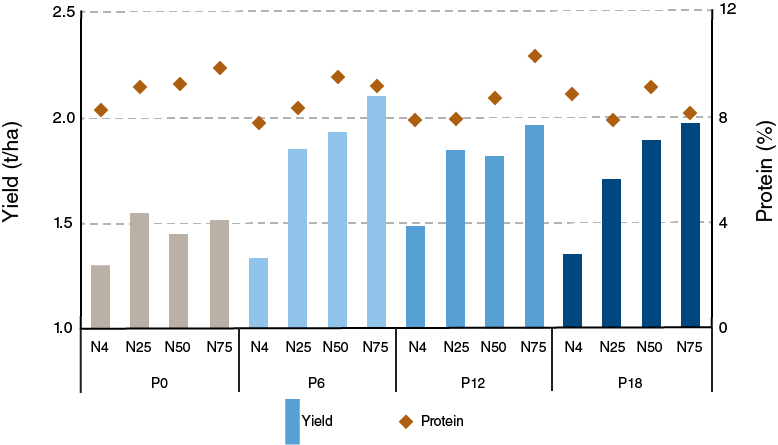
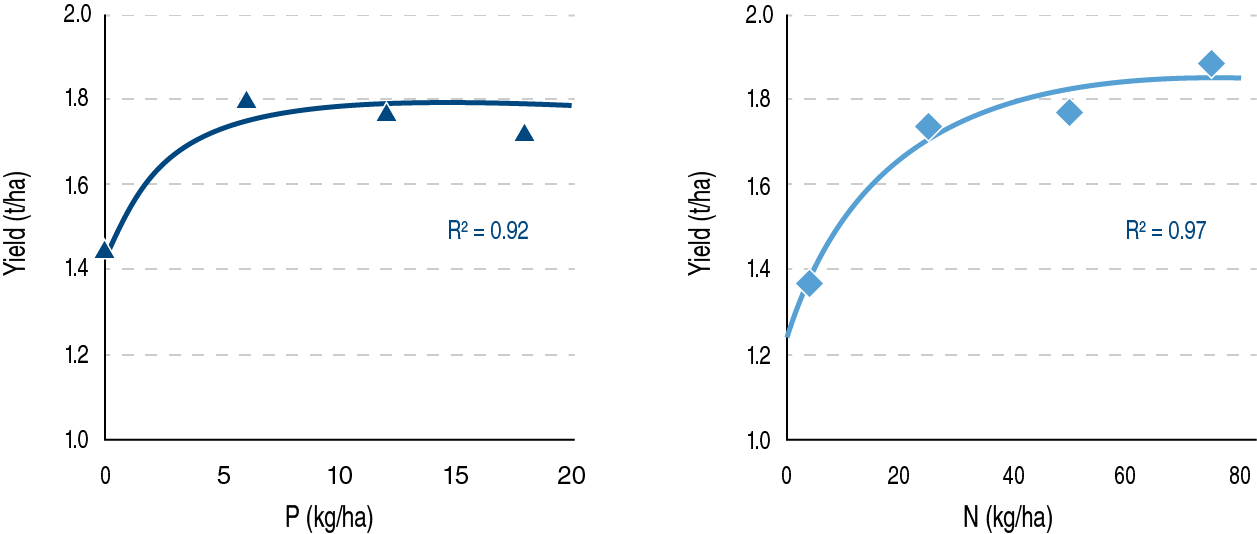
CONCLUSION:
- Differences in yield between treatments were significant and consistent with Summit trials over many years in the area
- A P recommendation of 8-10 kg/ha and N recommendation of 30-60 kg/ha maximises grower returns.
Sum15-10 NPK in Wheat, Burracoppin
AIM:
Expanding the series of eastern wheat belt trials assessing how wheat responds to N and P fertilizer applications under different conditions by the addition of K.
For further details contact your local Area Manager or the Summit Research Team

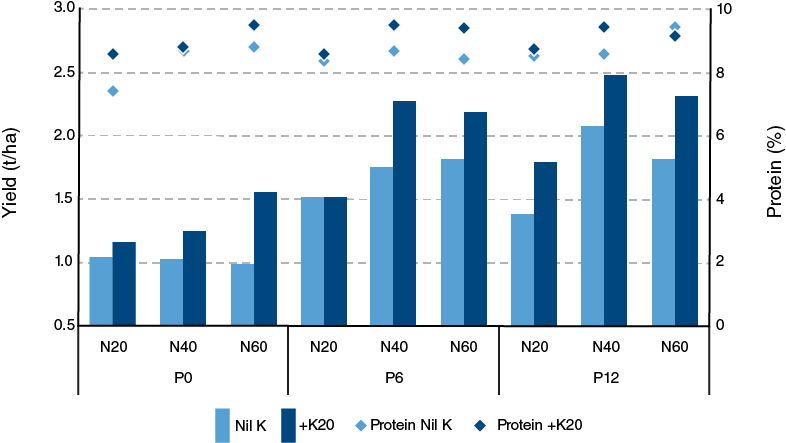
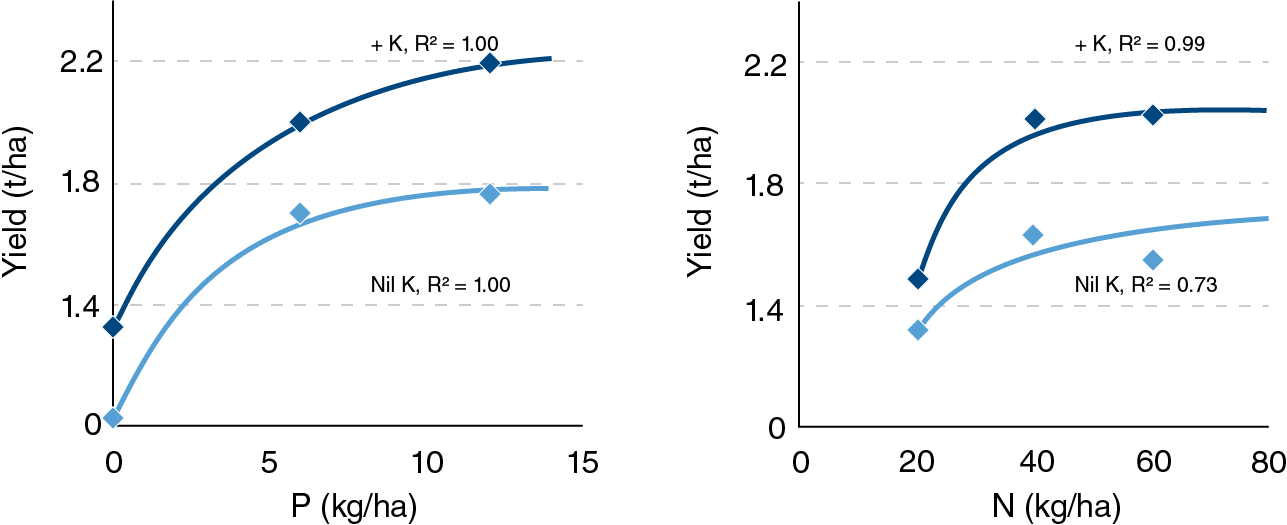
CONCLUSION:
- Differences in yield between P treatments were significant and consistent with Summit trials over many years in the area.
K application should be a consideration depending on results of soil testing. - A P recommendation of 8-10 kg/ha and N recommendation of 30-60 kg/ha optimises yield and grower returns.
Sum15-12 Nitrogen and Phosphorus in Wheat, Moorine Rock
AIM:
Part of a series of trials to assess wheat response to N and P fertilizer applications under different conditions, soil P stores and soil PBI across the wheat belt.
For further details contact your local Area Manager or the Summit Research Team

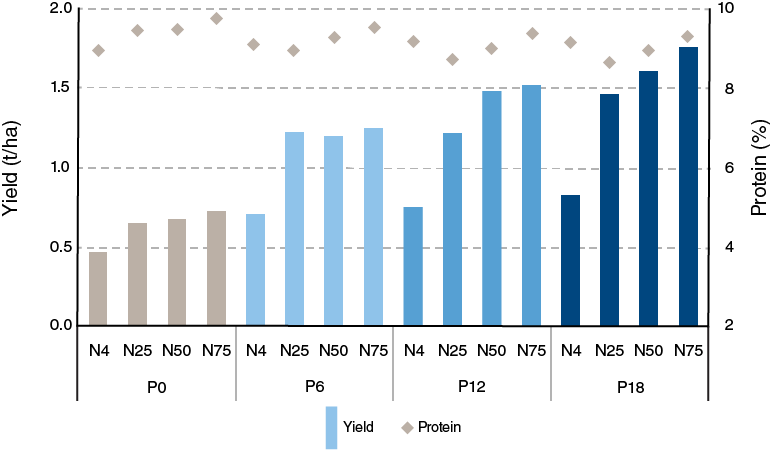
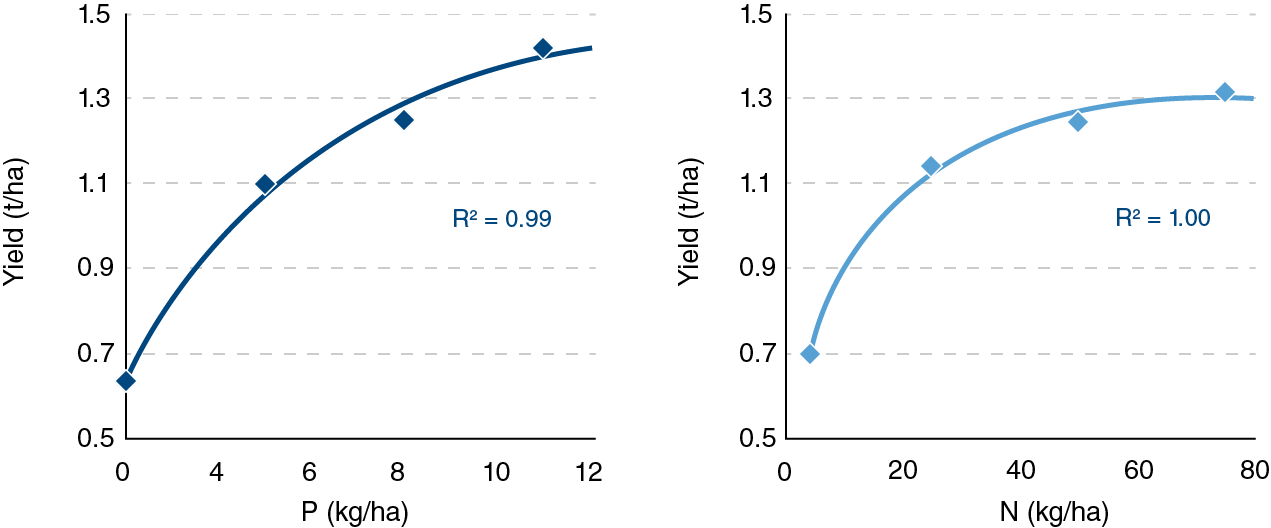
CONCLUSION:
- Both Phosphorus (P) and Nitrogen (N) combined significantly to improve wheat yield.
- Treatments responses were consistent with Summit trials over many years in the area.
- A P recommendation of 12-18 kg/ha and N recommendation of 30-60 kg/ha optimised yield and grower returns.
Sum15-17 Tactical N with Fuel Gauges
AIM:
Demonstrate and evaluate nitrogen-rich strips (N Gauges) and Normalised Difference Vegetation Index (NDVI) measurement as decision support tools to guide economic application of nitrogen during the growing season.
For further details contact yor local Area Manager or the Summit Research Team
KEY MESSAGES:
- Summit’s In-Season Nitrogen Calculator aims to calculate a precise N rate to maximize yield potential of a paddock where N may be limiting, using NDVI as on-the-spot growth measurement.
- This trial demonstrates using dynamic and real-time comparisons between growth of wheat with and without N limitations to determine optimal N application for yield and returns.
- The Nitrogen Calculator shows real promise on light country in the northern wheat belt.
The Calculator optimised yield and gross margin at the 9WAS application and gave a reasonable estimation of optimal N rate at 7WAS. - Summit’s In-Season N Calculator adds another tool to predict yield potential during a broad window of the growing season so growers can have increased confidence in their N application decisions,
decreasing risks of over-application and inefficient fertilizer usage.
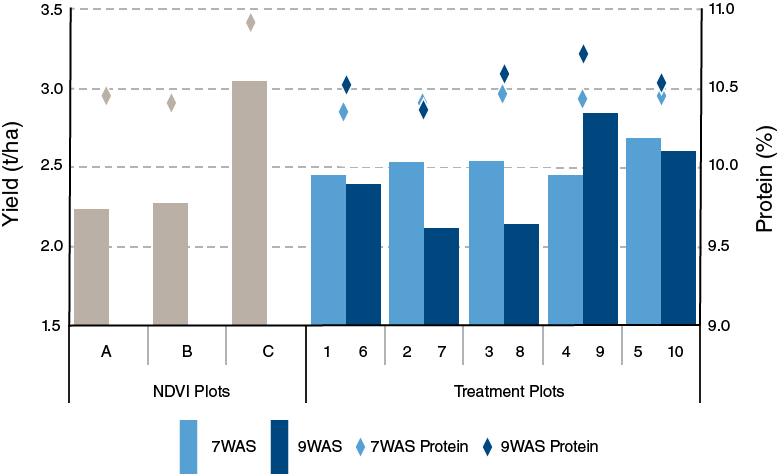
CONCLUSIONS:
- N Calculator recommendation was accurate for 9WAS application with additional nitrogen not increasing yield. The recommendation was slightly below optimum for 7WAS application.
- Achieving close to the target 10.5% protein indicates that recommended N rates were utilised to optimise growth and yield and application of N was not deficient or excessive.
- This provides confidence to incorporate the use of N-gauges and the N Calculator to assist in making N application decisions to wheat crops during the season based on the growth status of the crop.
- Summit will continue further testing of the N Calculator under different seasonal conditions in the northern wheat belt and the effect of timing of NDVI assessment and N-calculator recommendations on yield response to in-season N applications.
Sum15-18 Nitrogen and Potassium in Noodle Wheat Varieties, Binnu
AIM:
To investigate the effect of nitrogen and potassium on yield and grain quality of noodle wheat varieties in the northern agricultural region.
For further details contact your local Area Manager or the Summit Research Team

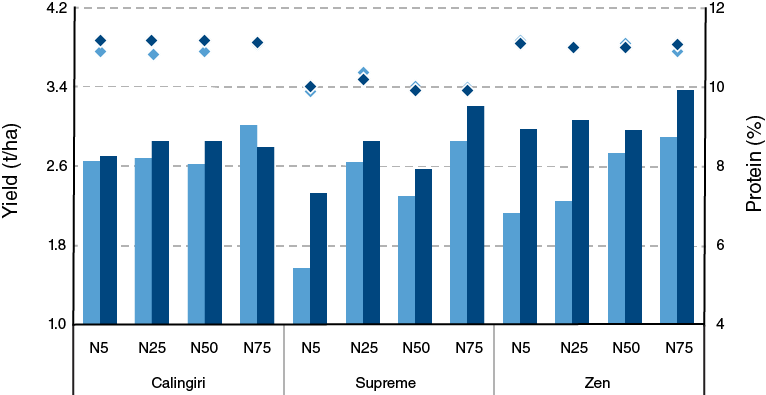
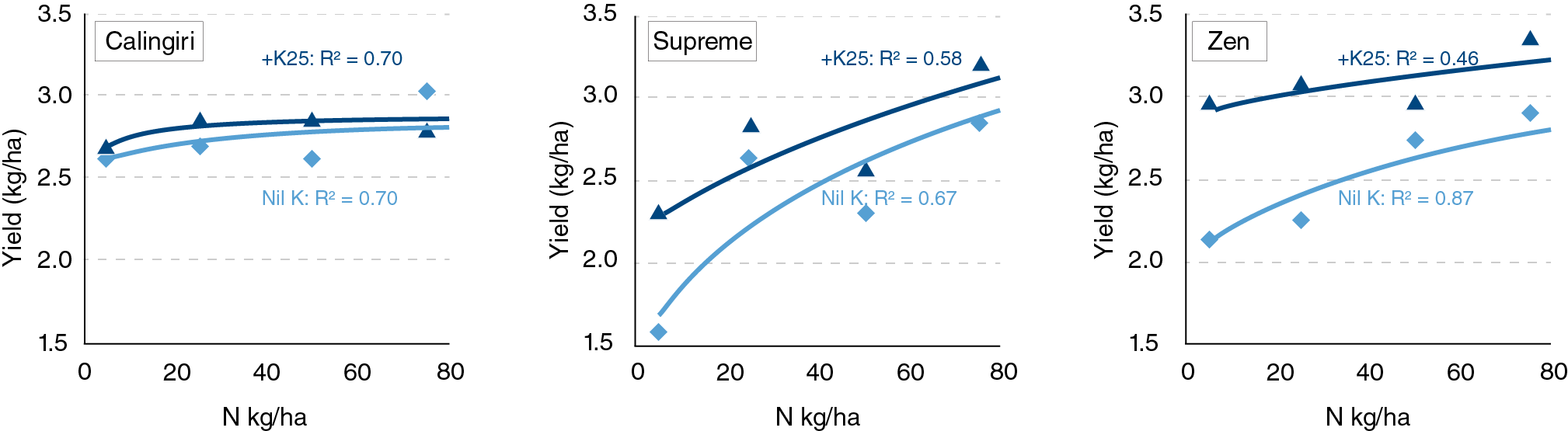
CONCLUSION:
- Calingiri is a consistent performer across various fertilizer rates, however the new varieties Supreme and Zen show potential to better utilise K and N fertilizer to improve yield and returns.
- Yields ranged from 1.5 t/ha in Supreme with nil K and N 5 kg/ha applied, to 3.4 t/ha in Zen with K 25 and N 75 kg/ha applied.
Response to K would be expected on a soil with Colwell K of 30 mg/kg at the surface and lower at depth. - Varieties responded differently to nutrient rates. Generally, application of K increased yield of noodle wheats and the response was significant for both Supreme and Zen, but not for Calingiri.
- Zen showed the greatest potential for top-end yield and had the greatest relative yield response to K application.
- Supreme had the lowest yield at low K and N rates but showed the greatest relative yield response to N application.
- Calingiri performed better than both Supreme and Zen at low K and N but was much less responsive to both K and N application.
- Neither K or N affected grain protein content.
- Supreme consistently showed lower protein (9.9-10.4%) than both Calingiri and Zen (10.8-11.2%). However, all three varieties were within the quality specifications to achieve ANW1 grade.
- Gross margins net of cost of fertiliser applied weigh strongly in favour of K application and increasedN in the new noodle wheat varieties Supreme and Zen, and much less-so in Calingiri.
Sum15-27 Potassium Sources and placement in wheat, Gibson
AIM:
To assess the relative value of banding and topdressing K at seeding time or topdressing after emergence on growth and yield of wheat in the Esperance area.
For further detaqils contact your local Area Manager or the Summit Research Team

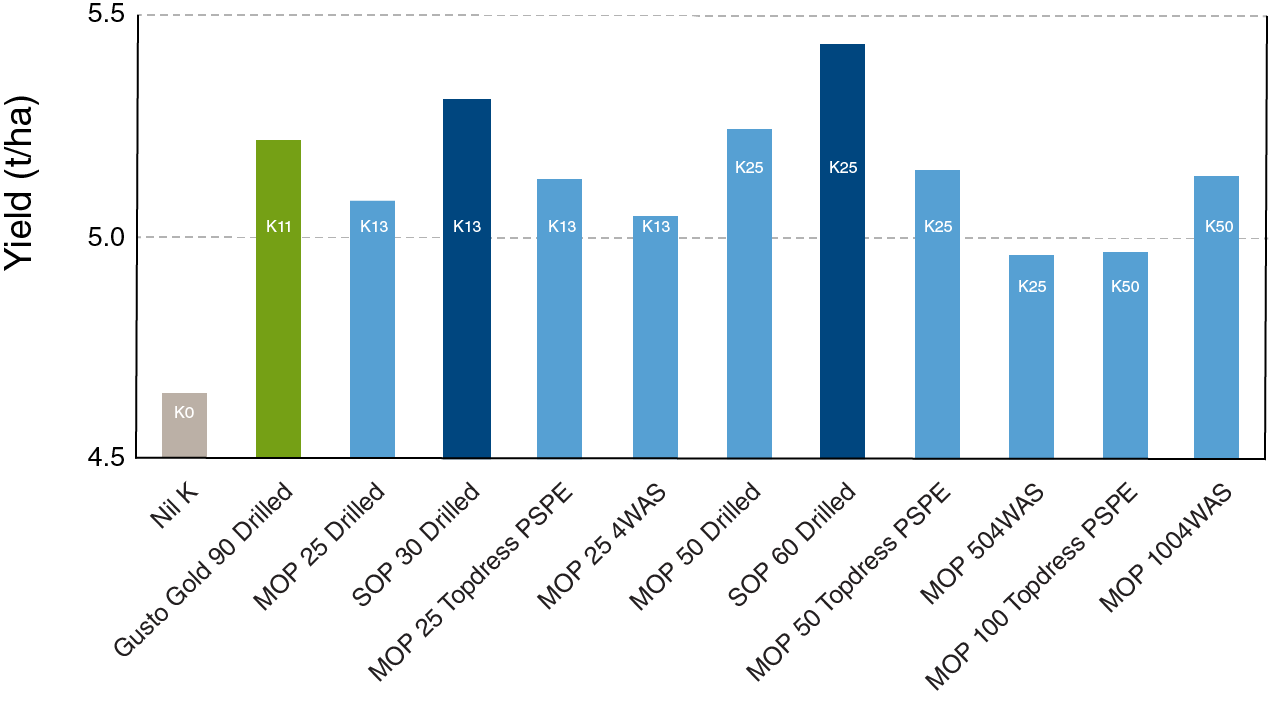
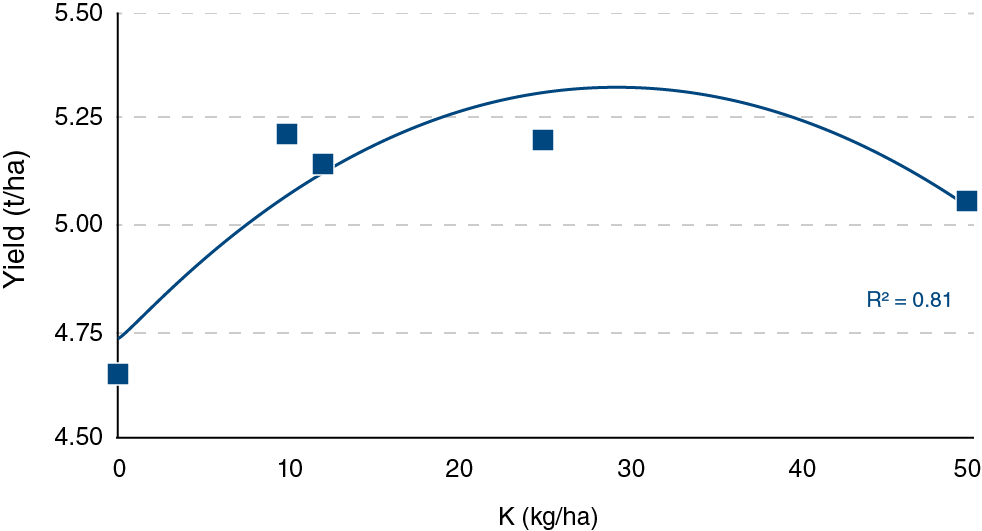
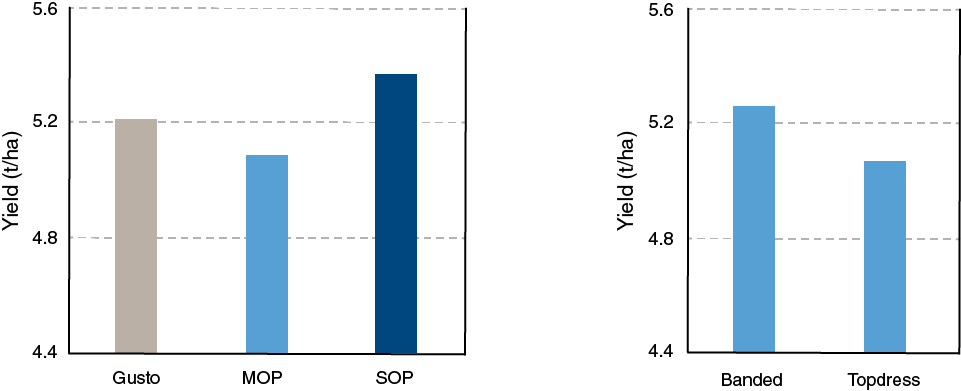
CONCLUSIONS:
- Differences in yield between treatments were significant.
- Treatments clearly demonstrated advantages of banding K fertiliser over topdressing.
- Sulphate of potash, and SOP-based K products such as the Gusto range, displayed yield advantages over muriate of potash, possibly due to additional S.
However, price differentials need to be taken into account if increasing K application rates is desired. - Early strong growth of Gusto Gold plots emphasizes the benefits of a full-compound product containing N, P, S and K plus trace elements.
- In a high yielding year, a Gusto-based fertiliser program may need to be supplemented with additional K to maximise yield and returns.
This will be addressed in future trials. - No toxicity was observed in any MOP application up to 50 kg/ha drilled with seed.
Sum16-02 NPK Wheat on Wheat
AIM:
Part of a continuing trial series to assess how wheat responds to nitrogen (N), phosphorus (P) and potassium (K) fertilizer applications under different conditions,
soil nutrient stores and soil phosphorus buffer Index (PBI) across the wheat belt and, locally, how the response may improve yields.
For further details contact your local Area Manager or the Summit Research Team

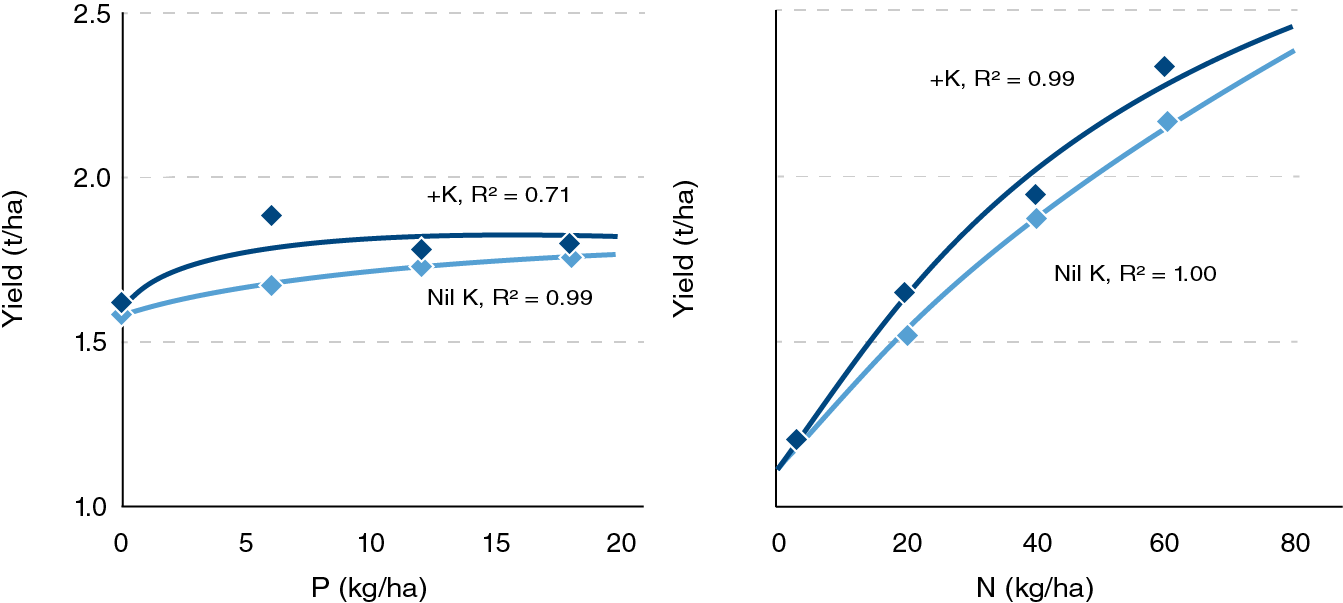
CONCLUSIONS:
- Application of P and N significantly increased yield in this trial and the addition of K, while statistically significant, had less of an impact.
- Maximum yield and gross margins was seen at N 60kg/ha, P 6-12kg/ha with K 20kg/ha providing a minimal increase.
- Gross margin impact can be up-to an additional $25 per hectare by selecting the optimal rate of P and an additional $200 per hectare for optimal rate of N.
- Adequate P nutrition is imperative, promoting early growth and vigour and setting up the crop to utilise applied N efficiently and gain maximum value from in-season N applications.
- Although frost in the region impacted final overall farm yields, localised areas will have yielded well and potentially, exported significant amounts of nutrients.
It will be important to consider fertiliser rates in these areas to avoid underutilising yield potential in the coming seasons.
Soil testing will assist in fertiliser decisions for P and K and continual local research trials will build a foundation of robust and validated data to support these decisions. - Achieving optimal productivity means considering adequate and balanced levels of all nutrients rather than a narrow focus on single nutrient.
Some nutrients, such as P, are only effective when applied at establishment so forming good base nutrition at the start of the growing season
allows the crop to take maximum advantage of opportunistic applications of in-season top up nutrients to which they will respond.
Sum16-05 N & P in Cereals
Is to determine the response of wheat, barley and oats to nitrogen (N) and phosphorus (P) application under the same conditions in the far eastern Wheatbelt.
For further details contact your local Area Manager or the Summit Research Team

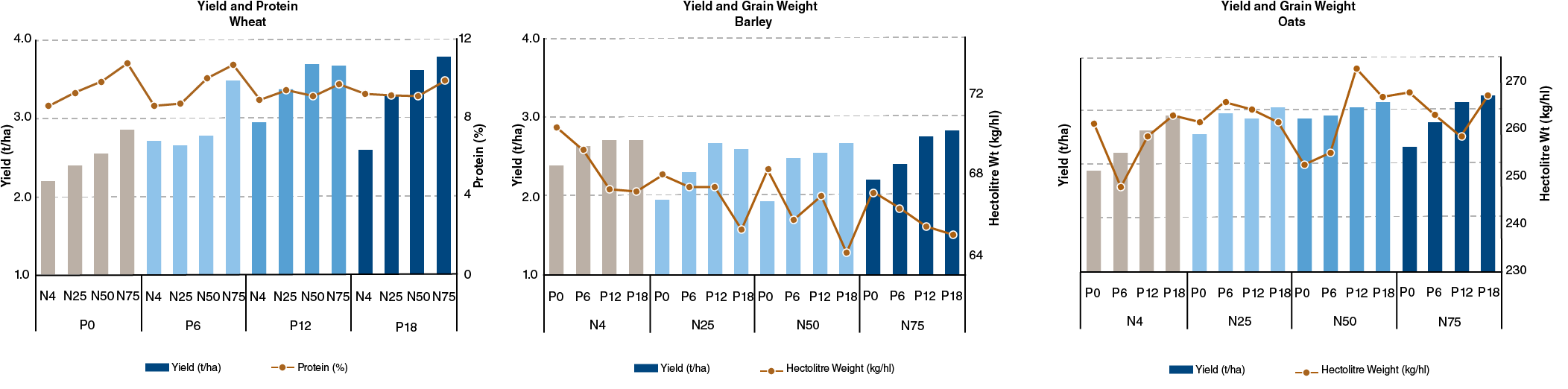
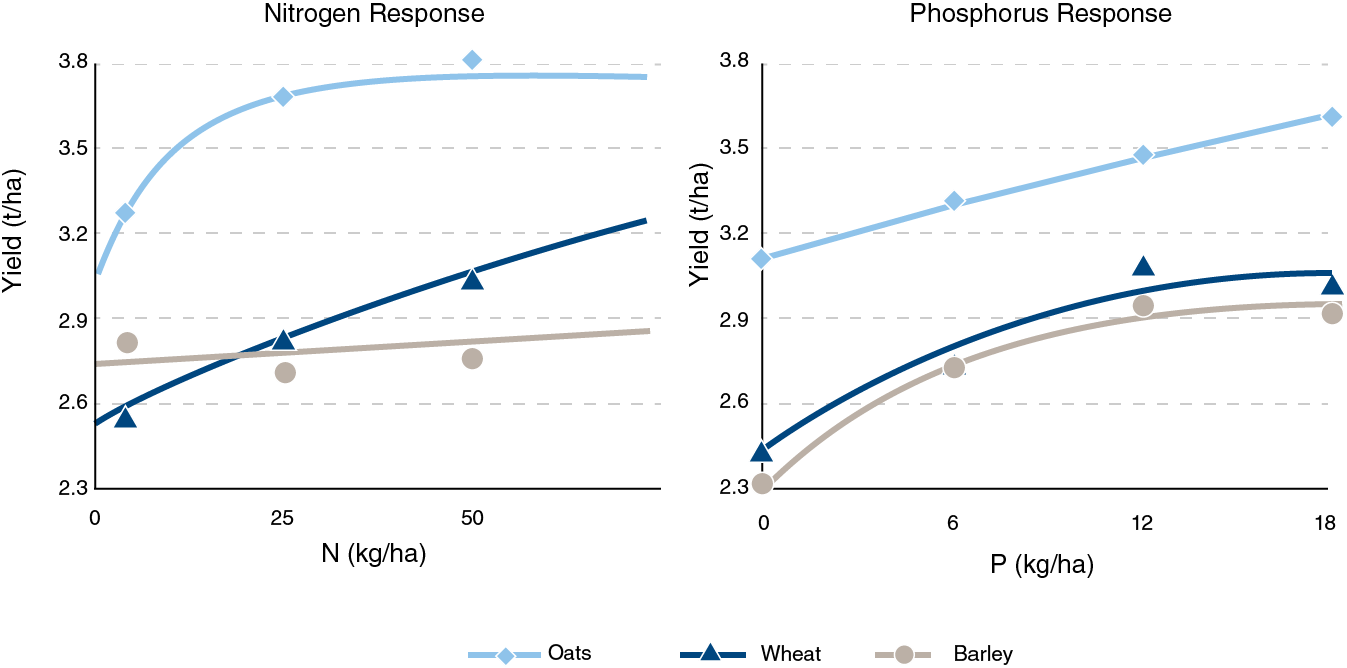
CONCLUSION:
- Overall, N application had a significantly positive effect on wheat yield, improved oats and almost nothing at all for barley.
- P application had an encouraging effect on yields with all three cereals demonstrating a strong correlation between application rates and increased yields.
- Highest gross margin for wheat was found when 151$/ha was spent on fertiliser with a return of 680$/ha. Greatest return on oats was seen when $51 was spent with 644$/ha back and for barley at $27 with a return of 594$/ha.
Sum16-11 Long Term P Strategies
Long term P strategies commenced in 2016
Sum16-13 Nitrrogen Timing on Canola
This trial was designed to investigate the use of Nitrogen to shorten the flowering window of RR hybrid canola.
However with the seasonal conditions the trial result of interest has become how late we can apply N to flowering canola and still influence yield and grain quality.
For further details contact your local Area Manager or the Summit Field Research Team

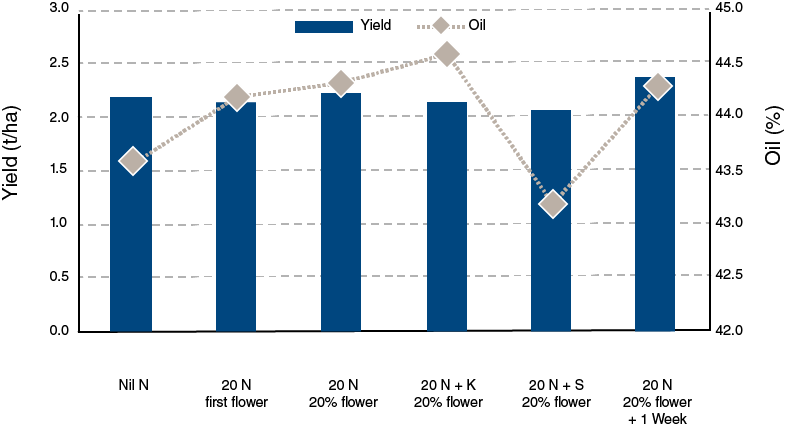
Given the seasonal conditions and yields in excess of 2t/ha the total N application of 61 kg N/ha may not be sufficient to fully express a response to timing of application.
Retention of flowers was observed to differ between plots. However the response was not consistent between replicates.
So, we conclude that there was no obvious effect or change in flowering due to the application of 45 L/ha UAN, 25 kg/ha MOP or 70 L/ha MaxamFLO at any stage during the 43Y23 RR canola flowering window.
Gross margins look to favour late N application, but with no significance in yield or oil differences there is no confidence that this is a real treatment effect.
- Although the kind seasonal conditions may have meant yield potential was missed by sub-optimal application of N, the concept of utilising N application timing to influence the flowering window of canola remains of interest.
- Repeating the trial to ensure that nutrient limitations do not prevent the expression of treatment differences may be worthwhile.
Sum16-15 P Rates and Sources
AIM:
To assess how wheat responds to phosphorus (P) fertilizer applications on high fixing soil
For further details contact your local Area Manager or the Summit Research Team

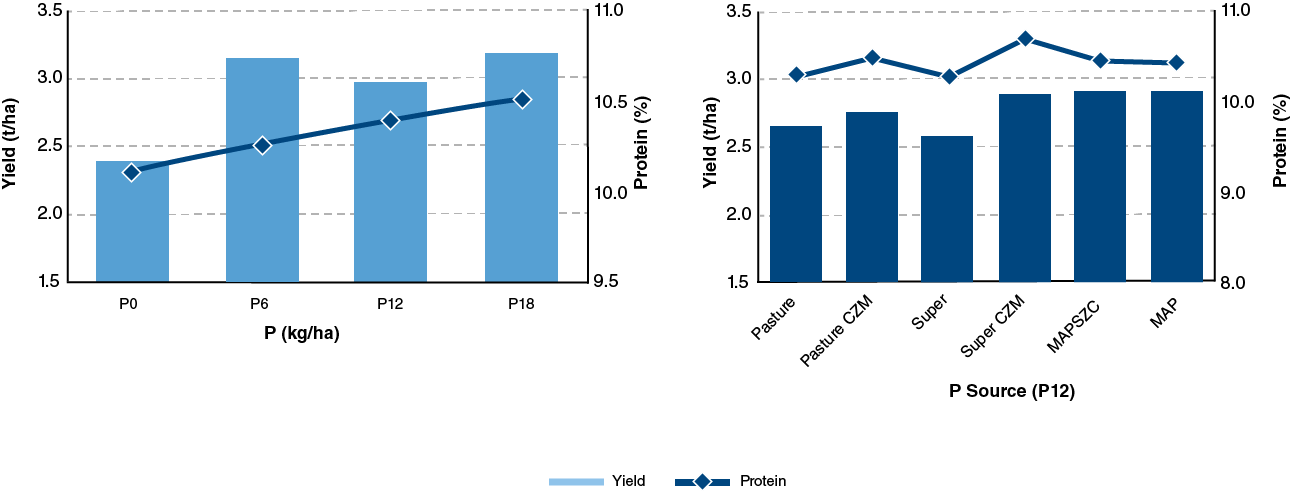
CONCLUSION:
- There was a significant positive response to P application under these conditions.
- No variation in yield between sources of P
- 6-12 kg/ha of P optimised yield and gross margin in this trial
Sum16-16 P Sources on low PBI Soils
AIM:
To assess how wheat responds to phosphorus (P) fertilizer applications on low fixing soil in the Carnamah region.
For further details contact your local Area Manager or the Summit Research Team

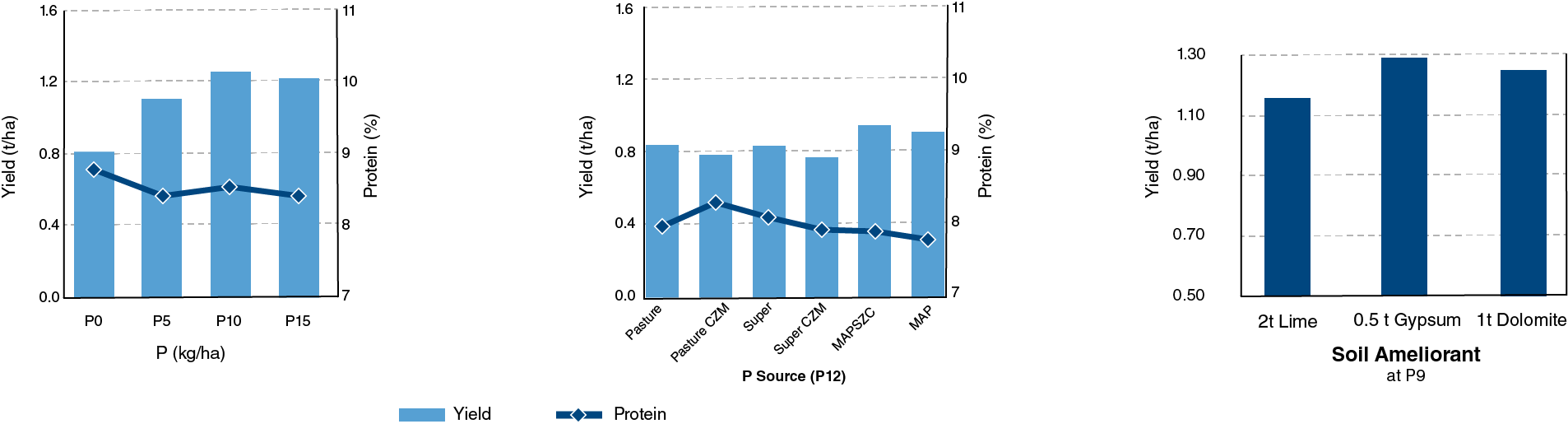
CONCLUSION:
Despite below average yields, 10 kg/ha of P generated the highest yield and returns in this trial.
This supports previous Summit trials highlighting the importance of fresh P upfront – even in low yielding seasons.
Sum16-19 Potassium rates and timing
AIM:
This trial examines potassium (K) rates as muriate of potash (MOP) products applied by a number of methods and the effects on growth and yield of Mace wheat.
For further details contact your local Area Manager or the Summit Research Team

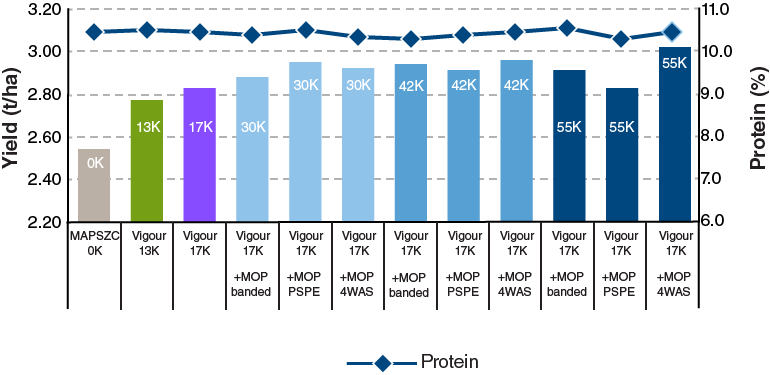
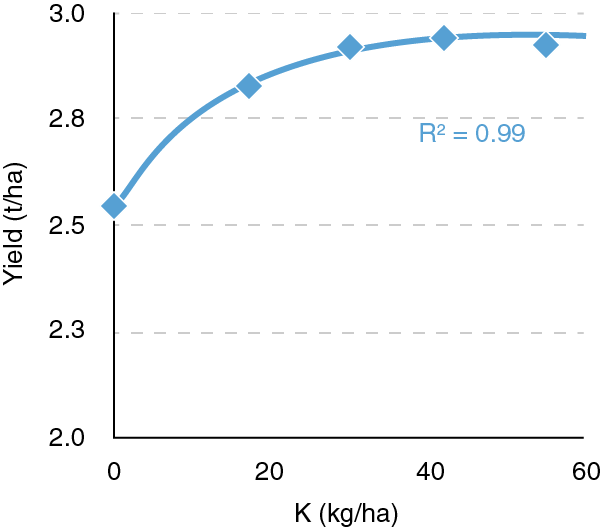
CONCLUSIONS:
- Sandplain soil with Colwell K analysis lower than 30 mg/kg is highly likely to be responsive to K.
- K applied at 13-17 kg/ha in the compound NPK+traces fertiliser, Vigour, banded below the seed improved yields compared to NP+traces compound alone, and yields were further enhanced by applying additional 12.5 kg/ha K as MOP.
- Optimised returns will depend on fertiliser and grain prices at the time.
In the present trial, the greatest increase in returns were seen with Vigour 140 kg/ha at seeding plus 25 kg/ha MOP applied PSPE.
Sum16-20 Tactical Nitrogen, Moora
AIM:
To demonstrate and evaluate nitrogen-rich strips (N Gauges) and Normalised Difference Vegetation Index (NDVI) measurement as to provide a simple, accurate and easy-to-understand decision support tool to guide economic application of nitrogen during the growing season.
For further details contact your local Area Manager or the Summit Research Team

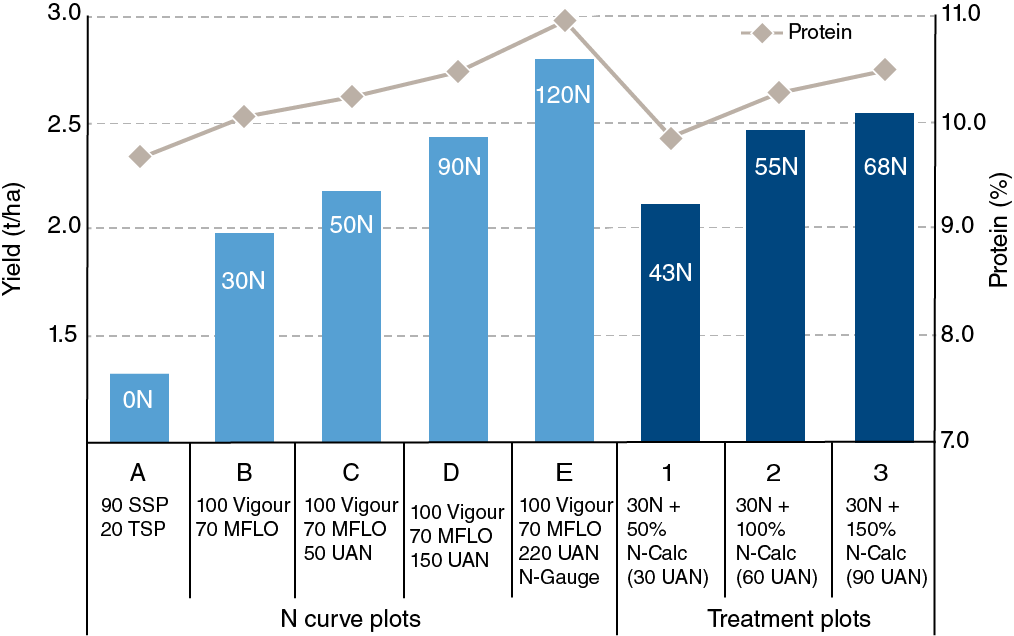
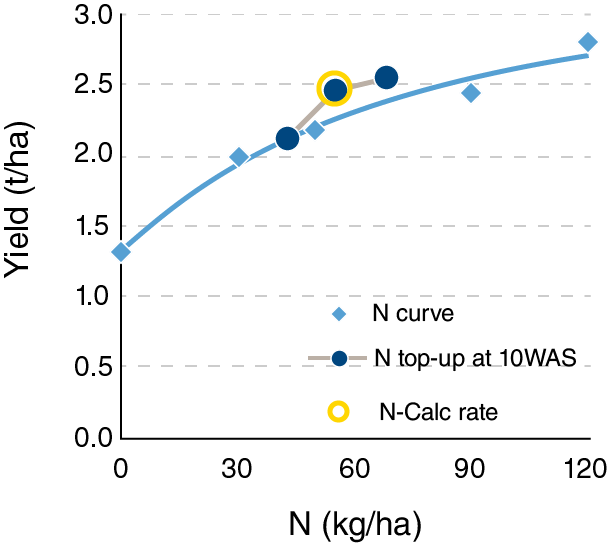
CONCLUSIONS:
- For this trial, the N-calculator prediction optimised yield and gross margin in Mace wheat.
- Getting mid-season N decisions right can have a significant impact on profitability since optimal top up N rates indicatively increased yields by 480 kg per hectare and net returns by $70 per hectare.
- The value of split N applications was shown and the trial provides more weight to the building confidence that the N calculator can provide real and robust N recommendations that are not in excess of crop requirement
and produce maximum or near maximum margin returns from mid-season N applications.
Sum16-21 N x K on canola
AIM:
To investigate the response of canola to potassium (K) and nitrogen (N) rates.
Yield and grain quality can be limited if either of these macro nutrients is in short supply.
For further details contact your loal Area Manager or the Summit Research Team

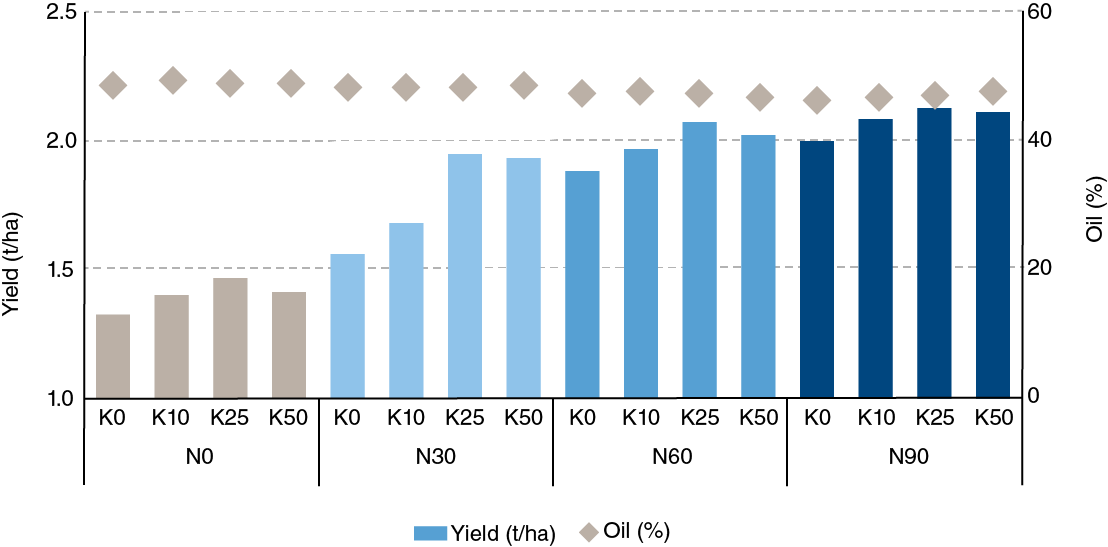
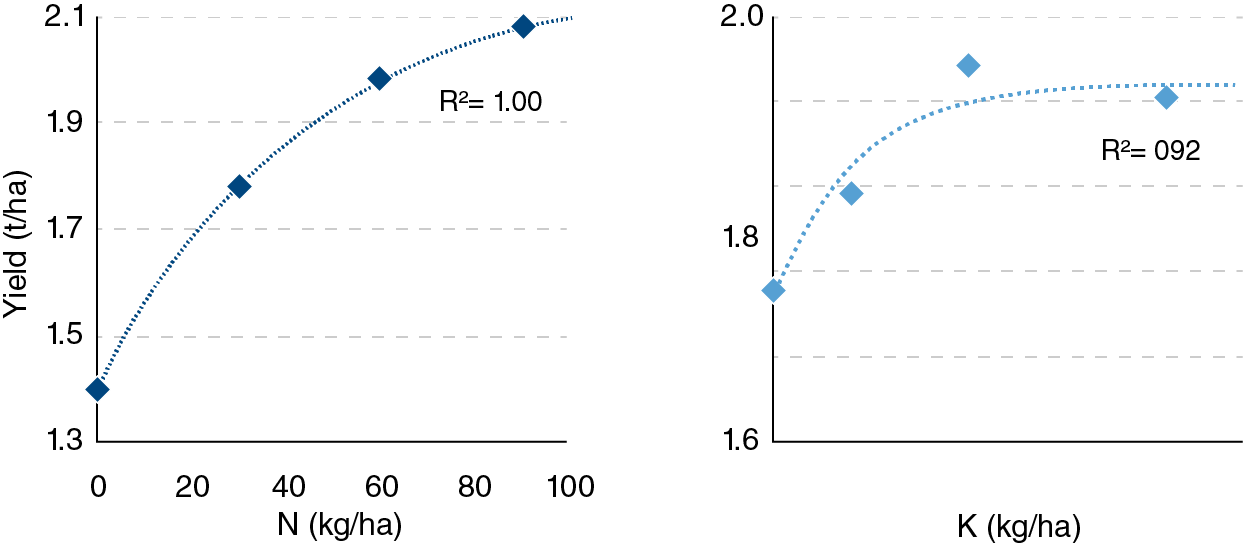
CONCLUSIONS:
- Bonito canola showed significant responses to both N and K at this site.
- Supplying 60 kg/ha of N and 25kg/ha of K was the best strategy for optimising returns under these conditions.
Sum16-23 Tactical Nitrogen in Oats
AIM:
Testing and calibrate the extension of the valuable in-season nitrogen calculator from wheat and barley to oats to help mid-season nitrogen decisions and maximise efficiency and returns.
For further details contact your local Area Manager or the Summit Research Team
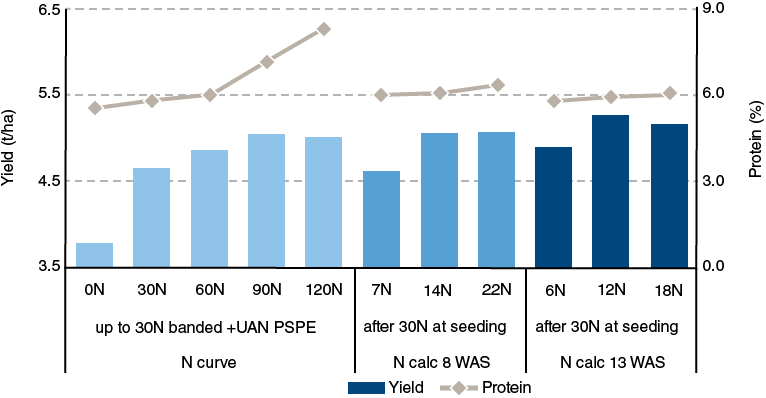
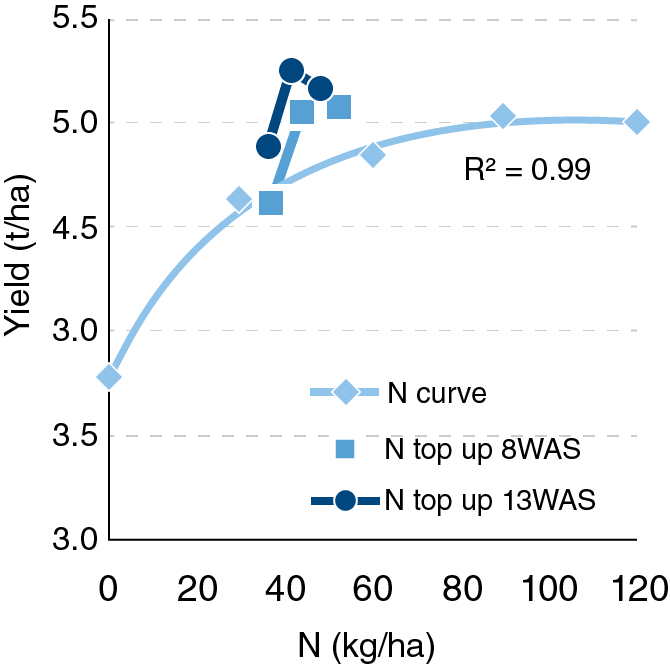
CONCLUSIONS:
- For this trial, the N-calculator based on barley calibration prediction optimised yield and gross margin in oats.
- Getting mid-season N decisions right can have a significant impact on profitability since optimal top up N rates indicatively increased yields by 400 kg to 600 kg per hectare and net returns by $20 to $50 per hectare.
- The value of split N applications was shown and the trial provides more weight to the building confidence that the N calculator can provide real and robust N recommendations
that are not in excess of crop requirement and produce maximum or near maximum margin returns from mid-season N applications.
Sum16-23 Tactical Nitrogen in Oats, Wickepin
TIMING AND RATES OF NITROGEN ON CANOLA
BACKGROUND
Nitrogen influences aspects of both vegetative growth and oil production in canola. Growers are continually seeking information about optimal strategies in terms of rate and timing of applications to maximise grain production while maintaining the ability to get that grain off at harvest.
Elsewhere in the state, anecdotal observations have been made of a shortened flowering window following N application to canola crops where flowering has started.
Yet, there is little well-recorded evidence of timings, relative crop stages and seasonal conditions to provide hard data to this effect.
With this in mind, we initiated a trial incorporating N application at different rates and at different times in a canola crop to record and observe the impacts on the length of flowering occurrence in the season and, ultimately, yield and oil production.
For further information on this trial contact your local Area Manager or our field research team on research@summitfertz.com.au
- Early biomass responses followed through to yield where there was a significant response to applied nitrogen.
- The N Gauge treatment (126N upfront), which aims to provide an unlimited source of nitrogen throughout the growing season, had the highest yield of 1.84 t/ha.
- 72 kg/ha of nitrogen maximised returns under these conditions.
- There was no significant difference in yield between timings of nitrogen application, even when nitrogen was applied at full flowering.
- Timing and rate of nitrogen did not affect grain quality under these conditions. All treatments were close to 50% oil and received the subsequent oil bonuses.
- The N-calculator recommended top-up rate of 17kg N/ha generated yield and returns very near the top of the response curve.

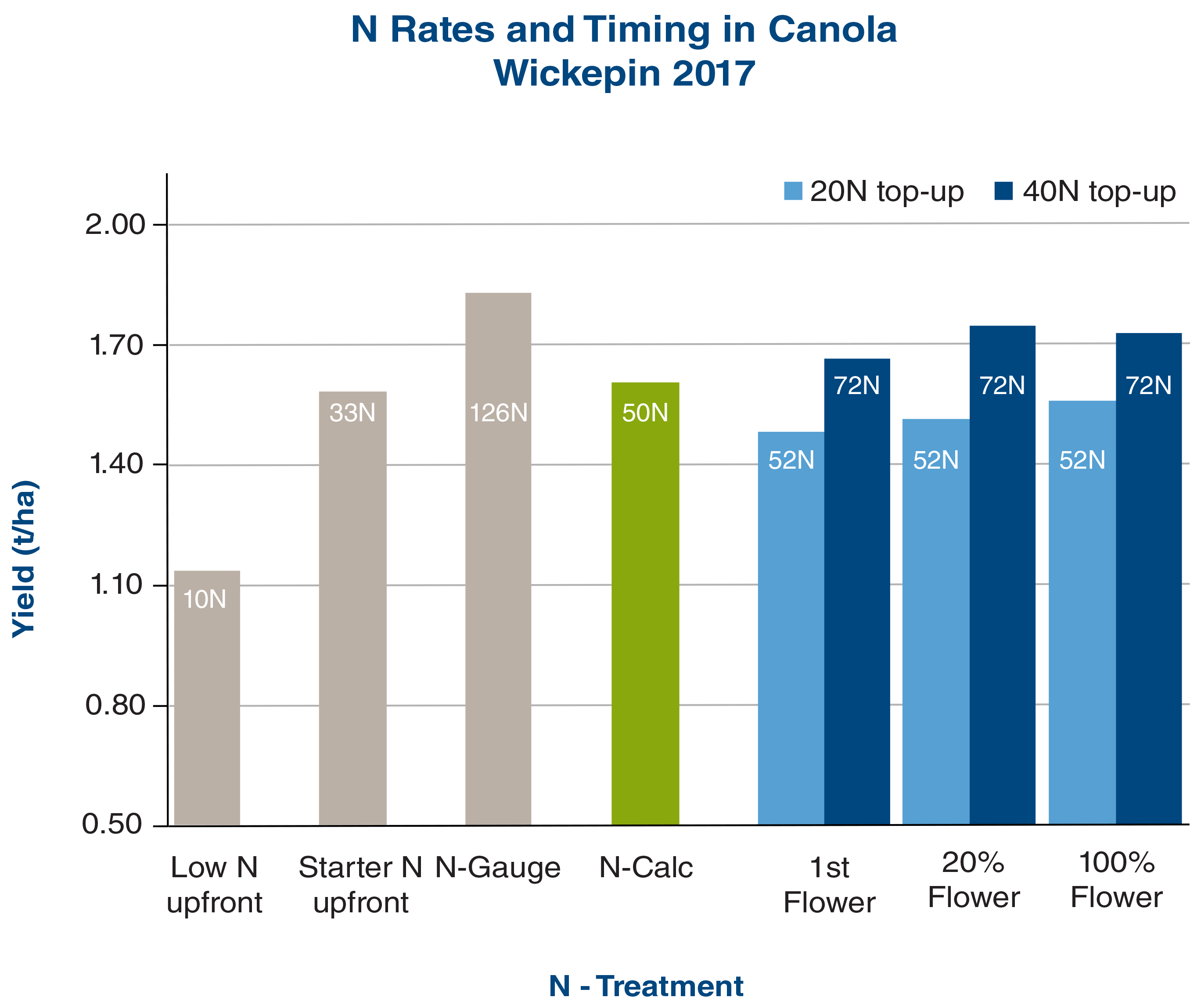
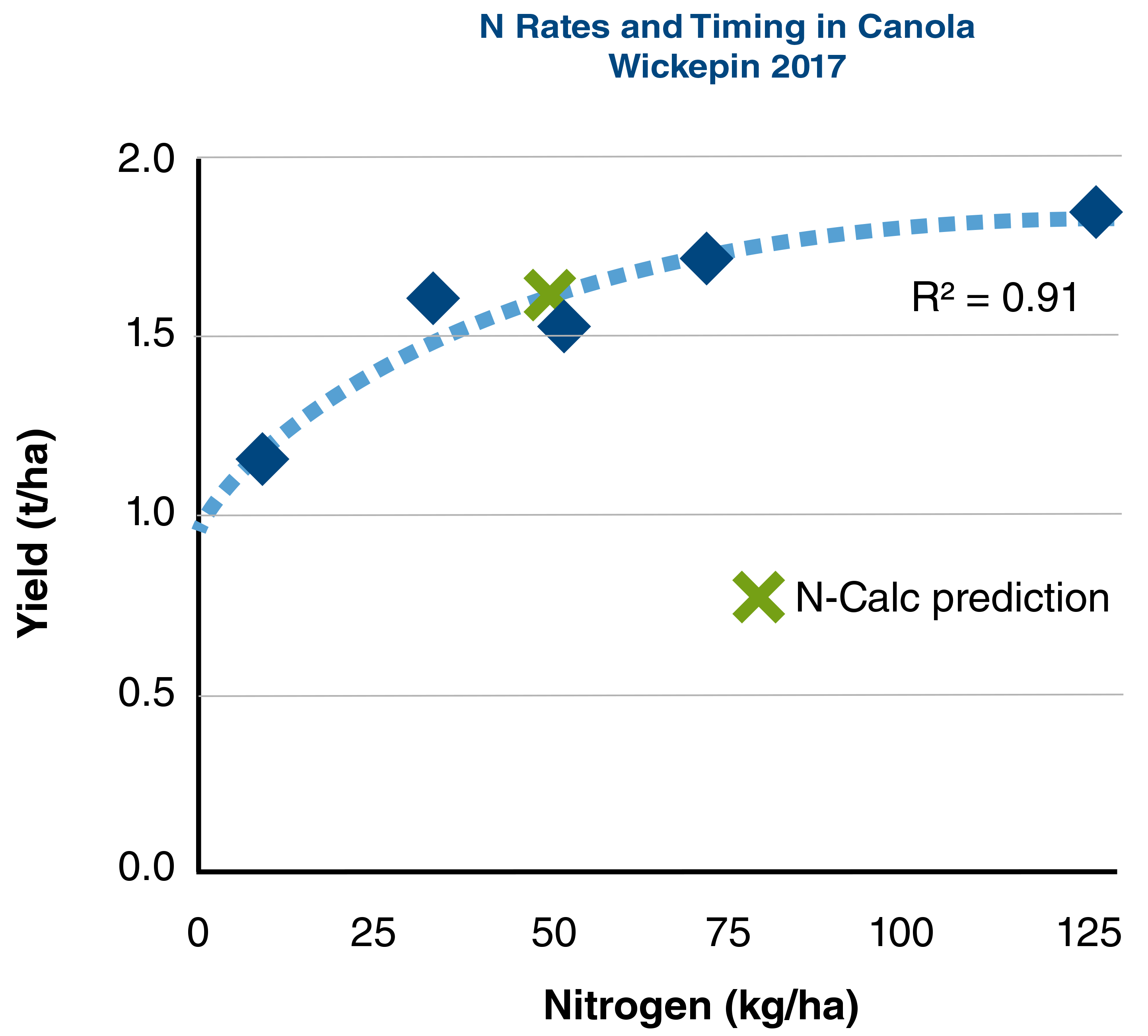
CONCLUSION
There was a significant yield response to nitrogen rate but not to timing of application under these conditions. Earlier nitrogen applications were observed to pod sooner and subsequently lose flowers compared to later applications, which flowered for longer.
These flowering observations did not result in any significant yield differences come harvest.
Harvest yield and gross margin were optimised at ~70kg/ha of nitrogen.
The insignificant difference in yield and quality between top up timings could provide growers with the flexibility to delay nitrogen decisions.
The highest yielding treatment was the N-Gauge where all N was applied upfront. Having enough nitrogen upfront is vital to avoid serious yield penalties and to utilise later N top-ups efficiently, all top-up treatments in this trial received 33 kg/ha of N at sowing.
Interestingly, grain quality was not affected by nitrogen rate or timing under these conditions. All treatments had close to 50% oil and received the subsequent oil bonuses.
100 kg/ha of Vigour® and 50 kg/ha of urea at sowing (33N) with the addition of 140 L/ha of MaxamFlo (40N 11S) during the season seems to be a solid nitrogen strategy for canola under these conditions.
Sum16-24 Response to K Placement, Rates and Timing, Corrigin
AIM:
To assess the value of different muriate sources of potassium (K) on growth and yield of wheat when applied by banding and topdressing at seeding time, or topdressing after emergence.
For further details contact your local Area Manager or the Summit Research Team

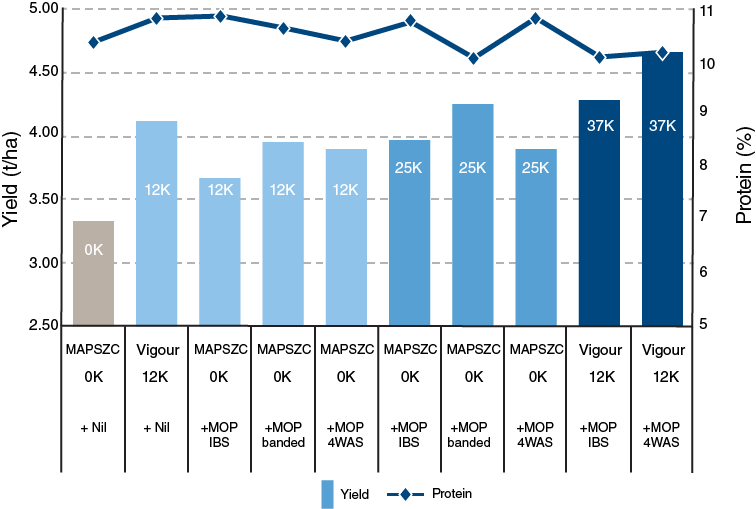
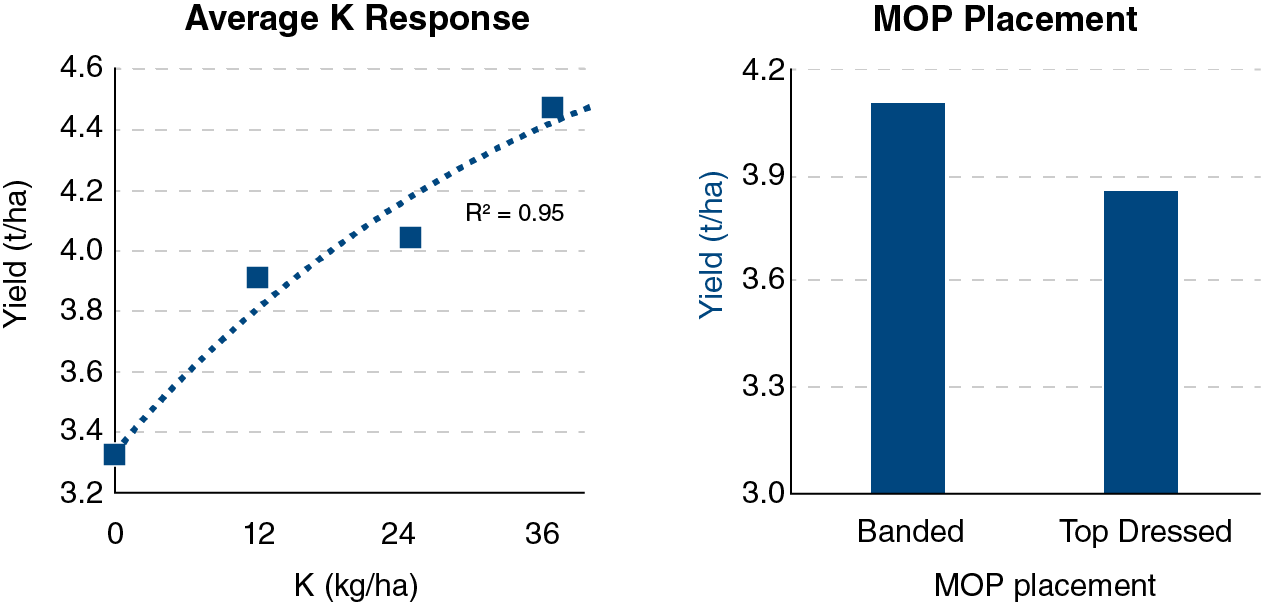
CONCLUSIONS:
- Calingiri wheat growth and yield responded strongly to K application at this site.
- As indicatively seen for the noodle wheat under the conditions at this trial site, there is potential for applications of K to increase returns by up to $300 per hectare,
depending on rates applied, method and timing. - Results suggest that the response of wheat to the NPK compound was greater than response to the NP+MOP blend at this site.
- Banding of K at seeding is recommended over topdressing as a method for most efficient plant uptake and utilisation.
- A combination of Vigour at seeding, topped up with topdressed MOP appears to be a valuable strategy on low K status soils.
Sum16-27 Tactical Nitrogen in oats, Wandering
AIM:
To testing and calibrate the extension of the valuable in-season nitrogen (N) calculator from wheat and barley to oats to help mid-season nitrogen decisions and maximise efficiency and returns.
For further details contact your local Area Manager or the Summit Research Team
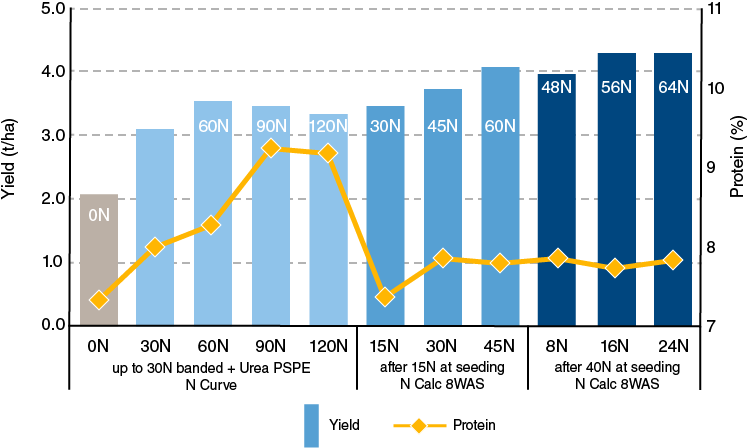
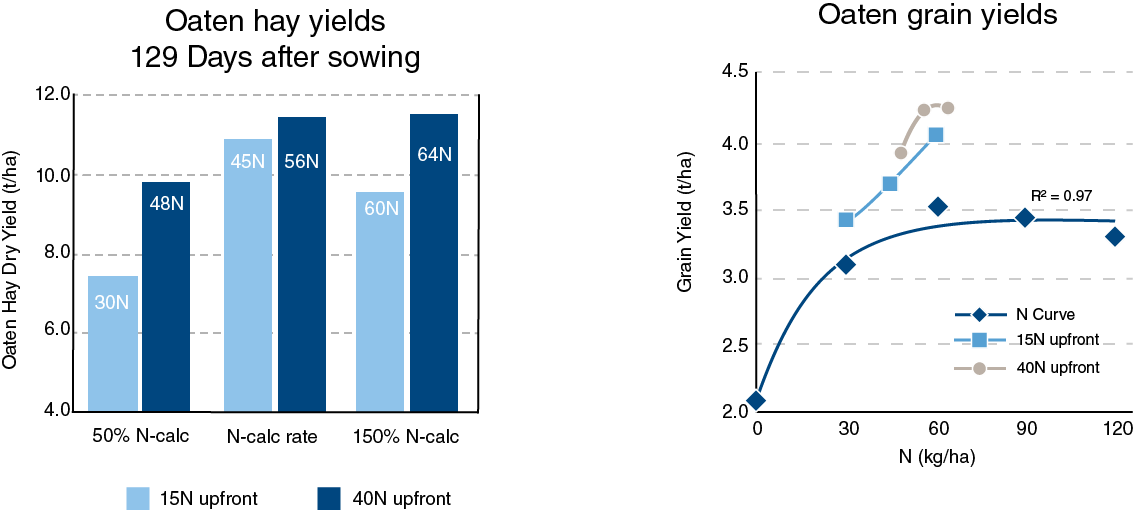
CONCLUSION:
- The Barley Model In Season Nitrogen Calculator produces a reasonably accurate N recommendation to maximise yield and returns for both oaten grain and hay.
- The N-calculator rate optimised yield and gross margin for the 40N upfront treatments, whilst slightly under predicting for the 15N upfront treatments.
- 60kg/ha of N maximised yield and gross margin for the N rate treatments.
- 40kg/ha of N upfront topped up with the N-calculator rate of 16 kg N/ha 8WAS was the optimal treatment for yield and gross margin under these conditions.
- The N-calculator again proves to be an effective strategy for predicting N requirements in cereal crops.
Sum15-01 Nitrogen, Phosphorus and Potassium in Wheat, Ballidu
AIM:
Part of a trial series to assess how wheat responds to N, P and K fertilizer applications under different conditions, soil P stores and soil PBI across the wheat belt and, locally, how the response may improve yields.
For further details contact your local Area Manager or the Summit Research Team

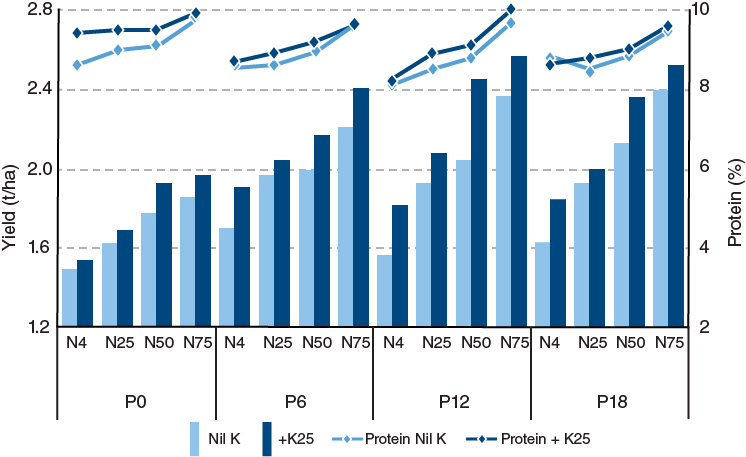
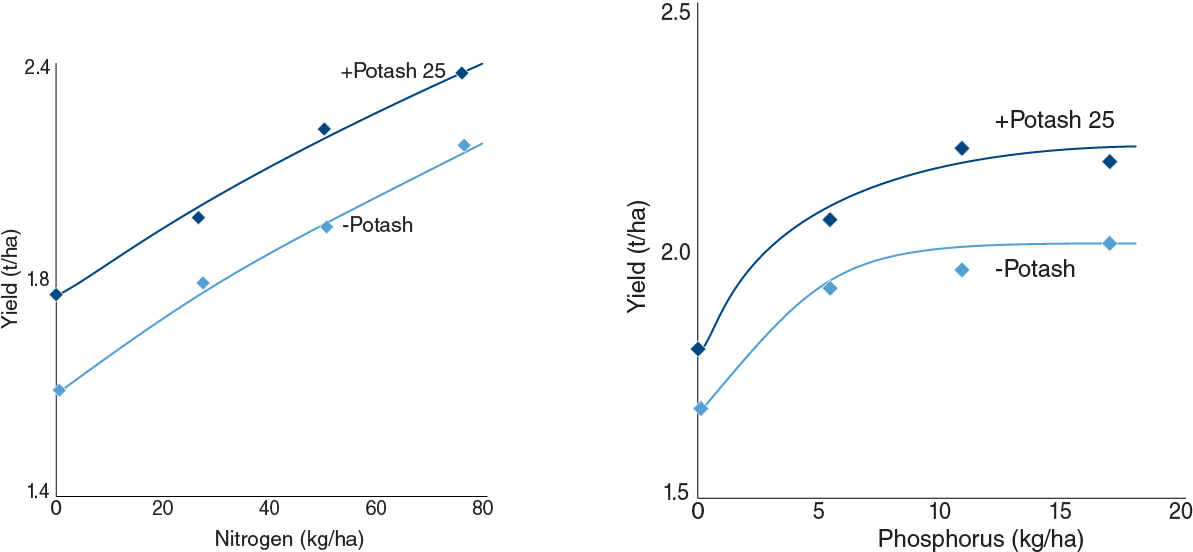
CONCLUSIONS:
- Application of P and N significantly increased yield in this trial and the addition of K at seeding markedly enhanced yield at all N and P rates.
- The interaction of all three nutrients was required to optimise yield and return.
- Maximum yield and gross margins was seen at N 75 kg/ha, P 8-12 kg/ha with K 25kg/ha.
- Adequate P and K nutrition is imperative, promoting early growth and vigour and setting up the crop to utilise applied N efficiently and gain maximum value from in-season N applications.
Sum15-02 Potassium rate, source and timing, Dandaragan
AIM:
To assess the value of different sources of potassium on growth and yield of wheat when applied by banding and topdressing at seeding time or topdressing after emergence.
For further details contact your local Area Manager or the Summit Research Team

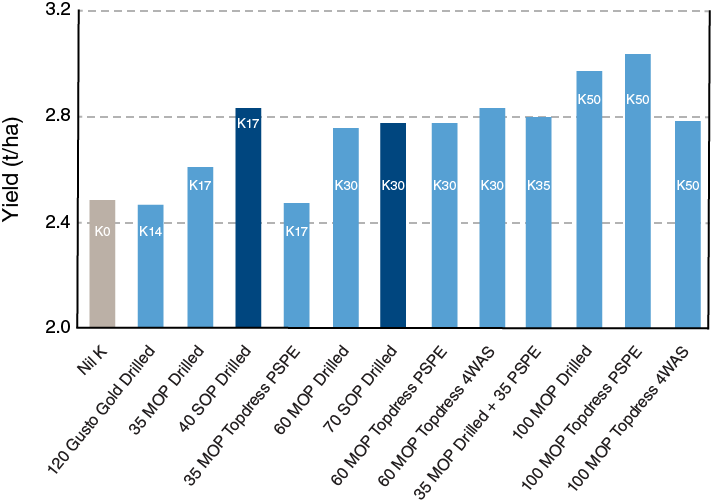
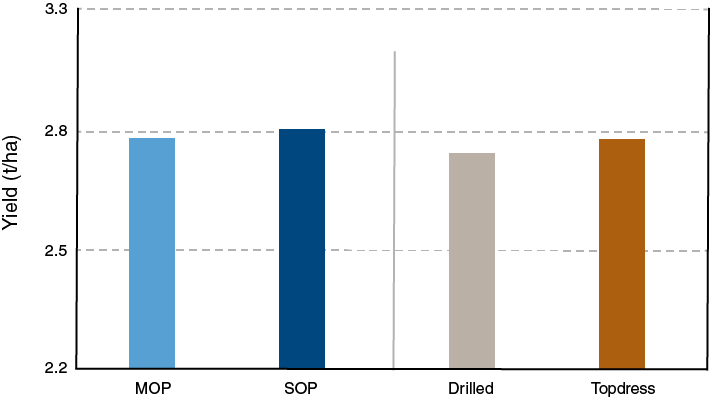
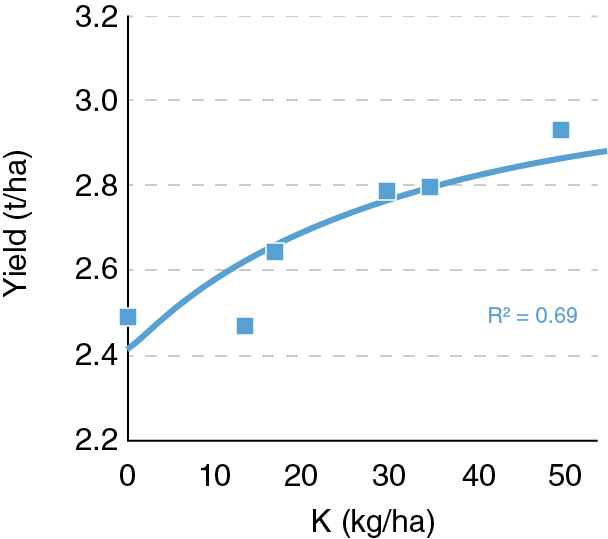
CONCLUSIONS
Mace wheat responded to K application at the site, but the response and yield was less than anticipated due to growing season rainfall being 200 mL below average.
Highest Gross Margin occurred where 50K kg/ha was applied drilled at seeding.
On similar soils in the area, applications of K are recommended at 30 kg/ha to optimise wheat yields or higher if K rundown is expected or determined by soil testing.
Sum15-05 Tactical N, N-Gauge, Mingenew
AIM:
Evaluate nitrogen-rich strips (N Gauges) and Normalised Difference Vegetation Index (NDVI) measurement as decision support tools for economic application of nitrogen during the growing season.
Testing NDVI usage in the Summit In-Season Nitrogen Calculator predictions of yield on a light sand-dominated site.
For further details contact your local Area Manager or the Summit Research Team
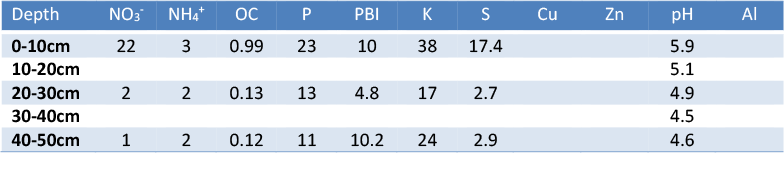
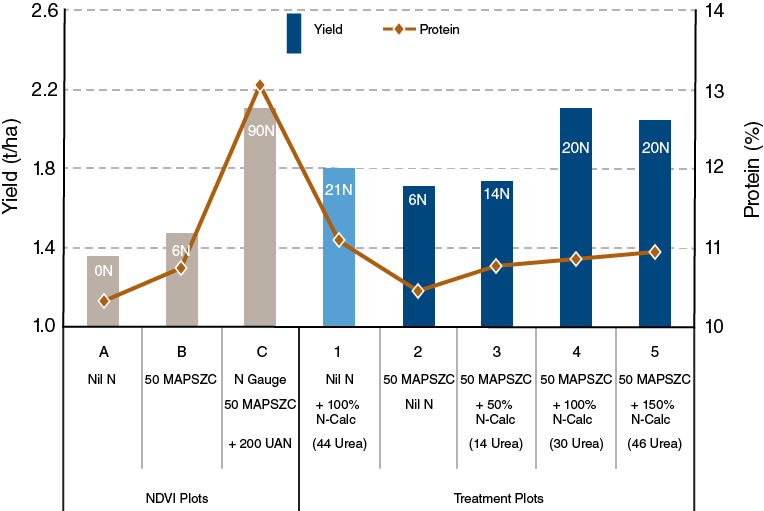
CONCLUSION:
The Summit In-season Nitrogen Calculator gave a reasonable indication of performance potential based on N Gauge and paddock practice NDVI differences.
The recommended N rate (Treatment 4) optimized both yield and gross margin returns compared to where N was either 50% less than (Treatment 3) or 50% greater than (Treatment 5) the recommended rate (Figure 4.). Differences were significant.
The results also highlight to the value of including some N in the starter fertilizer mix. Comparing Treatments 1 and 4 where similar total N was applied, applying 6 kg/ha N at seeding using MAPSZC (compound NPKS fertilizer) in this trial translated to >0.3 t/ha yield than nil N at establishment.
This yield increase occurred in spite of Treatment 4 receiving 32% less urea than Treatment 1 in the mid-season application.
N-rich strips and the In-Season Nitrogen Calculator show real promise as a N decision support tool for growers on sandy soils in the northern agri region and will be further tested under different conditions.
Sum15-06 Tactical N with Fuel Gauge, Morawa
AIM:
Evaluate nitrogen-rich strips (N Gauges) and Normalised Difference Vegetation Index (NDVI) measurement as decision support tools to guide economic application of nitrogen and testing NDVI usage in the Summit In-Season Nitrogen Calculator predictions of yield.
For further details contact your local Area Manager or the Summit Research Team

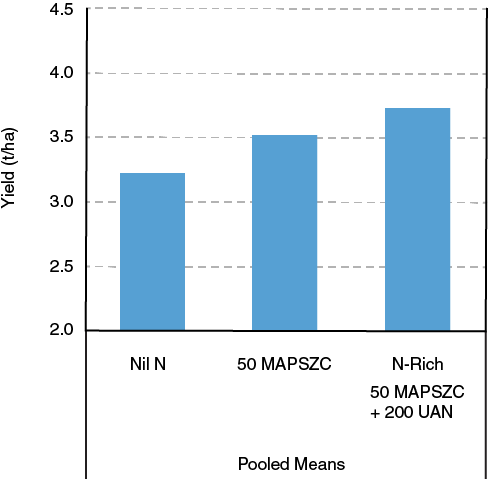
CONCLUSION:
N-rich strips and the In-Season Nitrogen Calculator show real promise as a N decision support tool for growers on sandy soils in the northern agri region.
Sum15-08 Nitrogen, Phosphorus and Potassium in Wheat, Merredin
AIM:
Expanding the series of eastern wheat belt trials assessing how wheat responds to N and P fertilizer applications under different conditions by the addition of K.
For further details contact your local Area Manager or the Summit Research Team

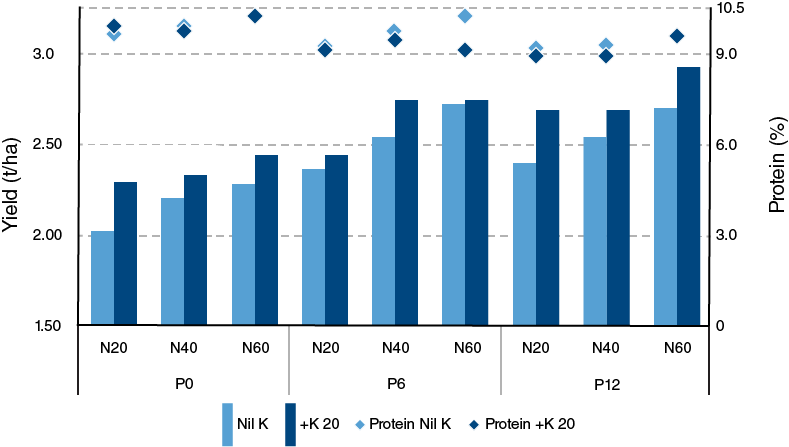
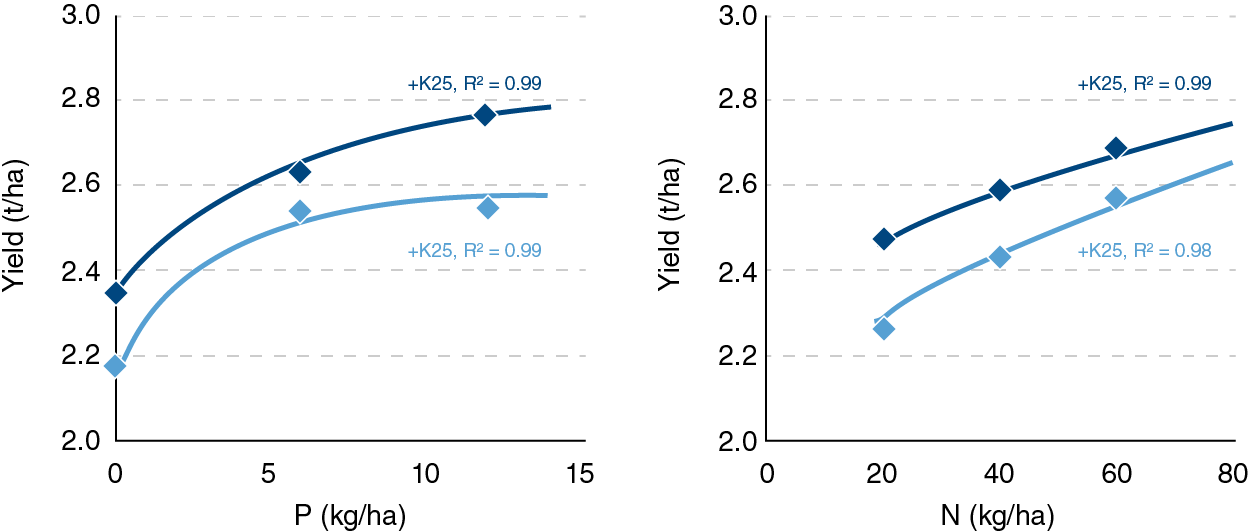
CONCLUSION:
- Differences in yield between N and P treatments were significant and consistent with Summit trials over many years in the area and K application should be a consideration depending on results of soil testing.
- Application of K at seeding improved yields at almost all P and N rates and markedly enhanced the response to increasing P rate.
- Returns from lower N rates were improved by K application.
- Yield and gross margins are optimised at recommended P 8-10 kg/ha and N 30-60 kg/ha, and growers should consider K applications where soil Colwell K is below 50 mg/kg in topsoil and decreases deeper in the profile.
Phosphorus and Potassium in Biserrula Pasture
Determining the most efficient way to allocate P and K fertilizer spend on pasture.
Phosphorus and Potassium in Wheat After Lupins
Assessing the yield response of Wheat to P and K rates following a Lupin rotation.
Phosphorus Placement in Barley on High Phosphorus fixing Morrel Soil
Investigating whether placing P drilled with the seed, banded below the seed or split drilled and banded, is the best strategy for barley in a high P fixing morrel soil.
Phosphorus x Potassium in Lupins
Assessing the Lupin response to P and K application.
Phosphorus x Potassium +/- Nitrogen in Pasture
Looking at the most efficient way to allocate P, K and N fertilizer spend on pasture.
Potassium and Mouldboard Ploughing
A long term trial looking at the annual yield response to K applied in 2014 before and after mouldboard ploughing.
Potassium and Phosphorus Response in Wheat
Assessing the response of wheat to P whilst evaluating the optimal source and strategy for applying K fertilizer.
Potassium and Phosphorus Strategies in Wheat after Canola
Assessing the response of wheat to P whilst evaluating the optimal source and strategy for applying K fertilizer.
Potassium Interpretative Methods and Response in Wheat
Assessing the response of Wheat to applied K as part of a long term trial looking to determine more accurate critical values for K.
Potassium Strategies in Wheat
Value of applying K drilled with the seed as a compound or a blend compared to topdressing K at sowing time or after emergence.
Regans Ford 2017
Nitrogen, phosphorus and potassium on pasture
AIM:
To assess the most efficient way to allocate fertiliser spend on ryegrass-dominated pasture
For further details contact your local Area Manager or the Summit Research Team

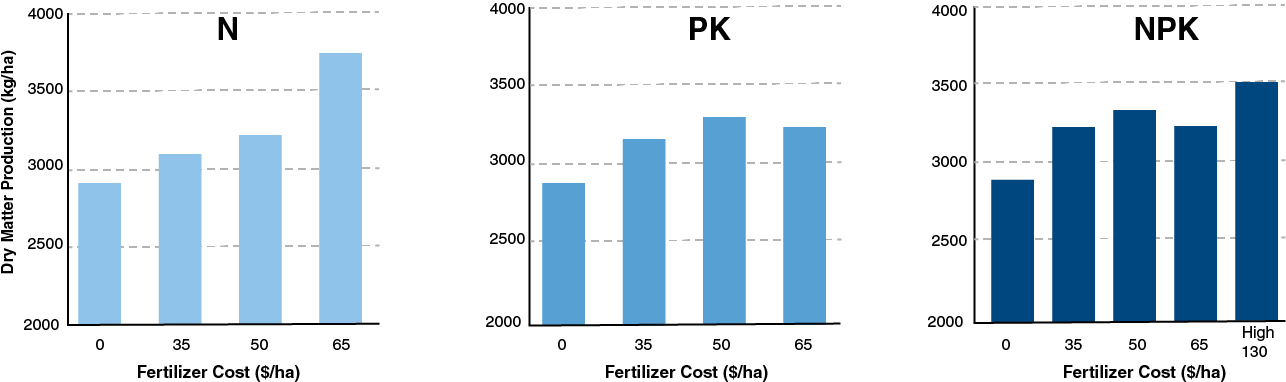
CONCLUSIONS
- There was a significant positive dry matter response to nitrogen but not to phosphorus and potassium.
- Nitrogen applied at 57 kg/ha ($65 /ha) generated the highest dry matter and gross margin under these conditions.
For the most profitable N application, a balance between application when the requirement for extra feed is greatest and when growth conditions are more favourable need to be weighed against each other.
Feed quality impacts of N applications can also be beneficial. - $65 /ha spent on nitrogen was the only treatment to increase gross margin significantly from the nil treatment.
PK and NPK treatments followed a typical diminishing returns curve. - $50 /ha spent on nitrogen, phosphorus and potassium increased total dry matter by 350 kg/ha.
This resulted in a similar gross margin to the nil treatment but more importantly maintains soil nutrient levels for subsequent seasons. - As soil nutrient reserves are utilised, it is expected that the nil treatment would fall further behind in total dry matter and gross returns.
- The results reaffirm that in a pasture situation, higher rates over smaller areas are likely to have a greater overall impact than low rates over a larger area.
Sth Burracoppin 2017
AIM
To study the response of wheat to phosphorus (P) and nitrogen (N), whilst examining how soil amelioration activities, of deep ripping and liming help to better improve yields and economical returns from fertilizer applications.
For more details about this trial contact your local Area Manager or our Summit Research Team
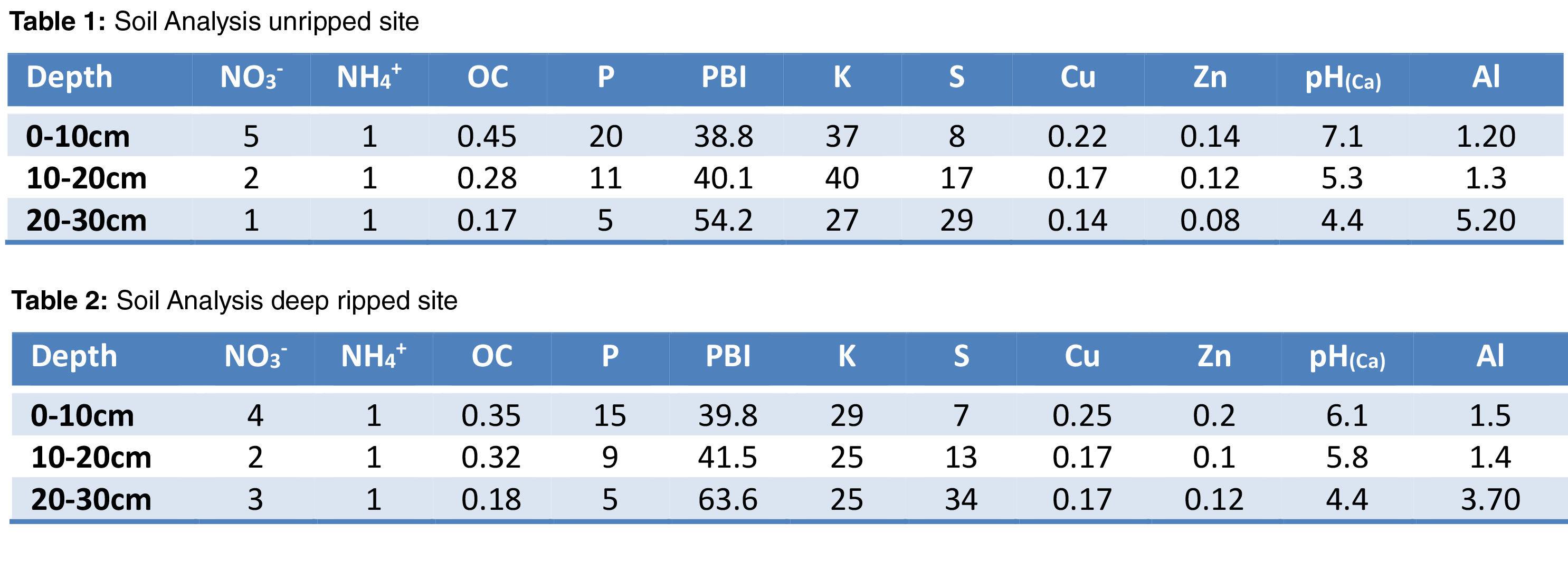
KEY MESSAGES
- The in-season biomass assessment and plant tissue samples highlighted a strong growth response to amelioration and to applied N and P.
- Calingiri wheat had a significantly positive yield response to amelioration and to N and P rates.
- The highest yield was 4.18t/ha and the greatest profit was $1145/ha.
- The optimal fertilizer rates on unripped soil is 12 units of P and 90 units of N and on deep ripped soil 18 units of P or higher and 90 units of N.
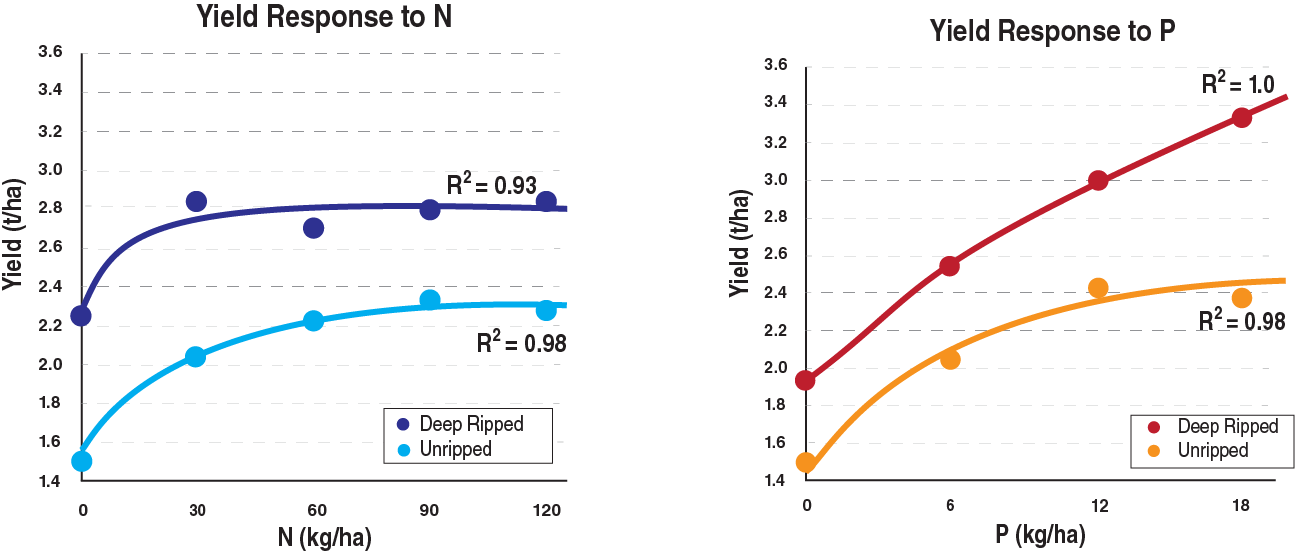
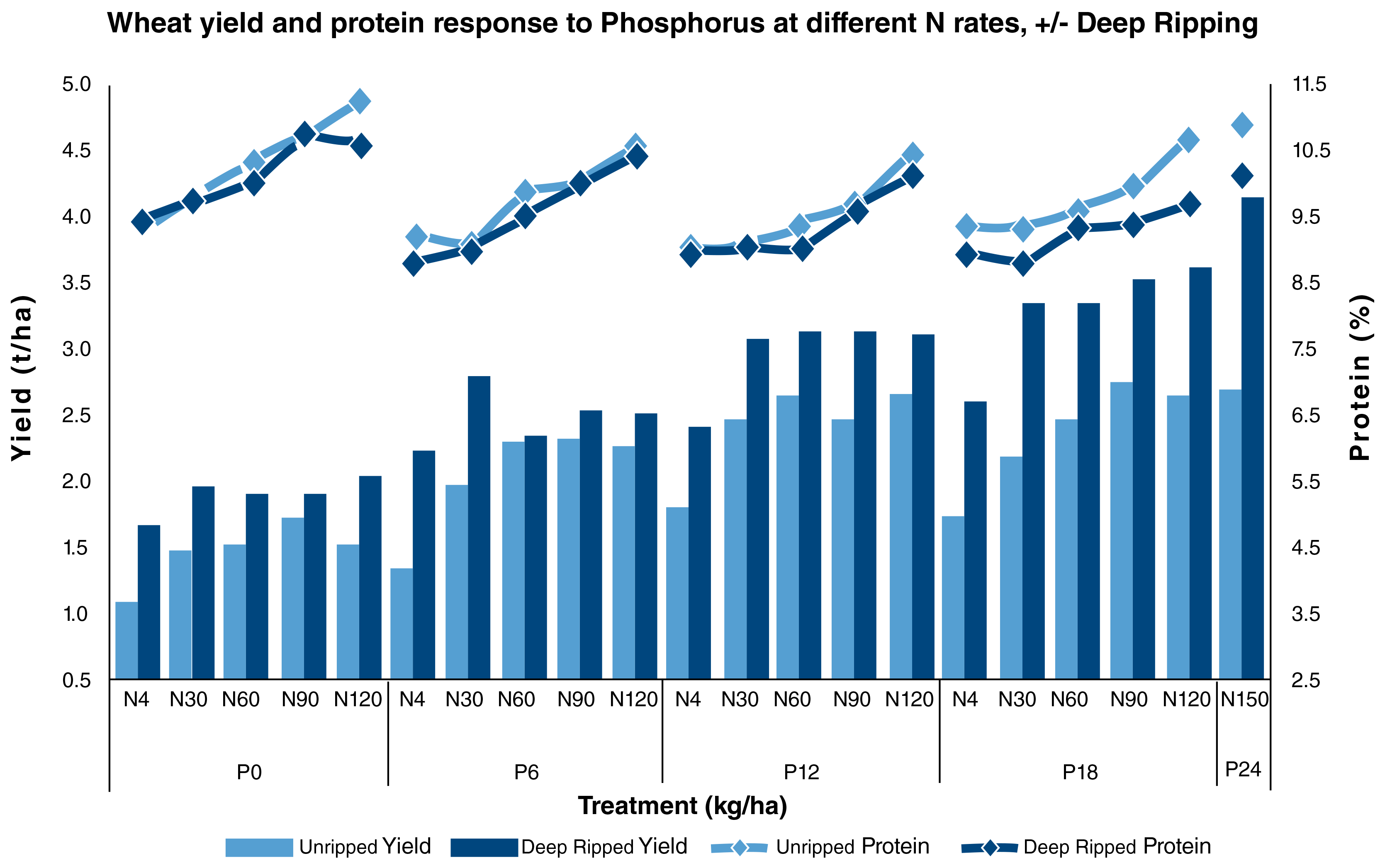
CONCLUSION
- NDVI readings showed a positive biomass response to applied N and P at both the sites, with greater growth seen on ameliorated plots.
- Plant dry weights did not increase with N application when P was unavailable or low, but when adequate P was provided the dry weights did increase.
The removal of soil constrains by amelioration resulted in greater dry weights. - The NO3- analysis shows that plants from both sites take up N at all rates, but data suggests that the ability of plants to utilise this N for plant growth is less when P is deficient.
Higher NO3- concentrations are in plants from unripped plots, suggesting restricted root growth decreases nutrient uptake even when luxury amounts are applied. - NO3- concentrations are higher in plants that received low P rates, as it is not being utilised for plant growth, suggesting that there is little advantage to applying N at sowing or throughout the growing season if adequate P has not been applied at sowing.
- Even with below average rainfall the yields demonstrated a significant response to N, P and amelioration.
The highest yield was 4.18t/ha which had been ameliorated and received P24 and N150.
The lowest yield was 1.10t/ha and was not ameliorated and received no fertilizer. When comparing yields at both sites the ameliorated site on average had a 31% higher yield. - The greatest gross margin was $1,145/ha which was at the ameliorated site and received P24 and N150.
The lowest revenue was $320/ha which was not ameliorated and received no fertilizer.
The gross margin calculations demonstrate that returns were much greater with amelioration, on average $188/ha higher. - Based on gross margin calculations and response curves the recommended application of fertilizer on unripped soil is P12 and N90 and on ameliorated soil P18 and N90
Sum14-04 K x Mouldboard Ploughing
AIM:
To investigate the residual response of potassium rates applied pre and post mouldboard ploughing in 2014 to a rotation of wheat 2014, barley 2015 and canola 2016.
For further details contact your local Area Manager or the Summit Field Research Team

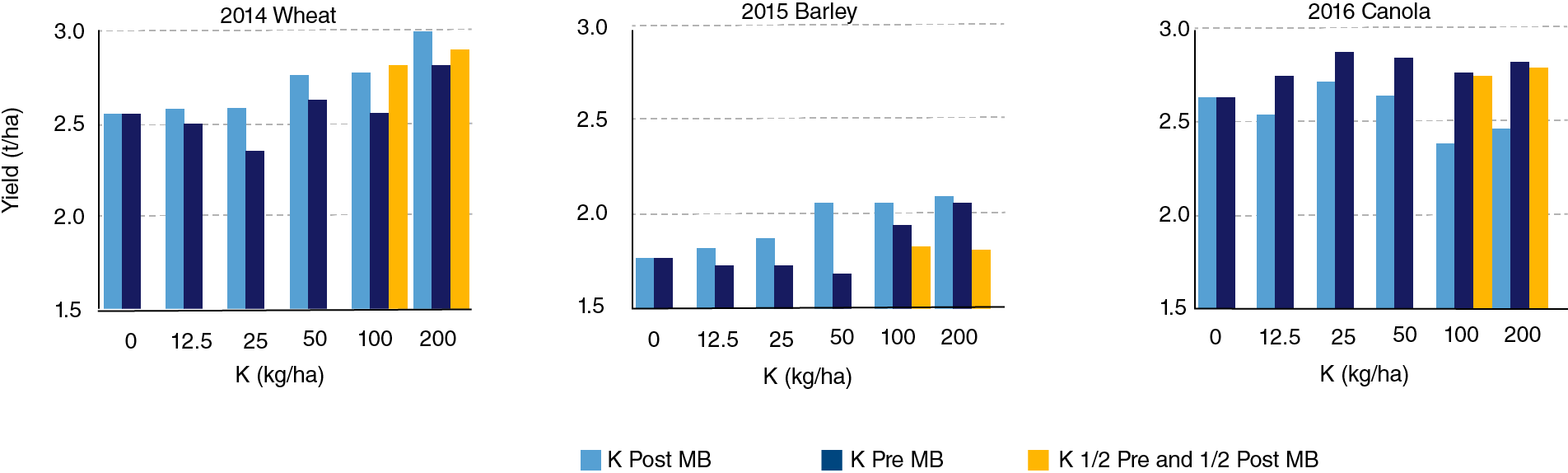
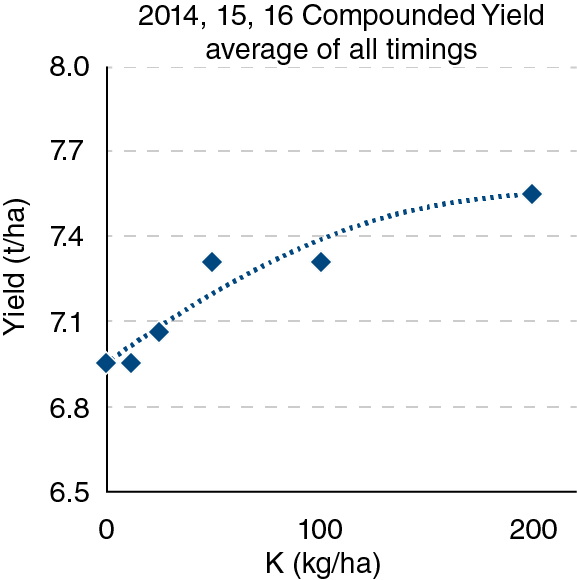
There was a positive yield response to K application in each season, although yield increase was progressively less in subsequent seasons and crops.
Applying K post mouldboarding had a yield advantage in 2014 and 2015; although by 2016 there was a yield advantage to K applied pre mouldboard.
The highly vigorous, deep rooting canola crop of 2016 was perhaps able to more readily access the K applied pre and buried by the mouldboard in 2014.
Pooled average K response for all timings indicated much less of a response to K in 2016 compared to 2014 and 2015.
This suggests that applied K has largely been used or leached out of the root zone since application in 2014.
Perenjori
Aim
A long-term trial to assess how wheat responds to N and P fertilizer applications after gypsum and lime application with and without incorporation
Key Messages
- 60 kg/ha of N and 12 kg/ha P optimised yield under these conditions
- Nitrogen response was significantly limited without the application of P
Table 1. Soil Test Results
Growing season rainfall at Perenjori was average, receiving just over the average in total and wetter than average June and July.
Methods
A factorial trial design that included three rates of nitrogen, 0, 25, 50 kg N/ha, and four rates of phosphorus, 0, 4, 8 and 12 kg P/ha with lime surface applied or incorporated and compared to gypsum.
Results:
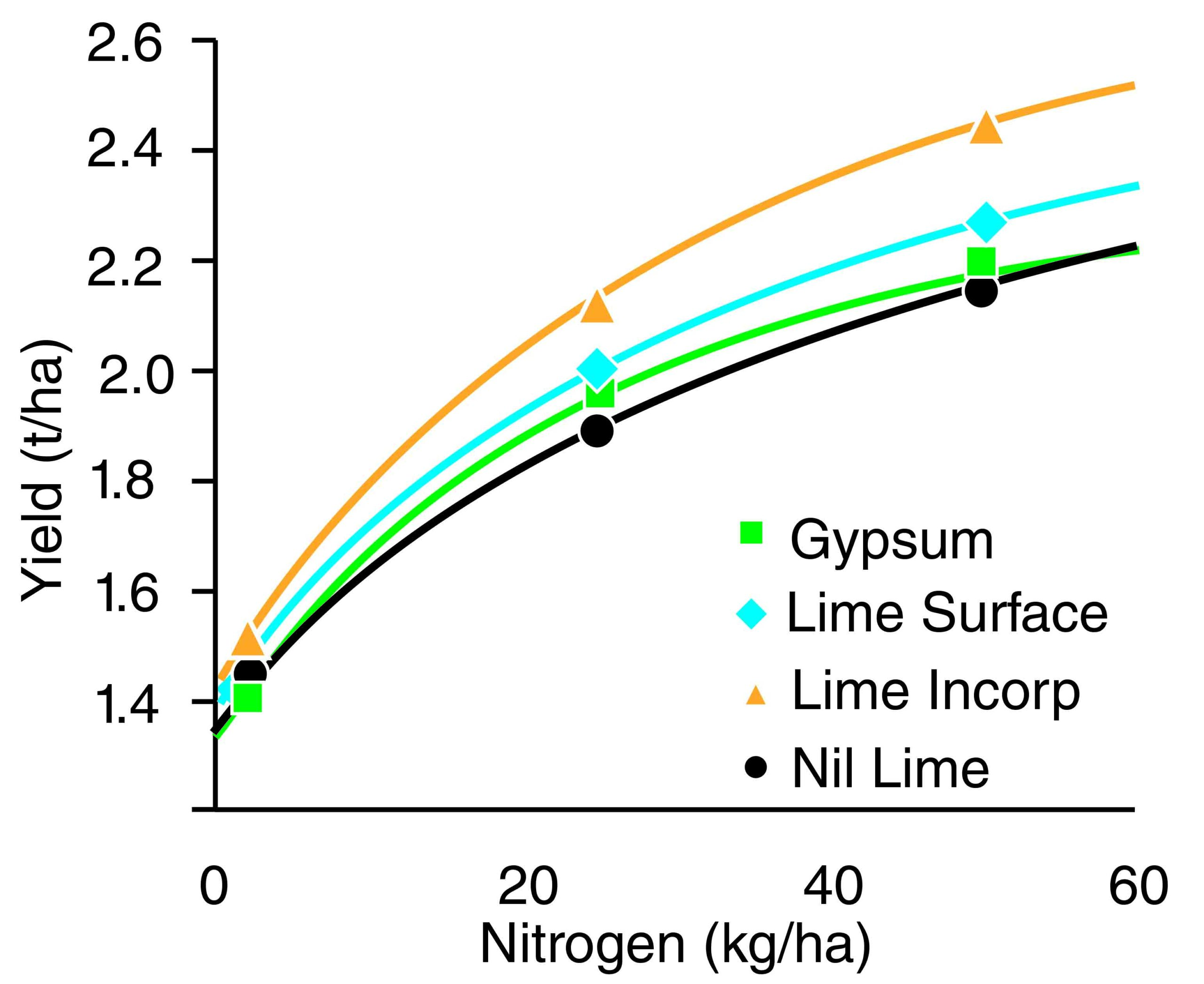
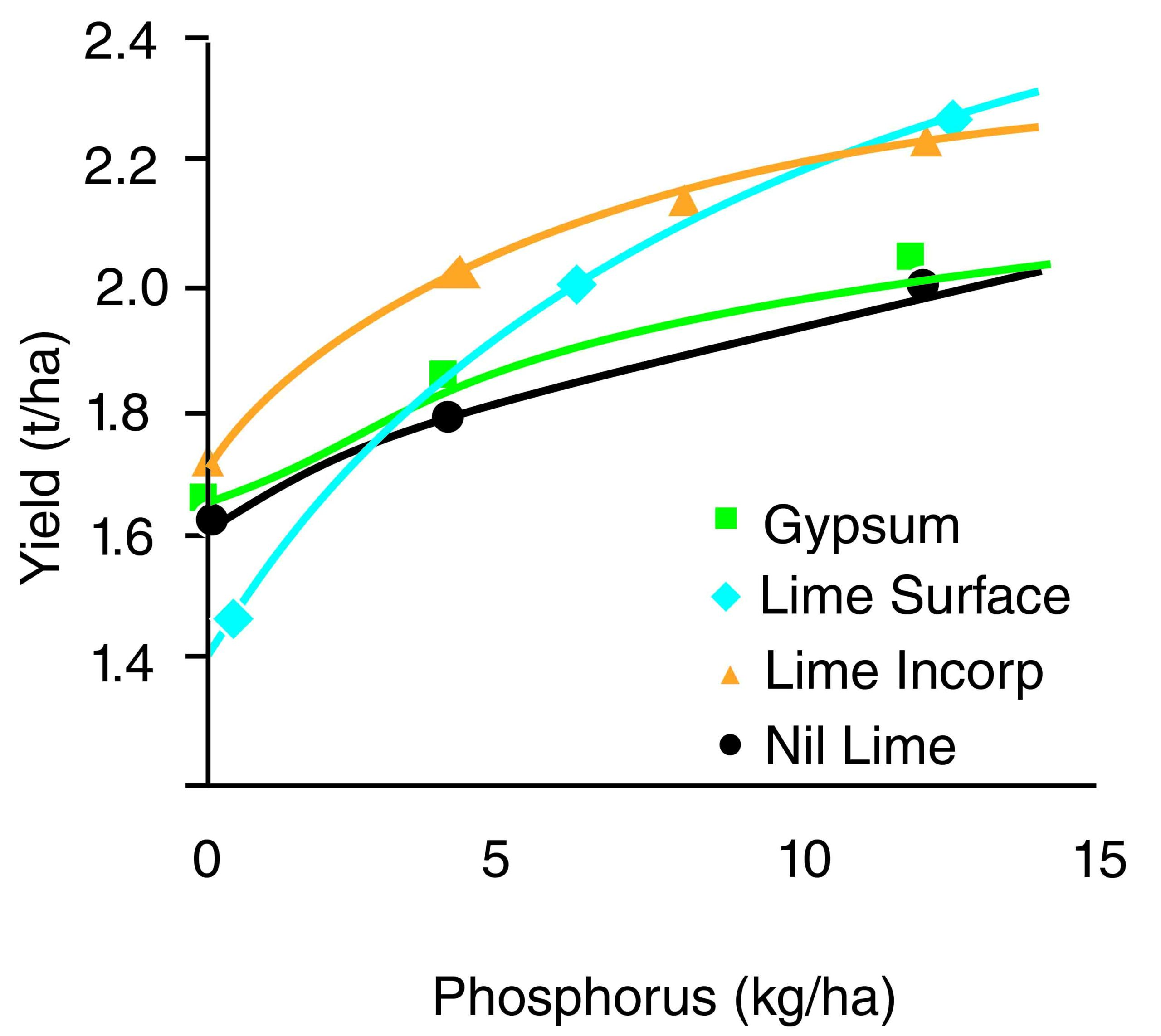
Conclusions:
- Significant yield response to N & P rates (P
- Significant yield differences between lime treatments
- The highest yields were generated from 60 kg/ha N and 12 kg/ha P
Phoshorus x Potassium +/- Nitrogen in Pasture
Looking at the most efficient way to allocate P, K and N fertilizer spend on pasture.
Mt Madden 2017
Nitrogen Response and in-season nitrogen decision tools.
Following a pea crop.
This trial was established to investigate the response of wheat to nitrogen (N) application after peas and develop a local N response curve.
Whilst also looking at the value of using N-rich strips and plant tissue testing as decision tools to guide in-season N application.
For full details of this trial contact your local Area Manager, or our Field Research team on research@summitfertz.com.au
Table 1: Soil Analysis Results
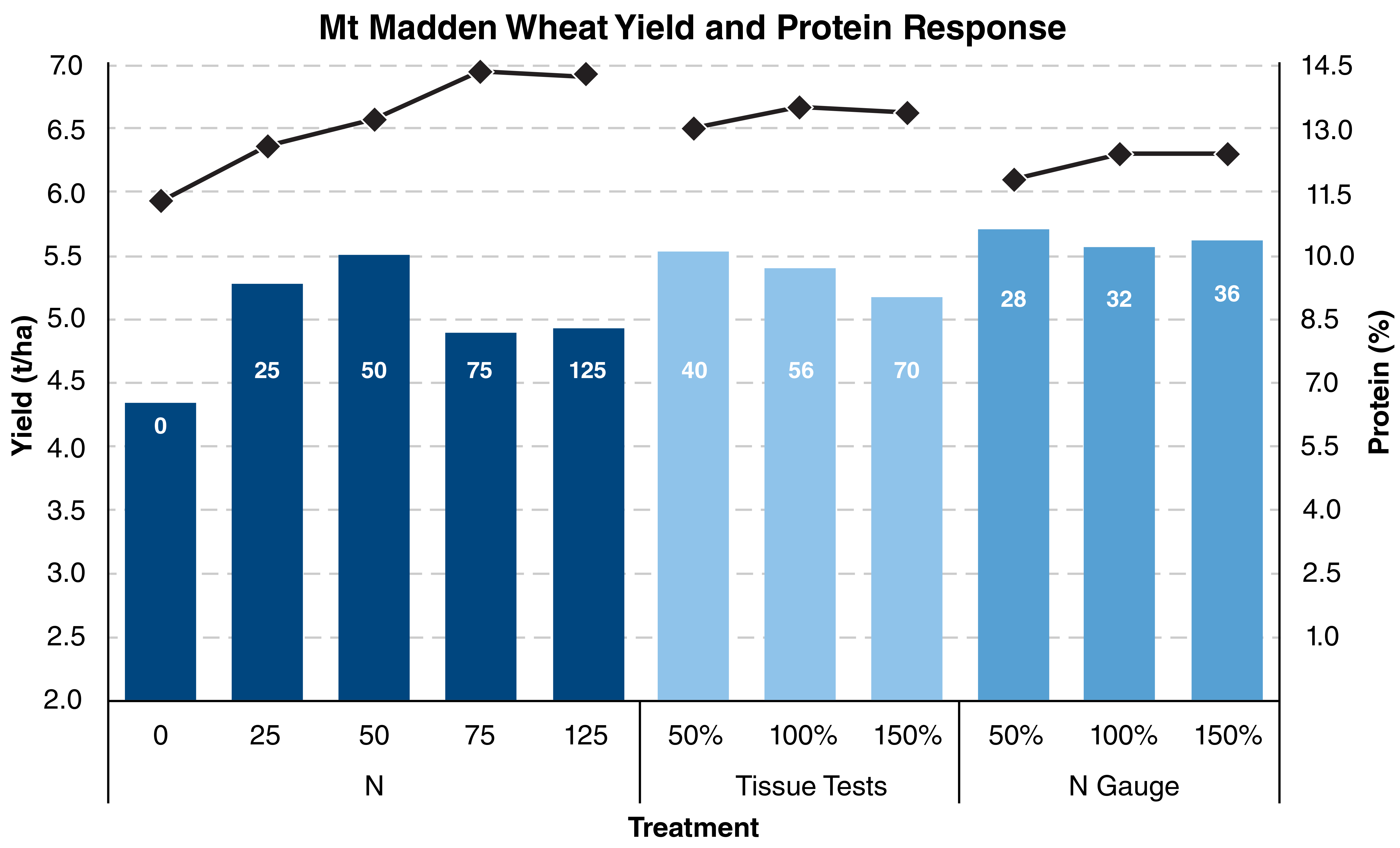
The harvest data showed that there was a statically significant yield response to applied N and there was also a significant difference between replicates.
The highest yield was 5.73t/ha which received the 50% recommendation from the N-gauge treatment at 28kg/ha of N.
The nil N treatment had the lowest yield with 4.35t/ha. On average a yield increase of up to 32% can be achieved by apply N at this site and under this seasons conditions.
The grain quality analysis showed high protein and hectolitre weights, with low screenings.
All treatments had screenings below 5% and hectolitre weights above 74kg/hl and it was protein percentage that determine grading.
Over half had protein percentages exceeding 13% and being graded as H1.
Additionally, there was a trend of increasing protein percentage with increasing application of N.
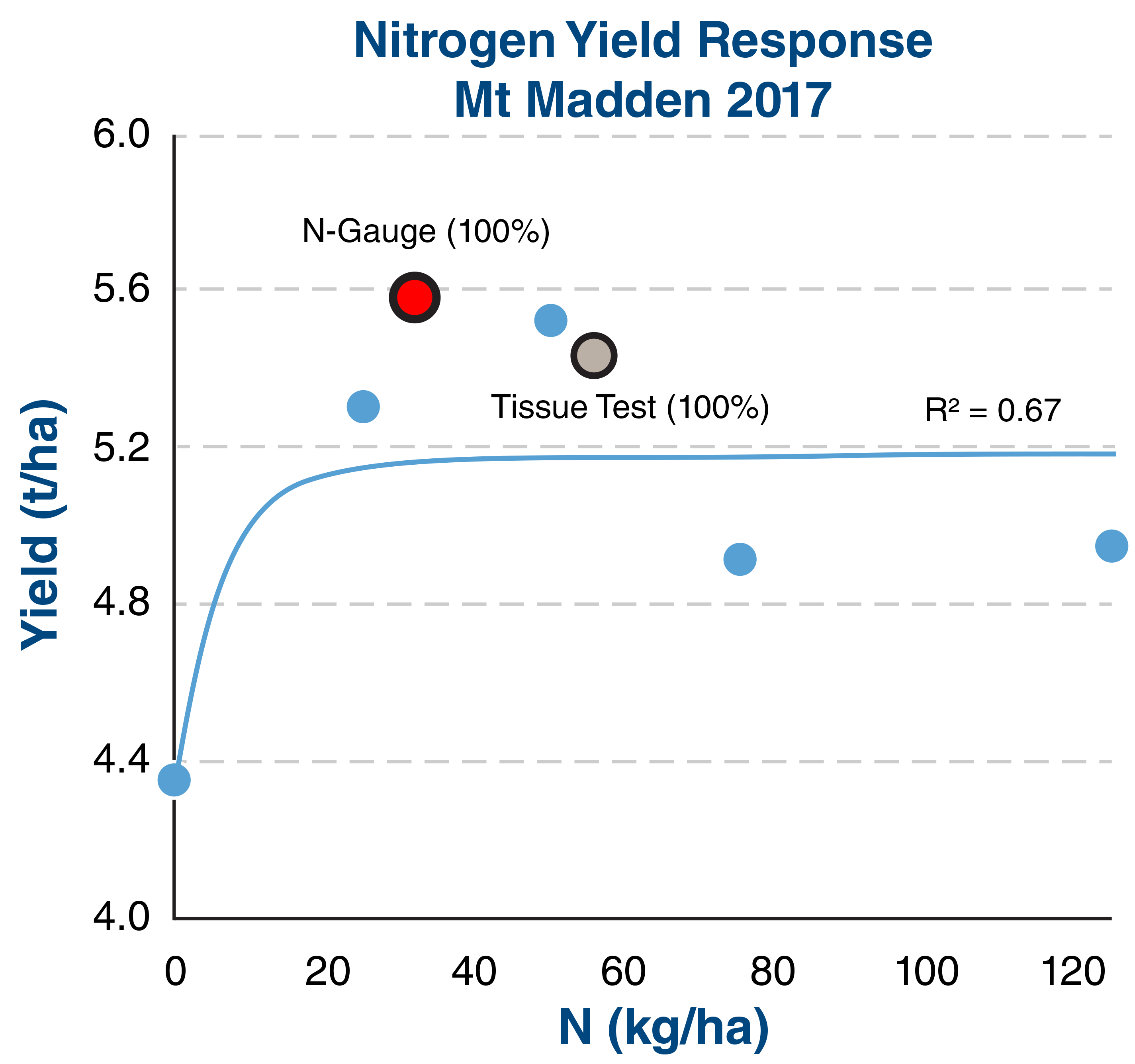
The N-calculator over predicted the optimal rate for optimising yield and gross margins.
The N-calc application of 20L/ha of UAN as recommended by the in-season nitrogen calculator produced 5.58t/ha yield, whereas the predicted yield was 2.81t/ha.
Increasing the application rate by 50% achieved a decrease in yield by and a 50% decrease of the recommended rate produced an increase in yield.
The protein percentage recommendation was also under predicted.
However, N-calc recommendations did fall at or near the inflection point of the standard N rate response curve indicating that rate recommendations were very close to optimal for yield production.
The N response curves shows a yield benefit to applying N up to around 30kg/ha.
- Scepter wheat had a significant yield response to applied N. The highest recorded yield was 5.73t/ha which received 28kg/ha of N, however the yield response curve showed yield plateauing out at 40N. Grain protein content was high (11.3% – 14.4%) and tended to increase with applied N.
- Tissue testing is a very robust method for making in-season N decision but only shows if a crop is deficient. There is no process for gaining a specific top up application rate to counter act this deficiency.
- The N rich strip is a more reliable and accurate process. The N rate recommendations given did fall close to the inflection point on the N response curve. However, the N-calculator did over predict yield, under predicted protein and it was the 50% of the recommended rate treatment that did optimise yield and gross margins.
- Gross margin calculations had the greatest profit at $1444/ha from applying 28N or 50% of the recommended N-calculator rate. By selecting the most appropriate rate of N an additional $398/ha could be made.
- This trial yielded very high, the 0N treatment on average still went 4.35t/ha. Soil analysis showed that Nitrate (NO3-) level were high in the top 10cm. The recommended rate for applying N after peas under these conditions is 40kg/ha.
Mukinbudin 2017
Nitrogen and phosphorus with and without potassium in oats
AIM:
Part of a continuing trial series to evaluate the response of cereals to nitrogen (N), phosphorus (P) and potassium (K) fertilizer under different soil characteristics and rainfall levels over the state.
Additionally, helping to further improve the guidance and advice given to local farmers when making fertilizer decisions.
For further details contact your local Area Manager or the Summit Research Team

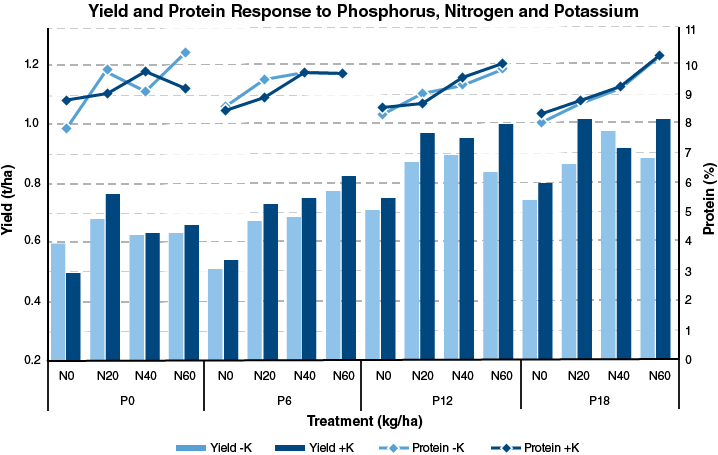
CONCLUSIONS
- Yields were poor across the trial due to low rainfall at the start of the growing season.
1.02t/ha was the greatest tonnage achieved from applying the highest fertilizer rate (N60, P18 & K20). - Response curves indicated that yields had not been maximised by P18, but yield was seen to plateau at N20.
A yield increase of 29% was achieved from applying N60 and 42% from P18. - Soil test results suggested adequate levels of P (37.5mg/kg Colwel P, 0-10cm) yet there was a significant yield response to applied P.
Soil K (86mg/kg Colwell K, (0-10cm) status was also sufficient and a yield response was noted, but was not significant - Gross margin calculations demonstrated poor returns with the greatest profit being $102/ha from applying nil fertilizer.
- Due to lack of early and mid-season rainfall, top-up N application timing was not ideal to gauge the full N response effect and contributed to decreased gross margins.
Muntadgin
Aim:
To investigate responses to phosphorus, nitrogen and potassium in wheat at Muntadgin
Key Messages:
- With surface soil layer P at 25 mg/kg prior to sowing, addition of P fertiliser at establishment significantly increased wheat yield.
- Similarly, N had a major impact on growth and yield, but K did not contribute to increasing yield at this site.
- Maximum yield and gross margins was seen at N 40-60 kg/ha, with establishment P of 6 kg/ha.
- Gross margin analysis suggests improved returns of between $50 and $100 per hectare can be achieved by choosing the most appropriate P and N rates.
Table 1. Soil Test Results
Methods:
A factorial trial design that included four rates of nitrogen,0, 20, 40 and 60 kg N/ha, and three rates of phosphorus, 0, 6, 12 and 18 kg P/ha with either 0 or 20 kg K/ha was established.
Results:
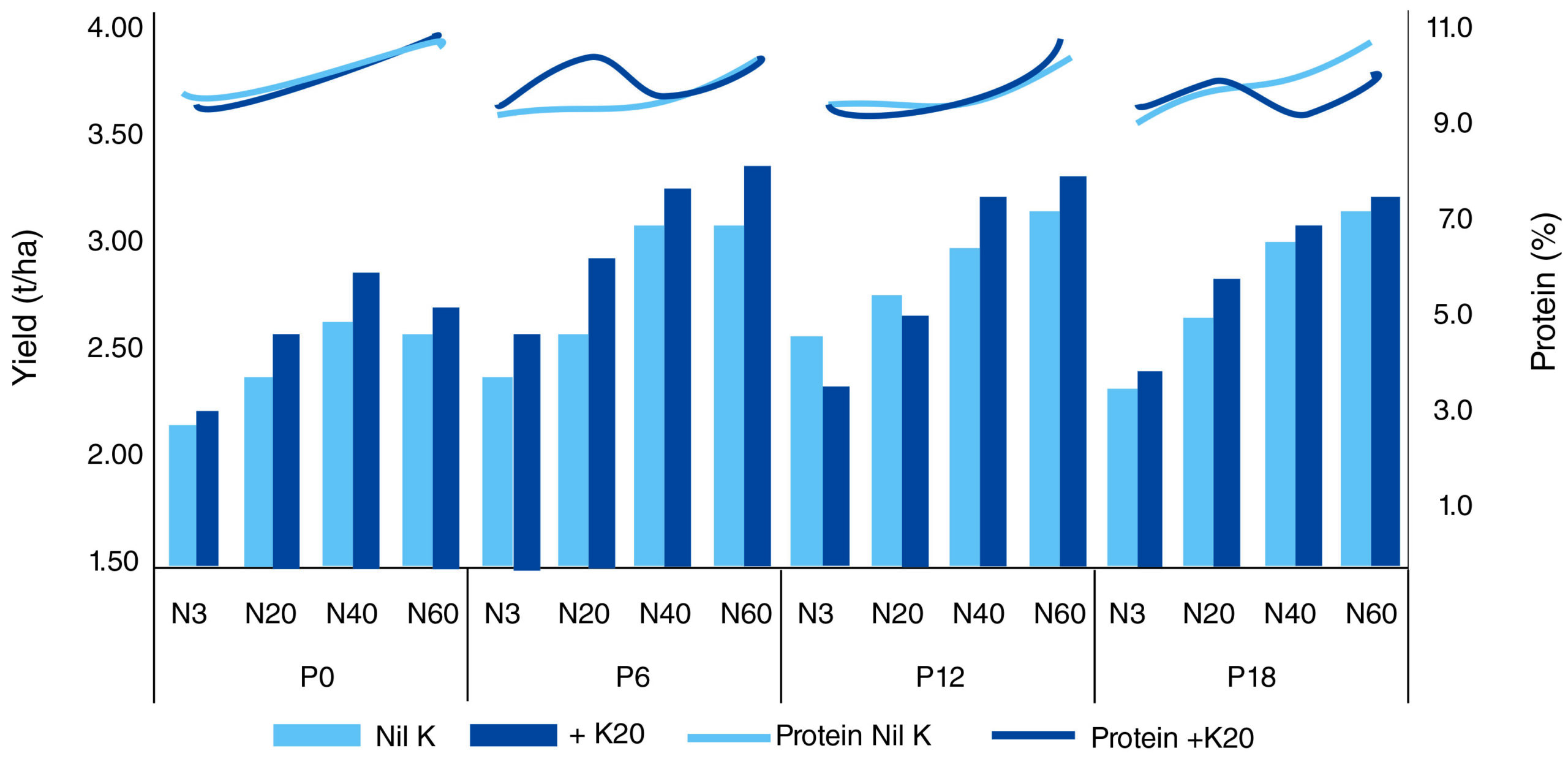
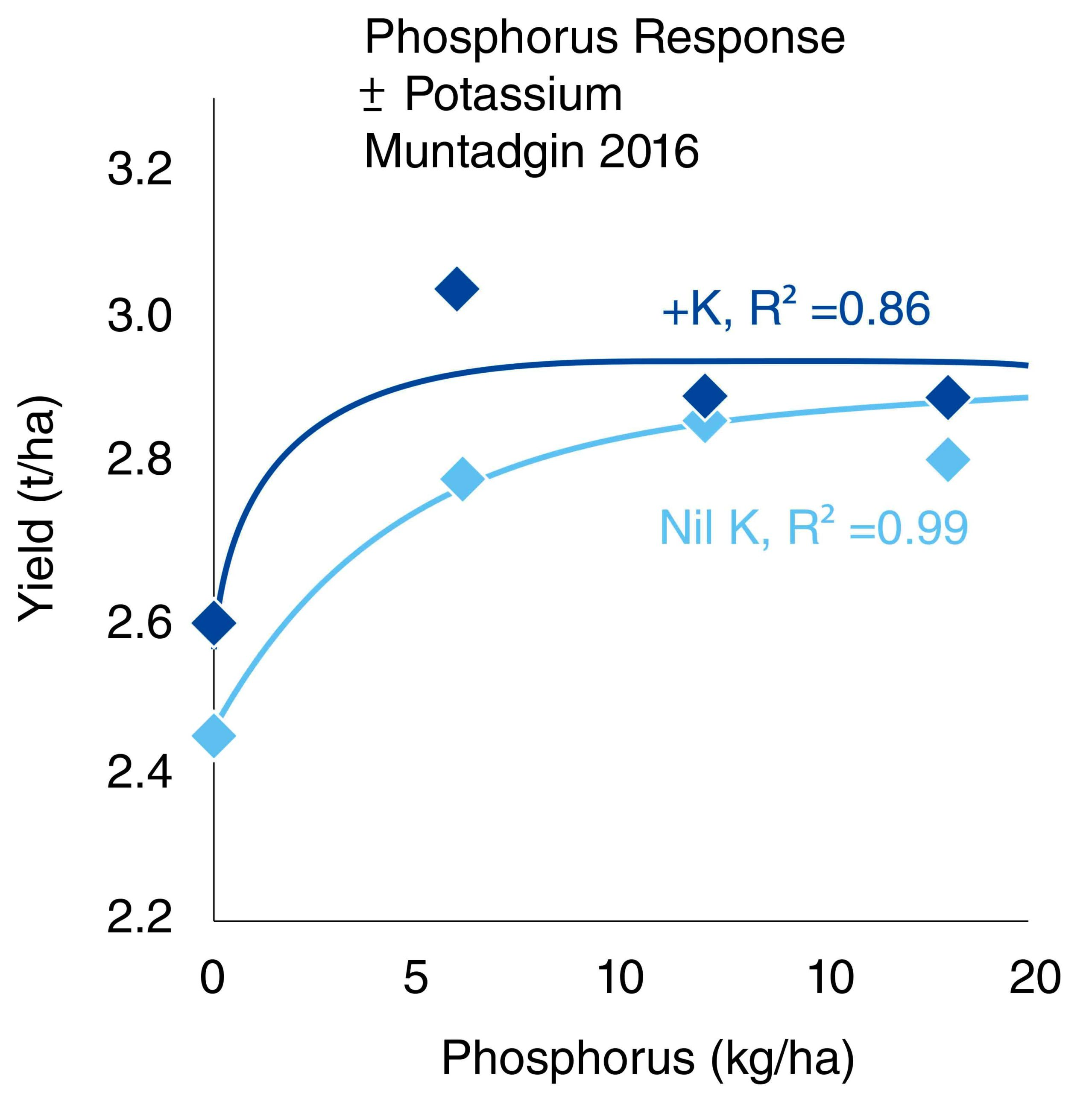
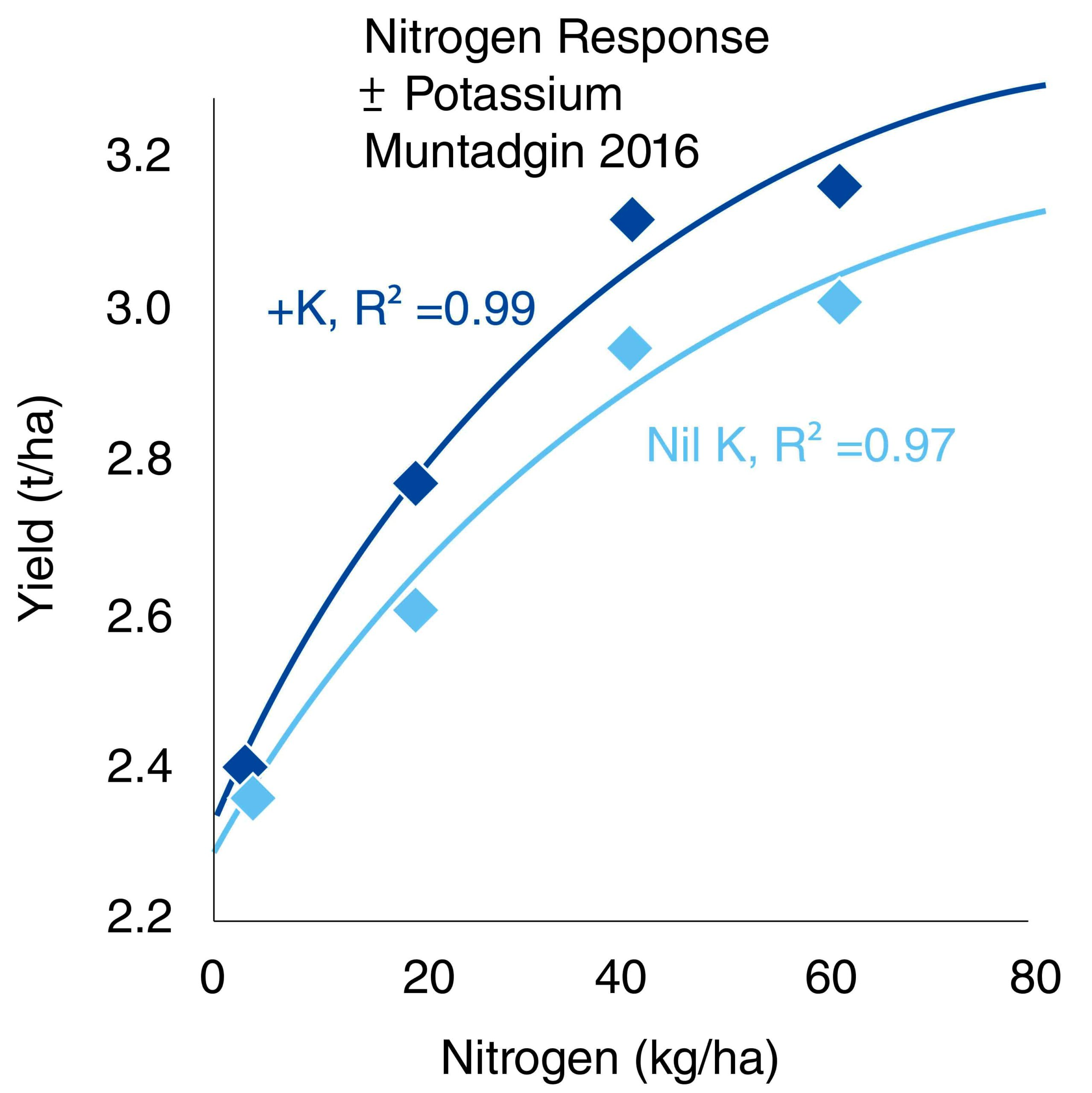
CONCLUSIONS:
- In this trial the application of P and N significantly increased yield, the application of K had less of an impact.
- Maximum yield and gross margins was seen at N 40-60kg/ha and P 6kg/ha, with K 20kg/ha providing a minimal increase.
- Gross margin impact can be up to an additional $50 per hectare by selecting the optimal rate of P, and an additional $100 per hectare for optimal rate of N.
- Adequate P nutrition is imperative, promoting early growth and vigour and setting up the crop to utilise applied N efficiently and gain maximum value from in season N applications.
- K can improve yield response to both N and P and increase returns where circumstances are right.
- The achievement of optimal productivity involves all nutrients and not an emphasis of a single one. Some of which, such as P, are only effective when applied at establishment so establishing good base nutrition at the start of the growing season allows the crop to take maximum advantage of opportunistic applications of in-season top up nutrients to which they will respond, such as N.
Nitrogen and Phosphorus in Pasture
Determining the most efficient way to allocate N and P fertilizer spend on pasture over consecutive years.
Nitrogen, Phosphorus and Potassium in Pasture
Looking at the most efficient way to allocate N, P and K fertilizer spend on pasture.
Nitrogen Rate and Timing on Canola
Effect of different N timings through the growing season on Canola and the subsequent impact on flowering, yield and oil content.
Nitrogen Response and In-season Nitrogen Decisions after Peas in Wheat
Yield response of wheat to N following a pea rotation whilst also determining the accuracy of N-rich strips and plant tissue testing to guide in-season N application.
Nitrogen Timing on Canola
Effect of different N timings through the growing season on Canola and the subsequent impact on flowering, yield and oil content.
Nitrogen x Phosphorus +/- Amelioration in Wheat
Compare N and P rates in wheat after canola. The site had been deep ripped and limed with half the trial sown on a strip left unripped. This allowed nutrition responses with and without amelioration to be compared.
Nitrogen x Phosphorus in Barley
Assessing the yield response of Barley to N and P rates on a heavy red loam.
Nitrogen x Phosphorus in Barley on High PBI soil
Response of wheat to N and P rates with and without the addition of banded K at sowing.
Nitrogen x Phosphorus +/-Potassium and Mn in Wheat
Most effective form for applying Mn and assessing the yield response of wheat to N and P rates with and without the addition of K.
Nitrogen x Phosphorus +/-Potassium in Oats
Response of Oats to N and P rates with and without the incorporation of K at sowing.
Nitrogen x Phosphorus +/-Potassium in Wheat
Response of wheat to N and P rates with and without the incorporation of K at sowing.
Nokaning 2017 Barley
Nitrogen and phosphorus rates in barley on heavy soil
AIM:
To assess the response of barley to nitrogen (N) and phosphorus (P) fertilizer application on heavy, red loamy soil in the Nokaning area.
Whilst helping to improve the knowledge and advice provided to local farmers in regards to their sowing and in-season fertiliser choices.
For further details contact your local Area Manager or the Summit Research Team

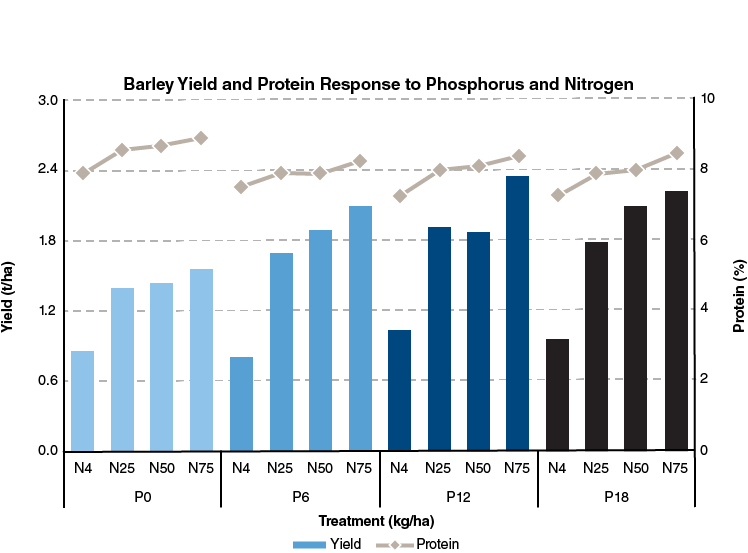
CONCLUSIONS
- Even with below average rainfall the harvest yield data demonstrated a significantly positive response to both N and P.
The highest yield was 2.36t/ha from 75kg/ha of N and 12kg/ha of P, whereas the lowest was 0.81t/ha from N4 and P6.
By applying P6 a yield increase of 24% was achieved, a 37% increase from P12 and 35% increase from P18 when compared to P0.
A greater yield increase was achieved from N with 86% from N25, 100% from N50 and a 125% from apply N75 compared to N4. - The grain analysis presented low protein levels and screenings, with high hectolitre weights.
All treatments went BFED1 as the variety Spartacus is not accredited as MALT. - The highest economical return was $457/ha receiving a treatment of N75 and P12, with the lowest being $176/ha from N4 and P18.
When applying P12 an additional $79/ha can be made on P0 and an extra $198/ha on N4 by applying N75 - This trial demonstrated that in order for a crop to fully utilise additional N, there must be sufficient P available.
The tissue samples display a positive biomass response from applying N and P.
However, treatments that received higher rates of P had higher dry weight compared to others that received nil P. - When relating plant dry weights to tissue nitrate levels it shows the poor ability for the crop to utilise the absorbed N for growth when P is deficient.
Nitrate concentrations remained higher in plants that received lower P rates, as it was not being utilised for plant growth. - Showing there is little advantage to applying N at sowing and throughout the growing season on crops which have not received ample P at sowing, as this additional N is not efficiently used by the plants and is a financial loss.
- Based on gross margin calculation and response curves the optimum fertiliser rate at this site in 2017 is N50 and P12.
Amelup 2017
Nitrogen and phosphorus +/- potassium in wheat
AIM
Part of a continuing trial series to evaluate how cereals, in this case wheat, responds to nitrogen (N), phosphorus (P) and potassium (K) fertilizer applications under different growing conditions.
For more detail on this trial contact your local Area Manager or the Summit Research Team
KEY MESSAGES
- The in-season biomass assessment showed a significant growth response to applied N and P.
- Mace wheat had a significantly positive yield response to N and P fertilizer application.
- The highest yield was 5.07t/ha and a 48% yield increase was noted from N0 to N120.
- The greatest profit was $1138/ha and an extra $312/ha was made from applying N120 compared to N0.

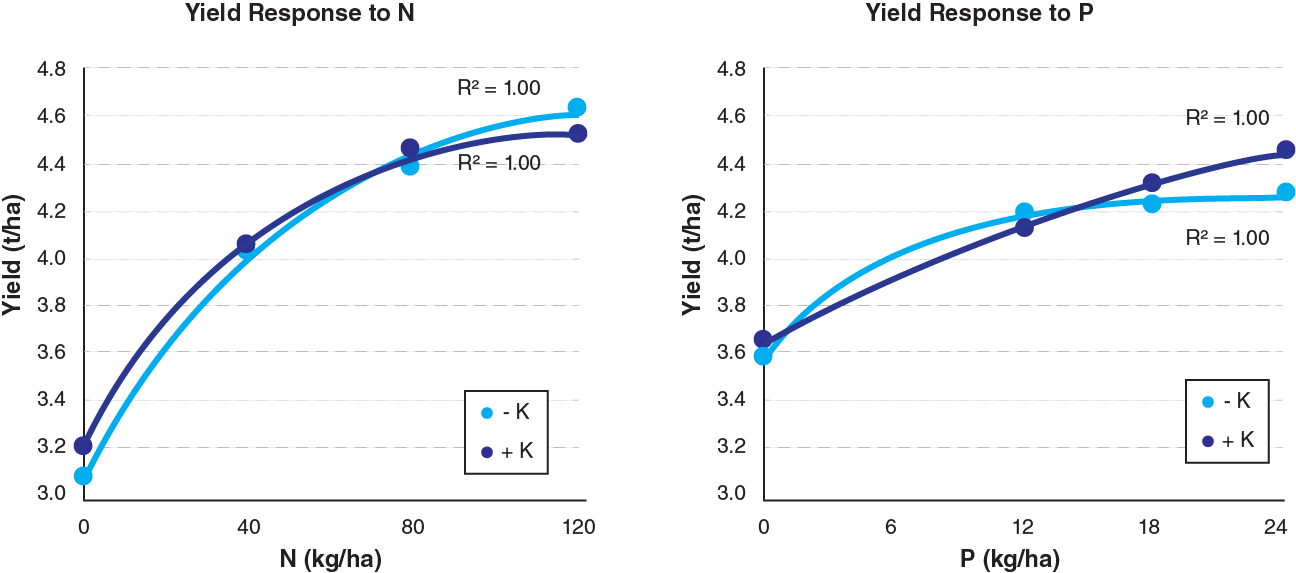
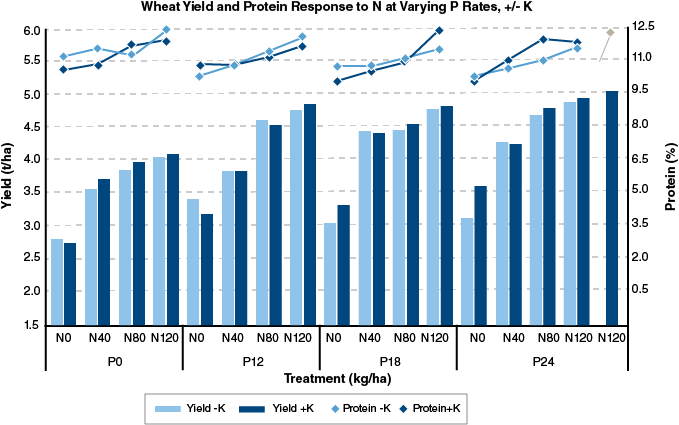
CONCLUSION
- The In-season NDVI biomass assessments showed a strong and significant growth response to P and N and relatively no effect from K.
- Scepter wheat had a significant yield response to applied N and P.
The highest yield was 5.07t/ha which received Vigour at N120, P24 and K25.
On average applying N120 increased yield by 48% and P24 by up to 20% compared to 0N and 0P, with K application having no effect. - Grain protein was moderate (10.1%-12.4%), and there was a significant increase in protein with increasing N application.
Badgingarra 2017
Phosphorus and potassium rates in wheat
Aim:
To investigate the value of incorporating potassium (K) and phosphorus (P) fertilizers at sowing time and to determine the optimum application rates of these nutrients in wheat on sandy soil in the Badgingarra area.
For more details contact your local Area Manager or our Summit Research Team

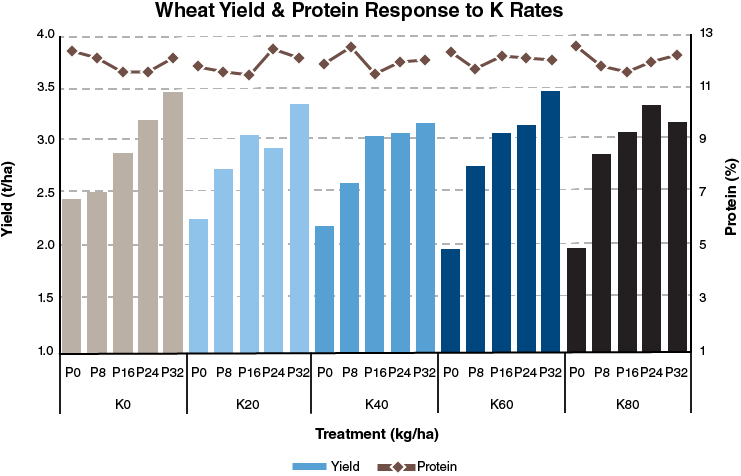
Badgingarra yield displayed as treatment averages, grouped by K and sorted by P.
Evident is the trend of increased yield with increasing P application across all K rates.
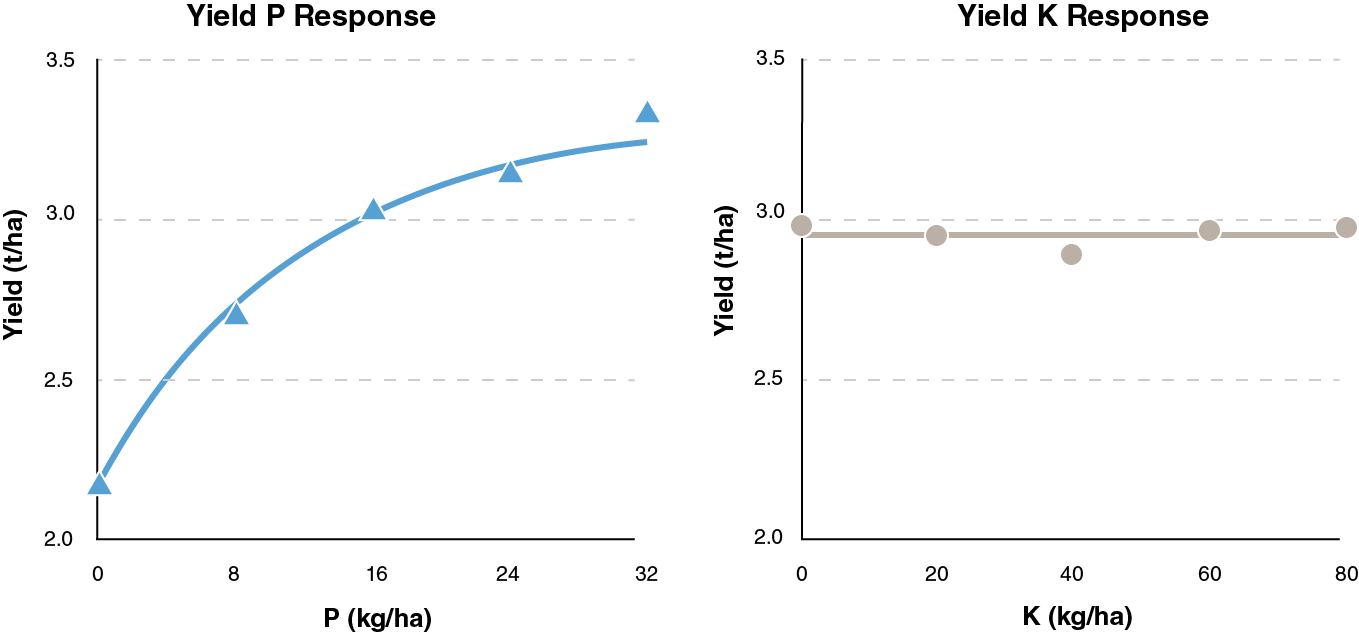
CONCLUSIONS:
- Early biomass assessment displayed a strong growth response to applied P and no response to applied K.
- Scepter wheat yield had a significantly positive response to P.
- The top yield was 3.47 t/ha and a yield increase of up to 53% was achieved from applied P.
- The highest gross margin of $703/ha was generated from 32 kg P/ha plus 20 kg K/ha.
- Establishment P provides the foundation for crop productivity and selecting the right P rate has potential to add up to $280/ha profit to wheat production.
- Average yield and gross margin curves suggest ~16-24 kg/ha of P and ~20 kg/ha of K to optimise yield and returns under these conditions.
Ballidu 2017
Potassium Strategies
AIM
To assess the value of potassium (K) through drilling as a blend or compound and topdressing K at seeding time or after emergence on the growth and yield of wheat in the Ballidu area.
For further details on this trial contact your local Area Manager or research@summitfertz.com.au

BACKGROUND
K supply is increasingly important for maintaining optimal productivity of cropping country. Sandplain soils generally show low extractable K levels.
Potassium is often supplied as topdressed Muriate of Potash (MOP) before seeding, but this may not be the most effective method since the K may be pushed into slower-wetting inter-rows by seeding bars.
In this trial, we supplied K at different rates by topdressing MOP post seeding pre emergence (PSPE), four weeks after sowing (4WAS), drilled at seeding, or in a full NPK compound granule drilled at seeding with or without additional MOP.
We are examining effects on germination, early vigour and later grain production.
Decile 10 Summer rainfall was followed by a very dry growing season. Despite the dry winter, a soft finish in August and September provided respectable yields across the trial.
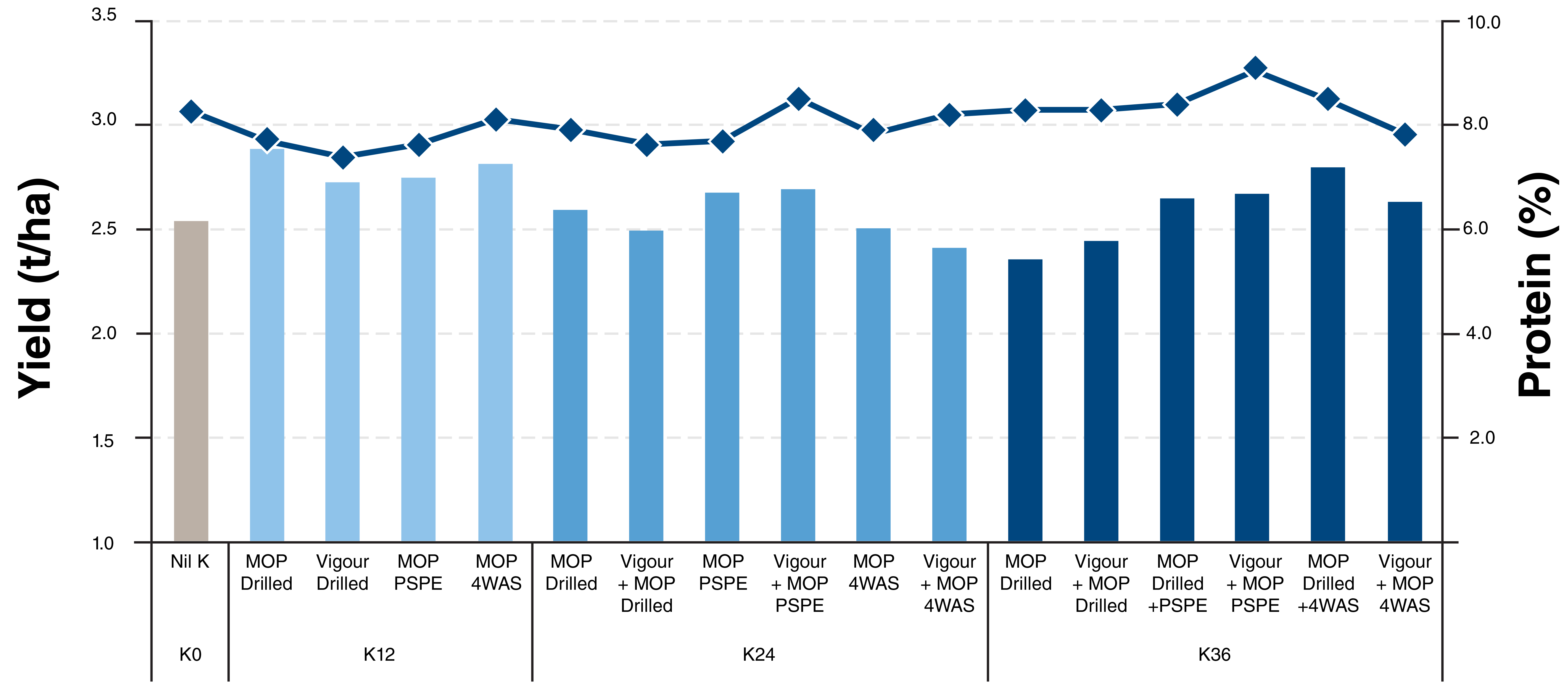
CONCLUSIONS
- Harvest yield and returns were maximised at 12 kg/ha of potassium.
- Early biomass suggested a response to 12 kg/ha of K but no improvement at higher rates. MOP drilled with the seed had a lower biomass than MOP topdressed or drilled in compound form.
- At harvest, there was a positive yield response to K at 12 kg/ha (200-400kg/ha) but no statistical difference between source or placement of potassium (p=0.05).
- Average gross margin response was $750 /ha at 12kg K/ha, whilst at higher potassium rates there was insufficient yield response to cover the extra fertiliser cost.
- At 24 kg/ha of K and above, MOP drilled with the seed had a negative impact on yield compared to the lower rates.
Binnu
Aim: To test and calibrate the extension of nitrogen-rich strips (N Gauges), Normalised Difference Vegetation Index (NDVI) measurement and the In-Season Nitrogen Calculator N-CALC) to assist in mid-season nitrogen decisions and maximise nitrogen efficiency and returns.
Key Messages:
- In a season with close to average rainfall, the application of nitrogen at seeding resulted in the best wheat yield and gross margin.
- Early biomass from the nitrogen applied at seeding set up a higher yield potential. Later top up applications determined by Summit’s In-Season Nitrogen Calculator did not bridge the gap created by lower nitrogen rates at seeding.
- Greatest returns were generated with the higher rate of nitrogen at seeding topped up with the N-calculator rate seven weeks after sowing.
Table 1. Soil Test Results
BACKGROUND:
Summit’s In-Season Nitrogen Calculator aims to calculate a precise N rate to maximize yield potential of a paddock where N may be limiting, using NDVI as on-the-spot growth measurement. Previous trials at Binnu and around the state have shown its value in recommending N rates that were not in excess or deficient to crop requirements and therefore maximised returns, meaning N applied was efficiently used. In 2015 at Binnu, value of the Calculator was demonstrated in determining best timing for N application, after low early N inputs, by repeated measurement of NDVI and running the model. Later applications were possible, but higher N rates were required to optimise yield and returns, increasing grower risk somewhat. In 2016, we looked to determine how the Calculator performs following different rates of early N input to a Mace wheat crop.
Results:
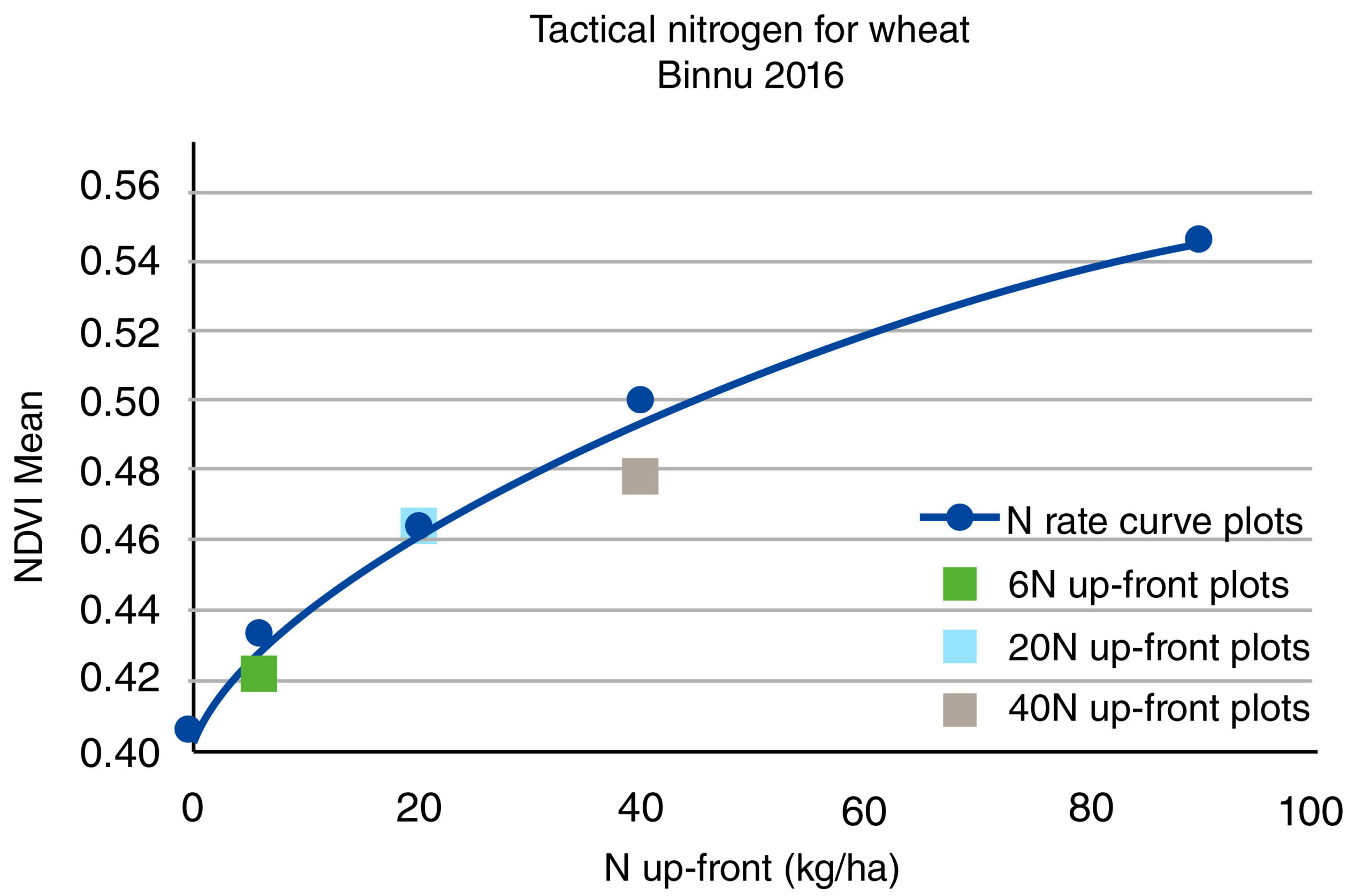
At 7 weeks after sowing, using NDVI assessment comparisons (Figure 2), for rates of [a] 6, [b] 20 and [c] 40 kg/ha N up-front, the In-Season Nitrogen Calculator:
i) projected a maximum potential yield of 4.239 t/ha and
ii) calculated an optimized N application rate of [a] 34, [b] 23 and [c] 19 kg/ha;
iii) predicted this regime would out-yield a crop with no N top-up by [a] 933, [b] 646 and [c] 529 kg/ha (Figure 3).
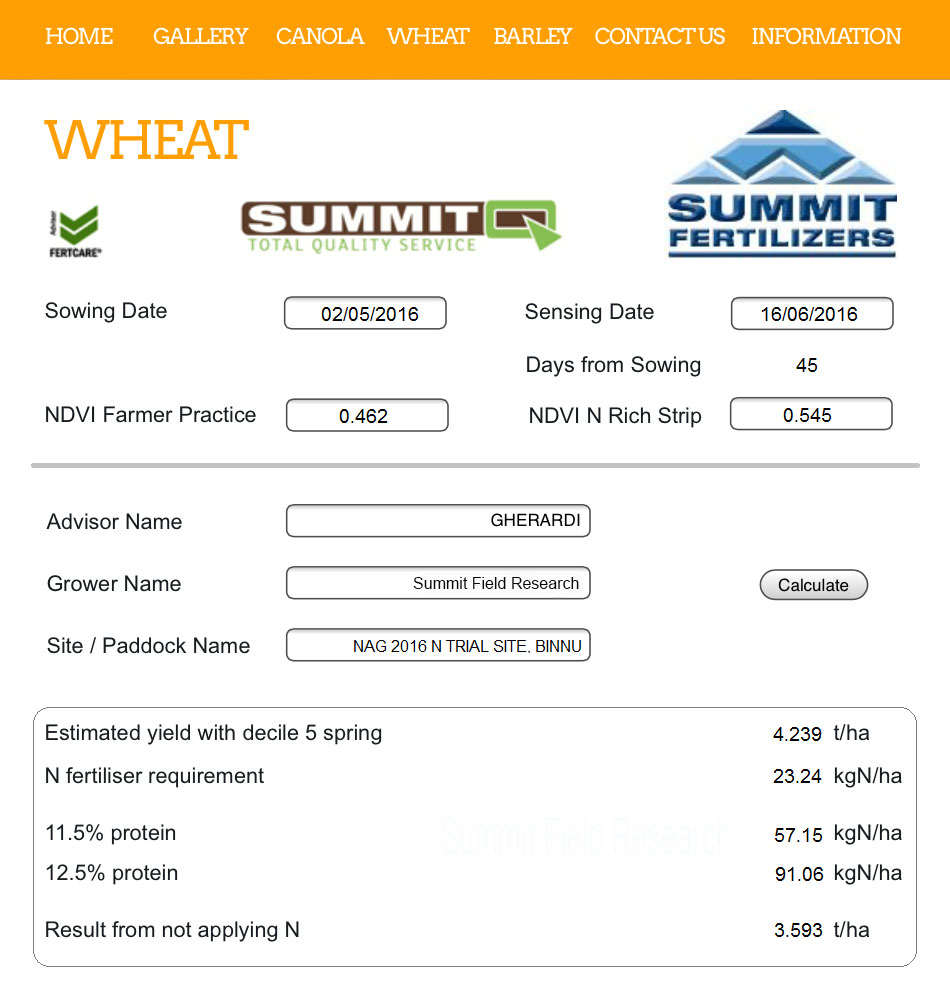
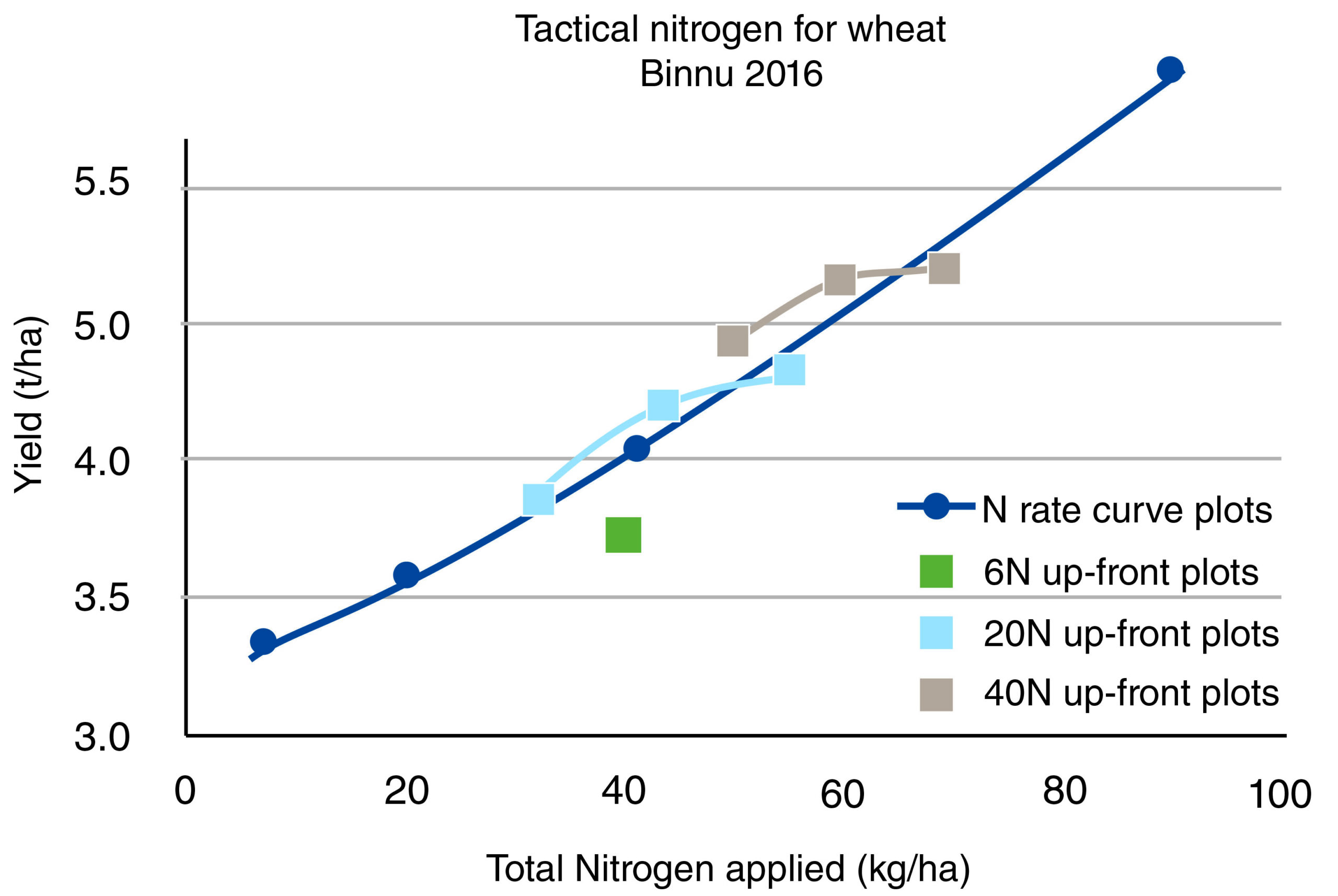
The N rates recommended by the N-calculator optimised yield and gross margin with yield differences being significant when the recommended rate was altered up or down by 50% (Figure 3). This has consistently been shown in Summit field trials for wheat and barley in different conditions over recent seasons and has even shown reasonable applicability to oat grain crops.
- 40N upfront generated higher yields than 20N upfront which in turn yielded greater than 6N upfront (P
- 40N upfront topped up with the N-calculator rate of 19 kg/ha N produced the highest returns for the N-calc treatments.
- An above average finish to the season meant the trial yielded higher than the 4.2 t/ha potential predicted by the N-calculator. Figure 3 plots the N-calculator rates on to the N rate curve and suggests that further N upfront would have continued to increase yield above our N-calculator upfront rates.
- The N-calculator predicted a yield penalty of 646 kg/ha from not applying N on the 20N upfront treatments which was very close to the 610 kg/ha actual penalty. Similarly, predictions for 40N upfront were very close with a yield penalty of 529 kg/ha compared to the actual 590 kg/ha.
- Grain quality data saw some protein response to increasing N but minimal, high hectolitre weights, no difference in screenings except for low N.
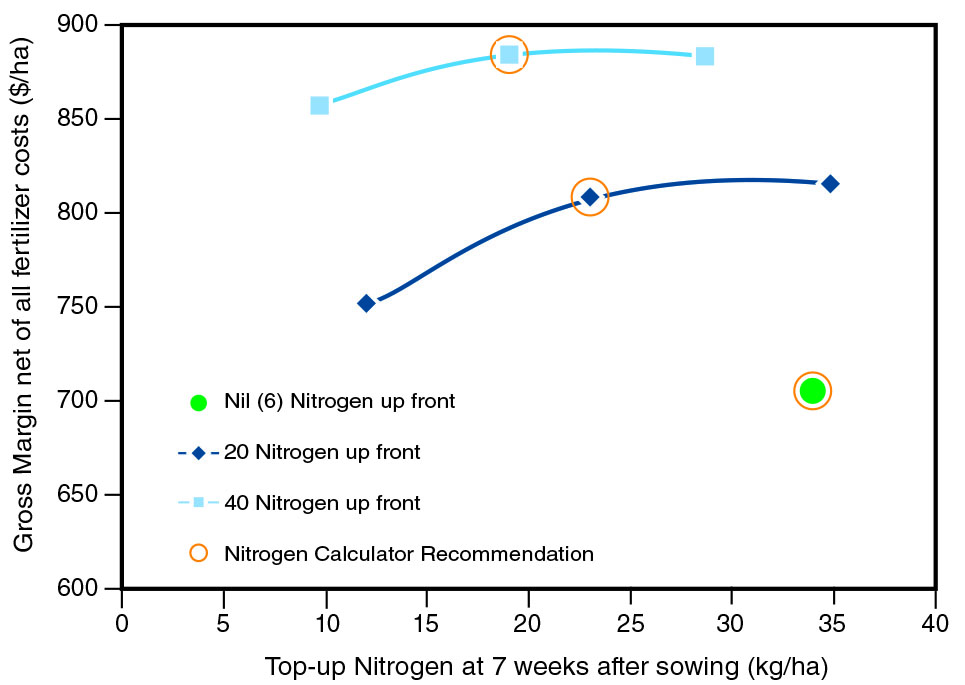
CONCLUSIONS:
- Yield potential was set up by applying nitrogen at seeding.
- Top up nitrogen, even at higher rates did not lift yields to levels achieved when nitrogen was applied at seeding.
- For this trial, the N-calculator prediction maximised or near maximised yield and gross margin in Mace wheat for the N-calculator treatments.
- Getting mid-season N decisions right can have a significant impact on profitability since optimal top up N rates indicatively increased yields by 610 kg/ha and net returns by 94 $/ha for 20N upfront treatments, and 590 kg/ha and 99 $/ha for 40N upfront treatments.
- This trial provides more weight to the building confidence that the N calculator can provide real and robust N recommendations that are not in excess of crop requirement and produce maximum or near maximum margin returns from mid-season N applications.
Borden 2017 P & K
Potassium strategies and phosphorus response in wheat
AIM:
To determine the optimal strategy and form for applying potassium fertiliser in wheat in the Borden area, whilst also investigating phosphorus response.
For more details about this trial contact your Area Manager or Summit’s Research Team

KEY MESSAGES
- Biomass measurements mid-season indicated a strong response to P and K fertiliser and an amplified response where K was supplied in compound form.
- At harvest, a significant yield response to K was measured but no significant difference between source or placement of K was measured.
- Higher P rates stimulaBorden ted greater biomass and advanced maturity, which was detrimental during early frost events, resulting in a negative yield response to P at harvest.
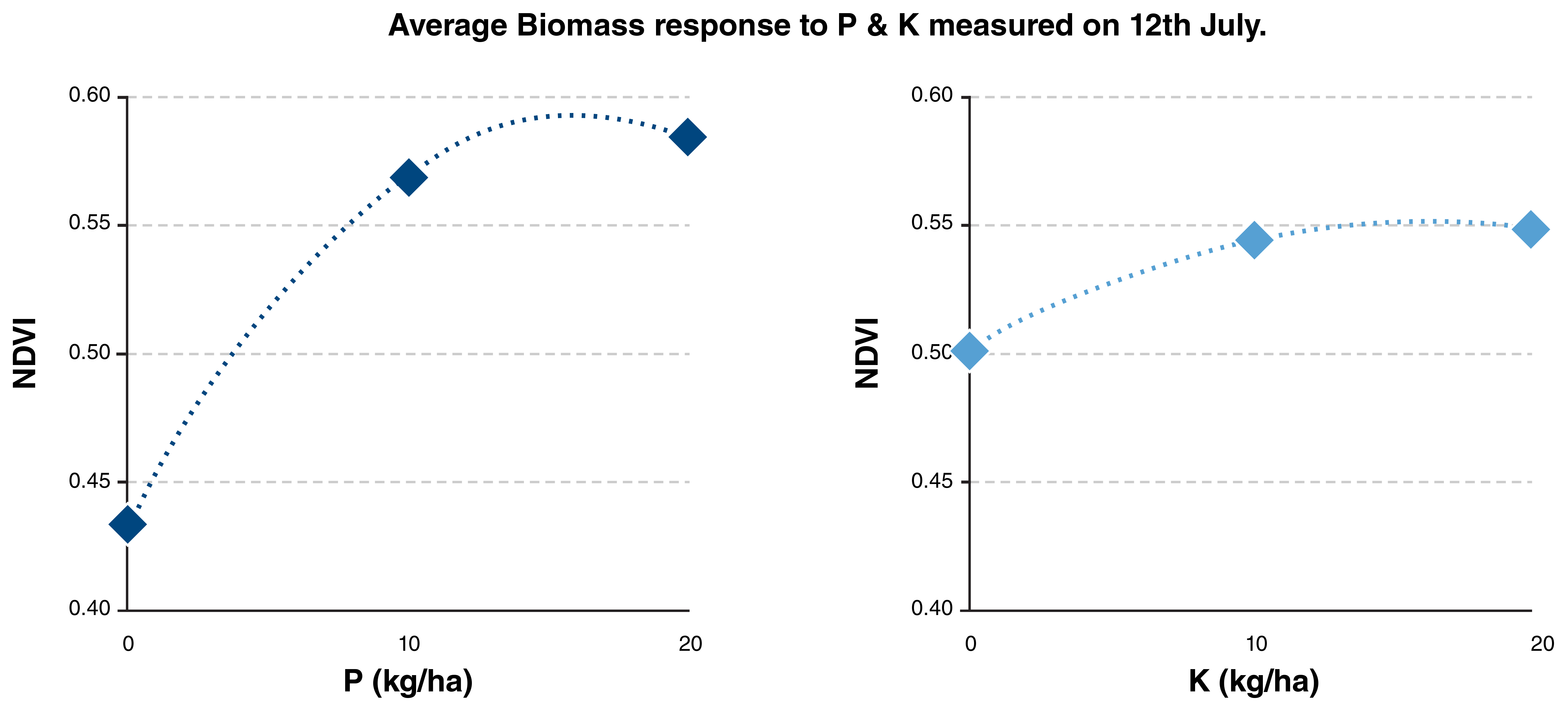
As a result of the moist sowing conditions, early sowing date and sandy soil; this trial was more advanced than the surrounding paddock and other crops in the region, posing a greater risk of damage from earlier frost events.
During field tours in August, some signs of frost damage were apparent across the trial and was confirmed at harvest with lower than expected yields.
Interestingly, there was a negative yield response to P despite the large biomass response measured during the growing season.
Higher P rates advanced to maturity more rapidly, which may have been detrimental during early frost events where flowering heads were susceptible.
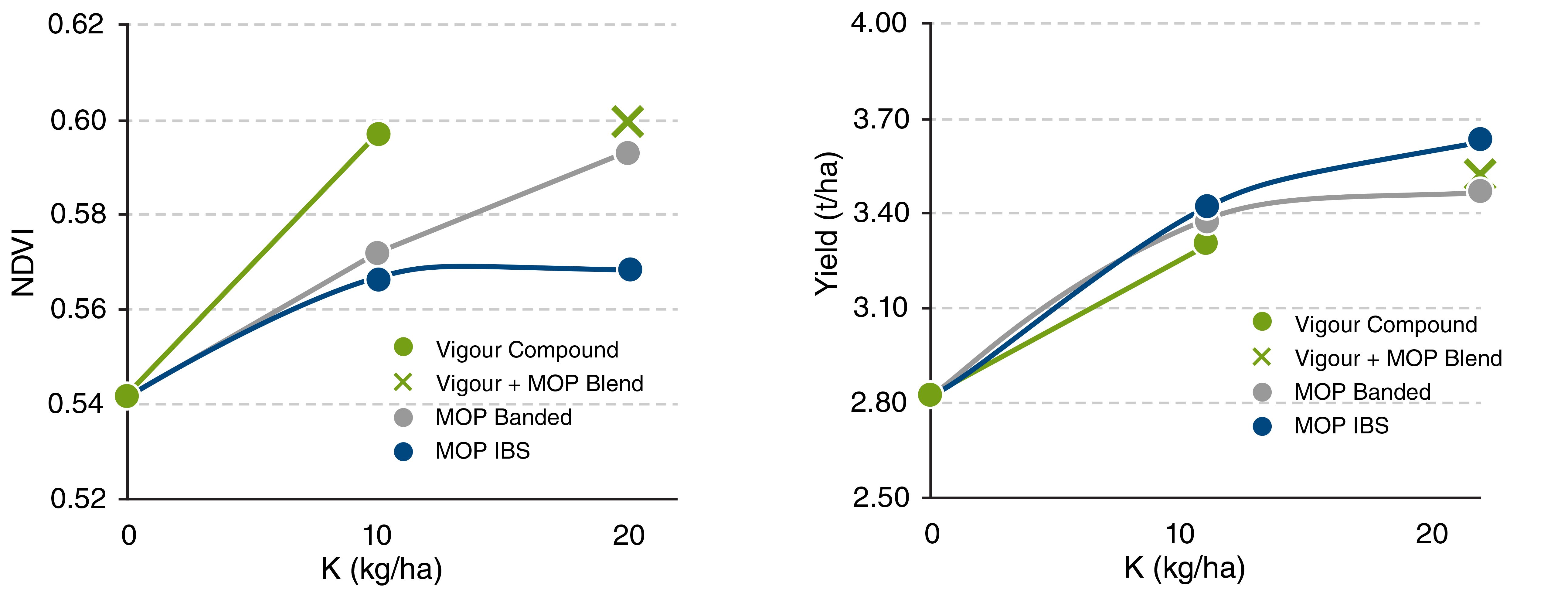
CONCLUSIONS
- Biomass measurements mid-season indicated a strong response to phosphorus and potassium fertiliser and an amplified response where K was supplied in the compound form.
- At harvest, a significant yield response to K was measured but no significant difference between source or placement of K was measured.
- The highest yielding treatment of 3.88 t/ha was generated by 10P with 20K as MOP topdressed IBS, which was an 860 kg/ha improvement compared to 0K.
- Higher P rates stimulated greater biomass and advanced maturity, which was detrimental during early frost events, resulting in a negative yield response to P at harvest.
- Under these conditions, yield and returns were maximised at 20 kg/ha of K and, due to the frost effect, nil P.
- Considering the biomass response to phosphorus during the growing season and yield results from other trials in the area, between 12-15 kg/ha of P would be close to maximising yield and returns without frost damage. A repeat of this trial sown later in the season to limit frost risk would be valuable to determine optimal P rates to maximise grower returns.
Borden 2017 P & K 2
Potassium strategies and phosphorus rates in wheat
AIM:
To determine the optimal strategy and form for applying potassium fertiliser in the Borden area, whilst also investigating phosphorus rates.
For full trial details contact your local Area Manager or the Summit Research Team

KEY MESSAGES
- Greater than 1 t/ha yield response was measured to phosphorus at 20 kg/ha (P
- Yield and returns were optimised at 15-20 kg/ha of P and 10 kg/ha of K.
- Under high yielding scenarios, extra care should be taken to replace P and K exported with the grain to avoid nutrient mining and safeguard subsequent crops.
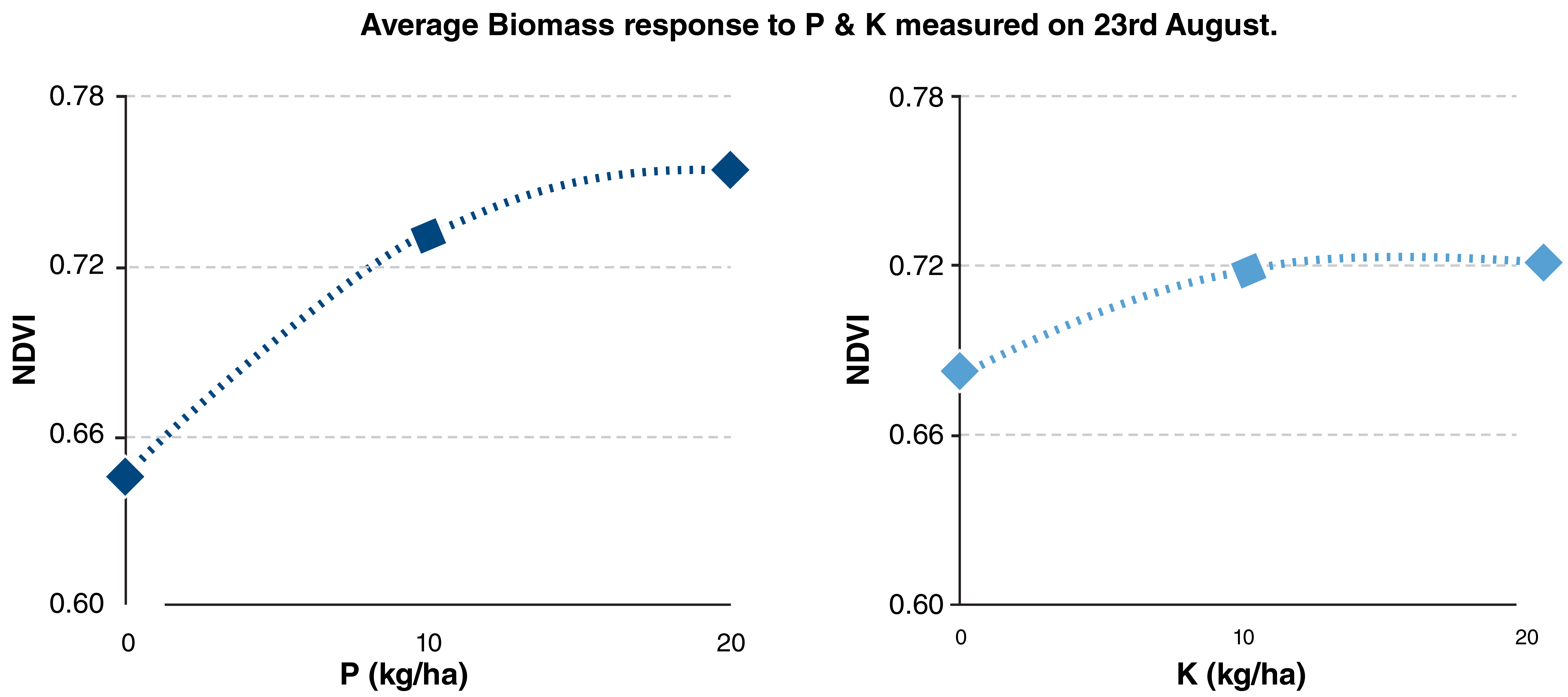
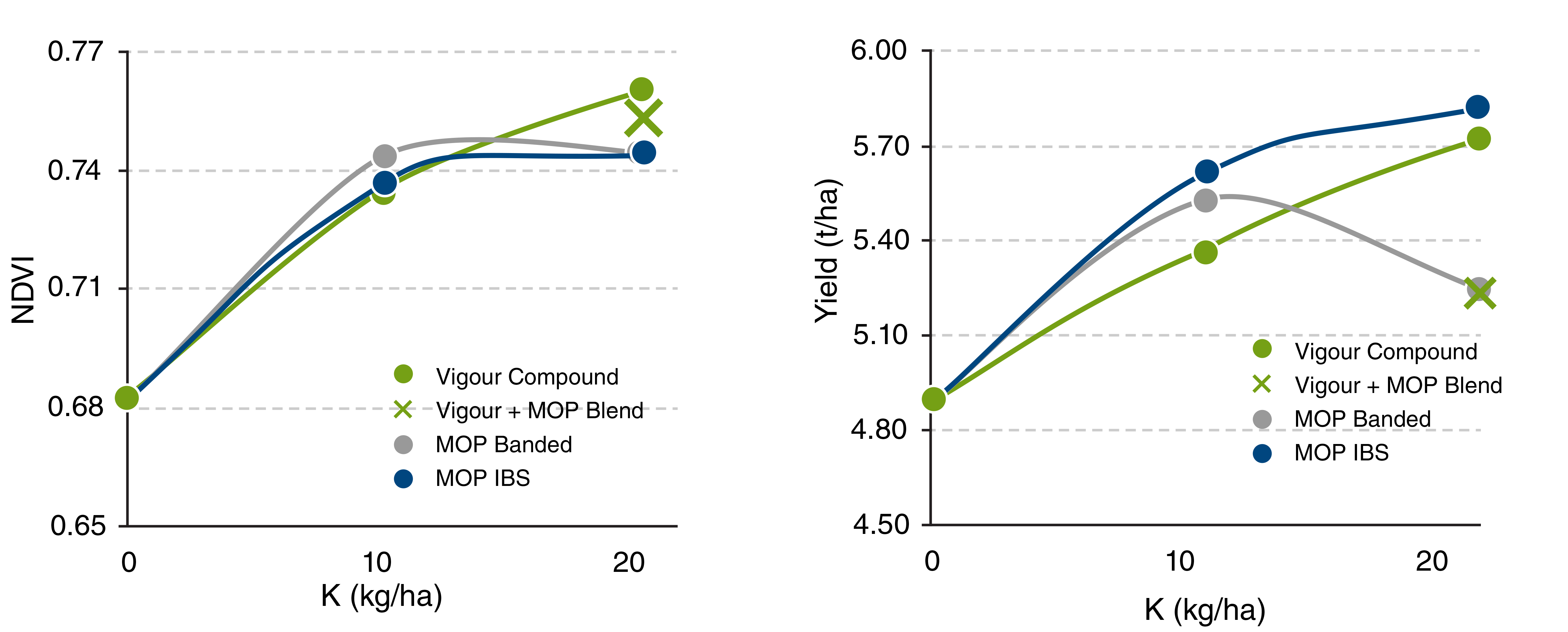
CONCLUSIONS
- Greater than 1 t/ha yield response was measured to phosphorus at 10 and 20 kg/ha compared to 0P.
- A similar NDVI response to K was measured between MOP topdressed immediately before sowing (IBS), MOP banded below the seed, and K supplied in a complete compound granule – Vigour® .
At the high K rate, Vigour treatments looked to have a slight advantage over MOP topdressed or banded but this was not statistically significant. - Despite early biomass indications, there was no significant yield response to K rate or placement. Vigour® and MOP topdressed IBS showed a similar response to K rate whereas MOP banded had faded at the 20K rate (Figure 4b). It is conceivable that 40 kg/ha of MOP banded (20K) could have caused chloride toxicity issues for the seedling, limiting germination and future yield potential
- Phosphorus at 15-20kg/ha supplemented with 10kg/ha of K would be a solid nutrition strategy to maximise returns under these conditions.
Potassium export should be noted particularly with high yielding crops; ~4kg of K is removed with each tonne of wheat harvested. With mid-range soil K levels (71ppm), maintenance K should be applied to avoid nutrient mining and to safeguard future crops.
Cordering
The aim was to compare and contrast the effects of liquid fertilisers (UAN & MAXamFLO) on growth and yield over a three year rotation of Barley (2014) Barley (2015) and Canola (2016).
Cordering 2017
Nitrogen and Phosphorus on Pastures
Cost Based Decision Making
To assess the most efficient way to allocate nitrogen (N) and phosphorus (P) fertiliser spend on second year consecutive pasture rotation in the Cordering area.
For greater detail on this trial contact your Area Manager, or email our research team on research@summitfertz.com.au
Nitrogen and phosphorus fertilisers are utilised on pasture both to maintain soil levels and to improve productivity by allowing a higher stock carrying capacity.
Tactical nitrogen application can be used to generate feed to fill in season feed deficits. Continual cropping can deplete the soil of nutrients and organic matter resulting in altered nutrient requirements when entering back into a pasture phase.
This trial looks to determine the most profitable fertiliser spend on a ryegrass dominated pasture following a medium term cropping phase.
The trial will be continued over successive years to monitor compounding nutrient responses.

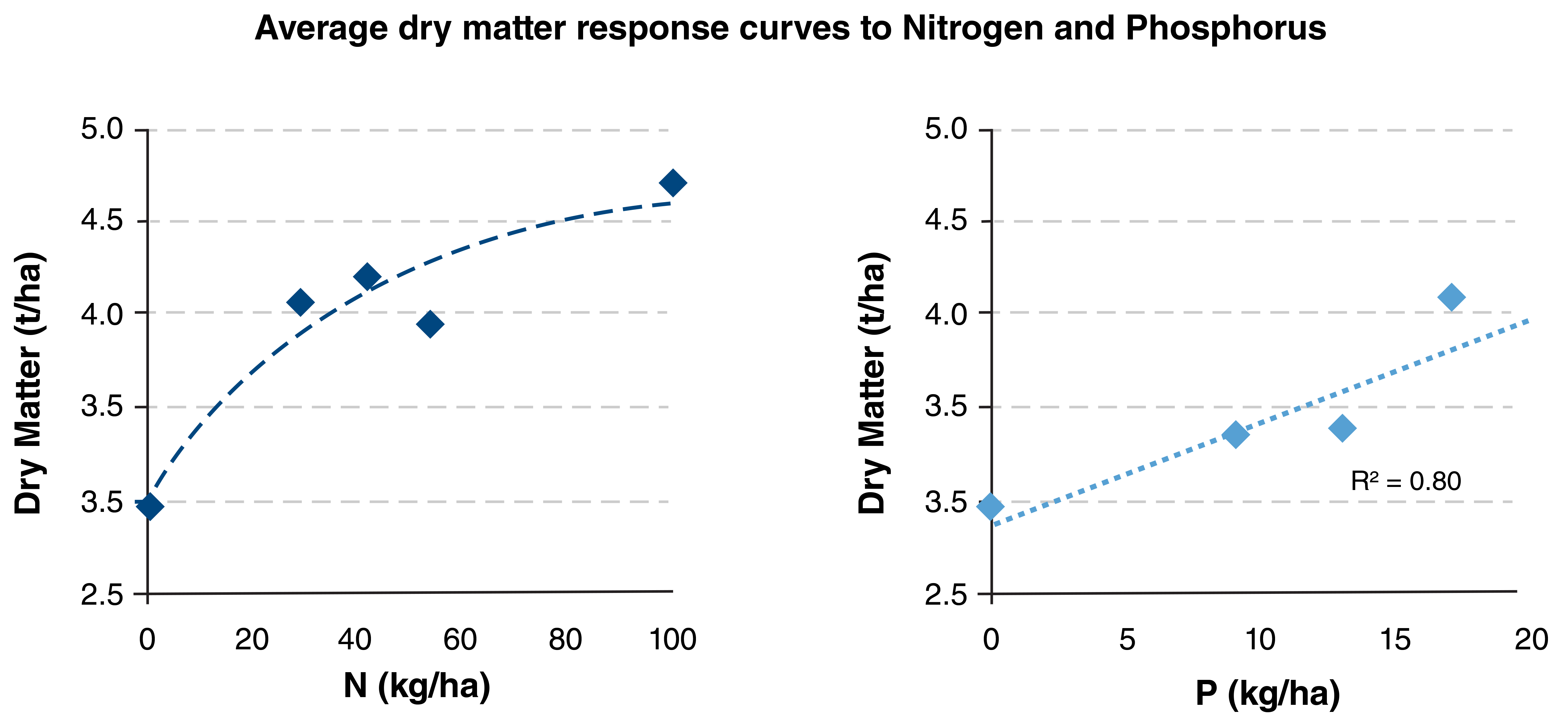
Being a grass based pasture, nitrogen responses were greater than phosphorus.
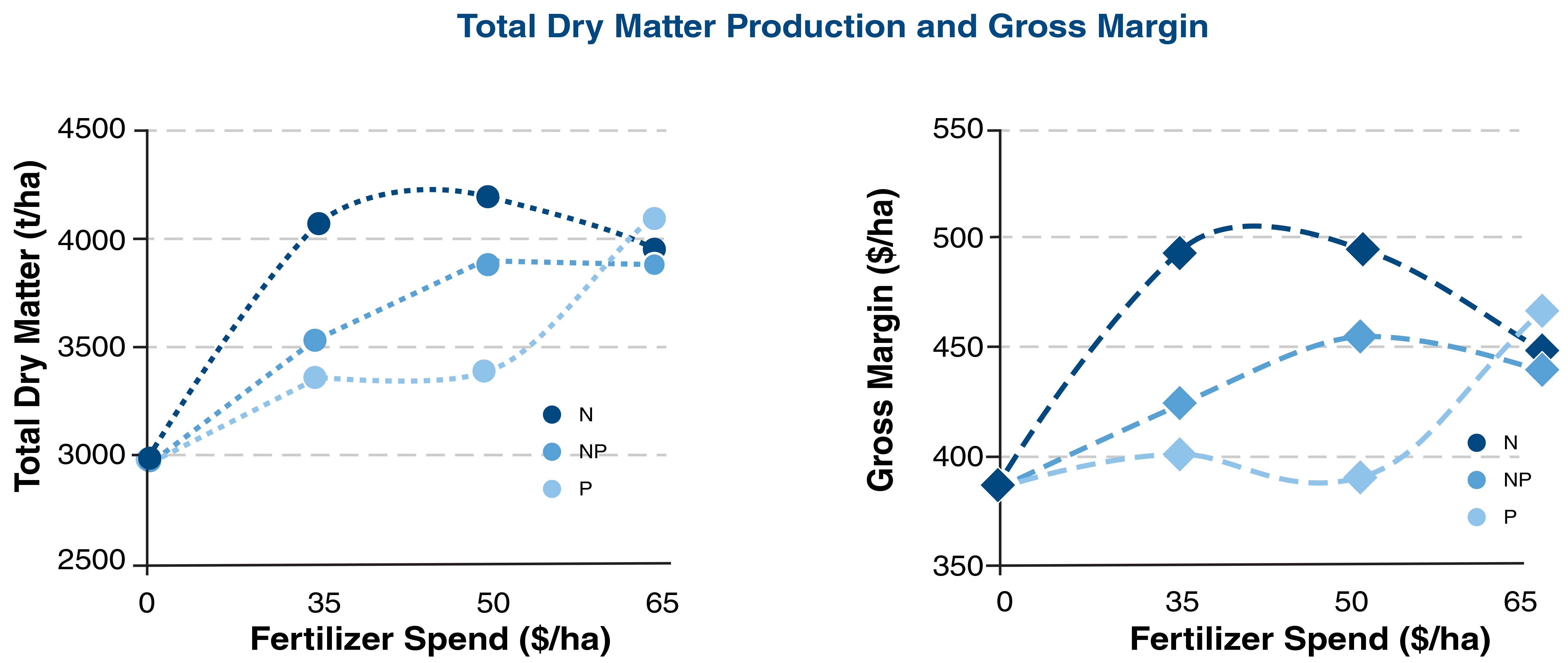
These results don’t account for the decline in soil phosphorus levels if a farmer chooses to use only nitrogen.
The results reaffirm that in a pasture situation, higher rates over smaller areas are likely to have a greater overall impact than low rates over a larger area.
In practical situations using Phosphorus (and Potassium) with strategic HIGH rates of Nitrogen on parts of the farm is likely to give the best results.
Under these conditions for pasture grown the second year after a medium term cropping phase, 35 to 50 $/ha spent on nitrogen generated the highest dry matter and returns.
For the most profitable N application, a balance between application when the requirement for extra feed is greatest and when growth conditions are more favourable need to be weighed against each other.
Lower response efficiencies during winter when soils are cold and wet may be offset by the increased value of the feed generated.
The results reaffirm that in a pasture situation, higher rates over smaller areas are likely to have a greater overall impact than low rates over a larger area.
Corrigin Pasture 2017
Phosphorus and Potassium on Biserrula Pasture
AIM
To assess the most efficient way to allocate fertiliser spend on biserrula pasture at Corrigin.
For full details of the trial contact your local Area Manager or research@summitfertz.com.au

BACKGROUND
Phosphorus and potassium fertilisers are utilised on pasture both to maintain soil levels and to improve productivity by allowing a higher stock carrying capacity.
Continual cropping can deplete the soil of nutrients and organic matter resulting in altered nutrient requirements when moving back into a pasture phase.
This trial looks to build data on the nutrient response of biserulla to phosphorus and potassium and to determine the most profitable fertiliser under these conditions.
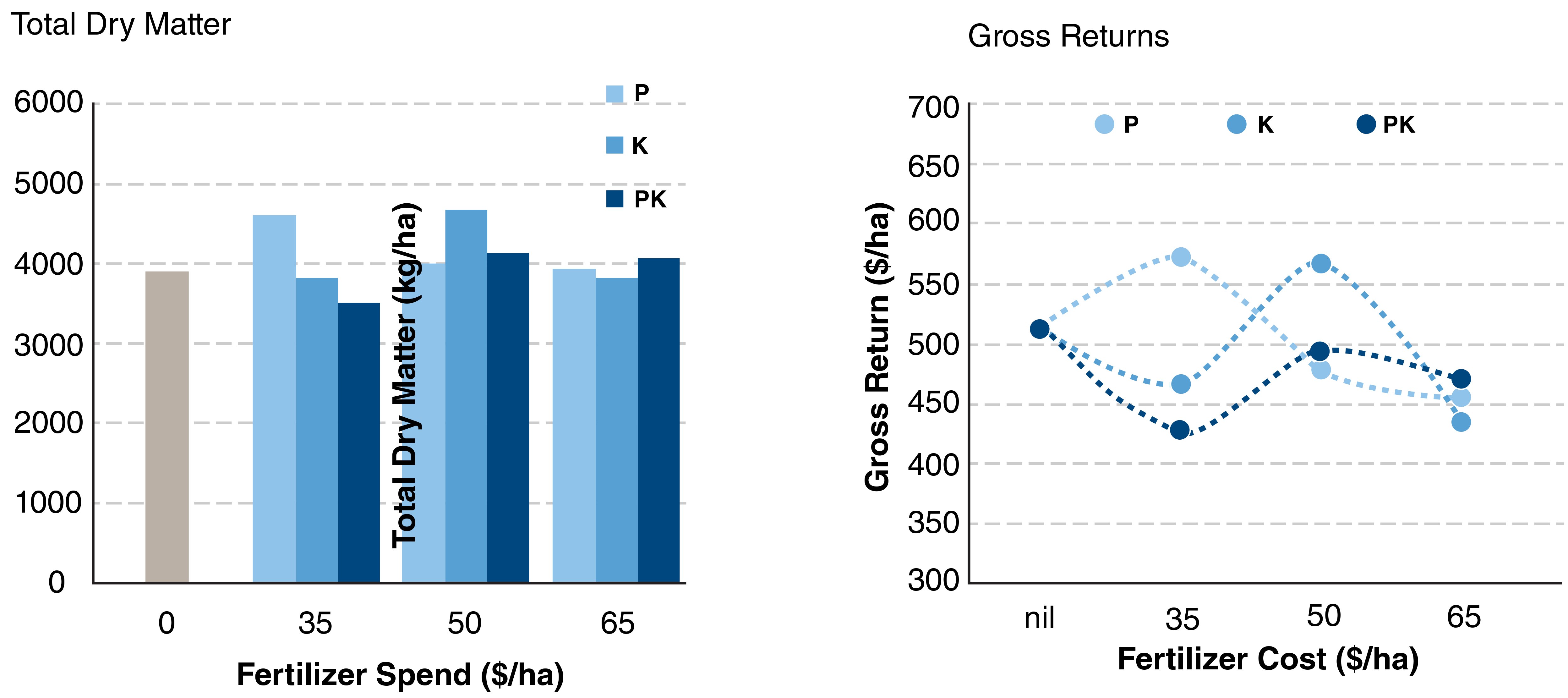
CONCLUSIONS
- Very high summer rainfall was followed by a dry start to the growing season resulting in late pasture establishment.
NDVI biomass and dry matter measurements were taken on the 29th August after rainfall in July and August had improved pasture growth.
NDVI indicated a positive biomass response to $35-50 /ha of phosphorus, with $35 /ha of potassium and $50 /ha of P and K blended also considerably improving biomass - No significant response to phosphorus or potassium was measured when total dry matter was calculated (p>0.05).
- Although phosphorus and potassium treatments did not drive a significant dry matter response, there was enough of an increase at $35 and $50 /ha to maintain similar returns to nil fertiliser whilst safeguarding soil nutrient levels for later seasons.
- Repeating this trial into subsequent seasons to measure compounding effects of varying nutrient applications, and during a season without delayed establishment, would be beneficial to build data and determine optimal fertiliser rates to maximise returns on biserrula.
Darkan 2017
Nitrogen and phosphorus +/- potassium
AIM:
To assess the response of wheat to nitrogen (N), phosphorus (P) and potassium (K) fertilizer application in the Darkan area, whilst evaluating the effectiveness of manganese (Mn) as a compound form (MnO) or as a blend (MnSO4).
For further details contact your local Area Manager or the Summit Research Team

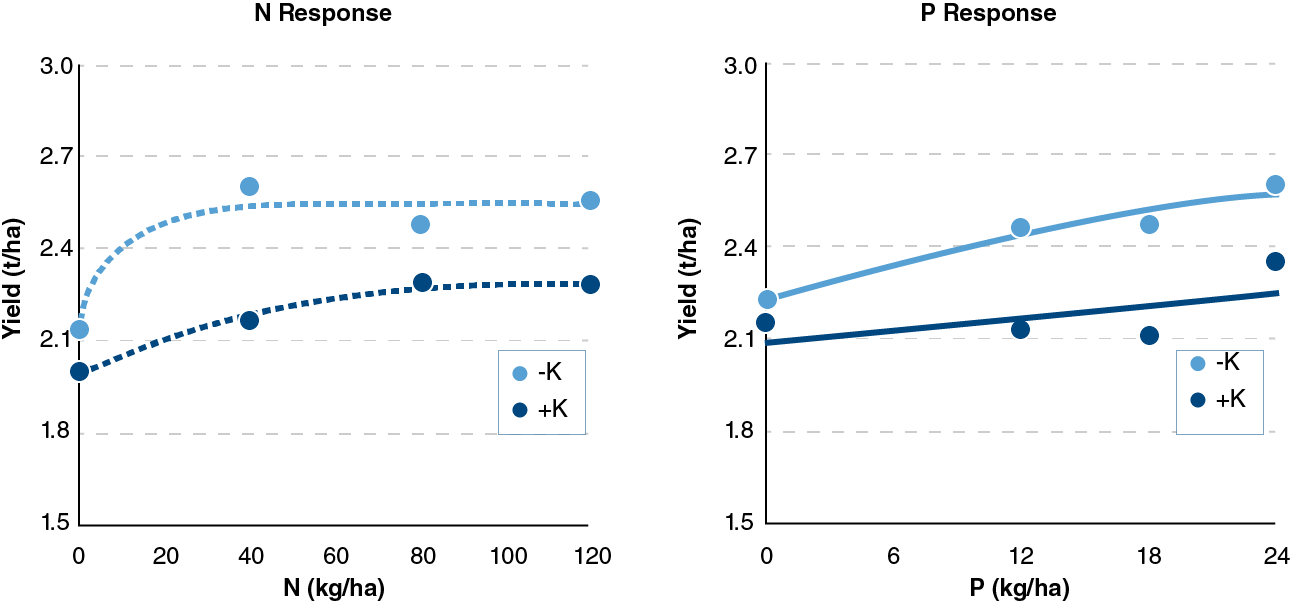
CONCLUSIONS
- Despite the large biomass response to phosphorus during the growing season, harvest results were variable with considerably lower than expected yields.
- Although a positive yield response was measured to applied N , the large improvement from P during the season had diminished and a decrease in yield was measured for applied K.
- Under these conditions, ~40kg/ha of N and ~12 kg/ha of P without additional K, optimised returns.
- A repeat of this trial under closer to normal yielding conditions would be valuable to determine optimal N, P and K nutrition considering the large responses during the season.
- Summit will continue to research manganese sources and availability both in the field and at the glasshouse level.
Eradu 2017 Potash Rates
Potassium interpretative methods & response in wheat
AIM
This trial investigates the response of wheat to potassium (K) fertilizer application on sandy soil in the Eradu area.
Additionally, looking at the capacity of different interpretative methods at measuring soil K concentrations accurately.
Also apart of series of yearly trials looking to determine a more accurate critical value for K.
For further details contact your local Area Manager or our Summit Field Research team
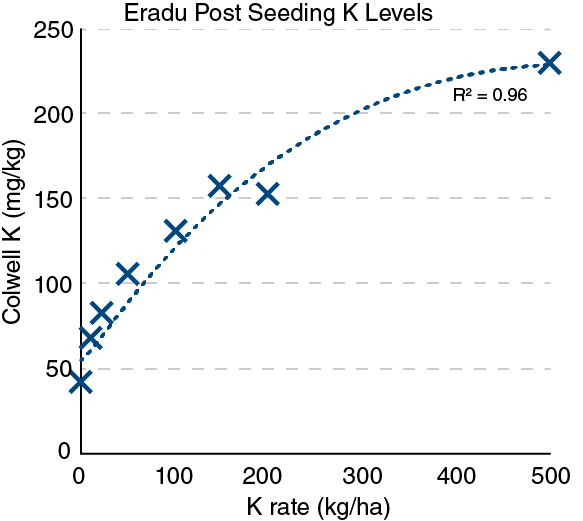
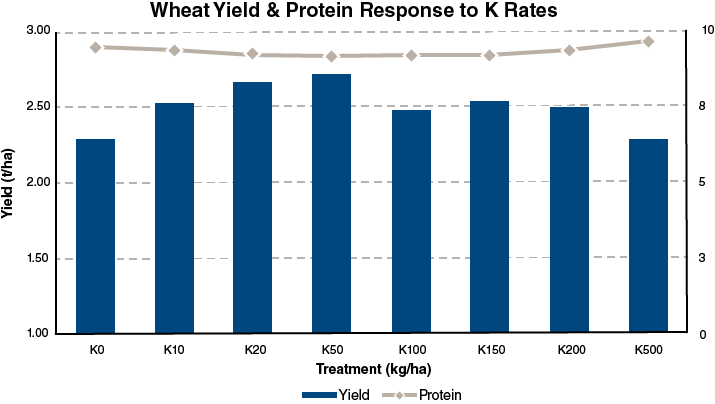
CONCLUSION
- With the bulk of pre sowing soil samples having levels below 40-50mg/kg Colwell K a yield response to K would be expected.
A notable variability between K measuring methods of Colwell K and Exchangeable K was apparent. - Post sowing soil samples demonstrated that K application had altered the levels of K in the soil.
Showing an increase in soil sample Colwell K values with increasing K application. - The NDVI data showed a significant biomass decrease with increasing K rates (p
- Scepter wheat had a significant yield response to applied K.
The highest yield was 2.71t/ha which received 50kg/ha of K. - Plant biomass was considerably less at higher K rates earlier in the season, this decrease is not express as strongly in yield.
- Higher K rates did have an unfavourable effect on early plant growth and harvest yields.
MOP can have a toxicity effect on germinating crops, especially in low rainfall seasons.
Esperance 2017
High Nitrogen Input with PGR and Fungicide
To achieve high yields through nitrogen (N) application and to develop a N response curve.
Additionally, looking at the value of using fungicide and PGR and the accuracy of N rich strips, plant tissue testing and nitrate testers as decision support tools to guide in-season N application.
For full details of this trial contact your local Area Manager or our field research team on research@summitfertz.com.au

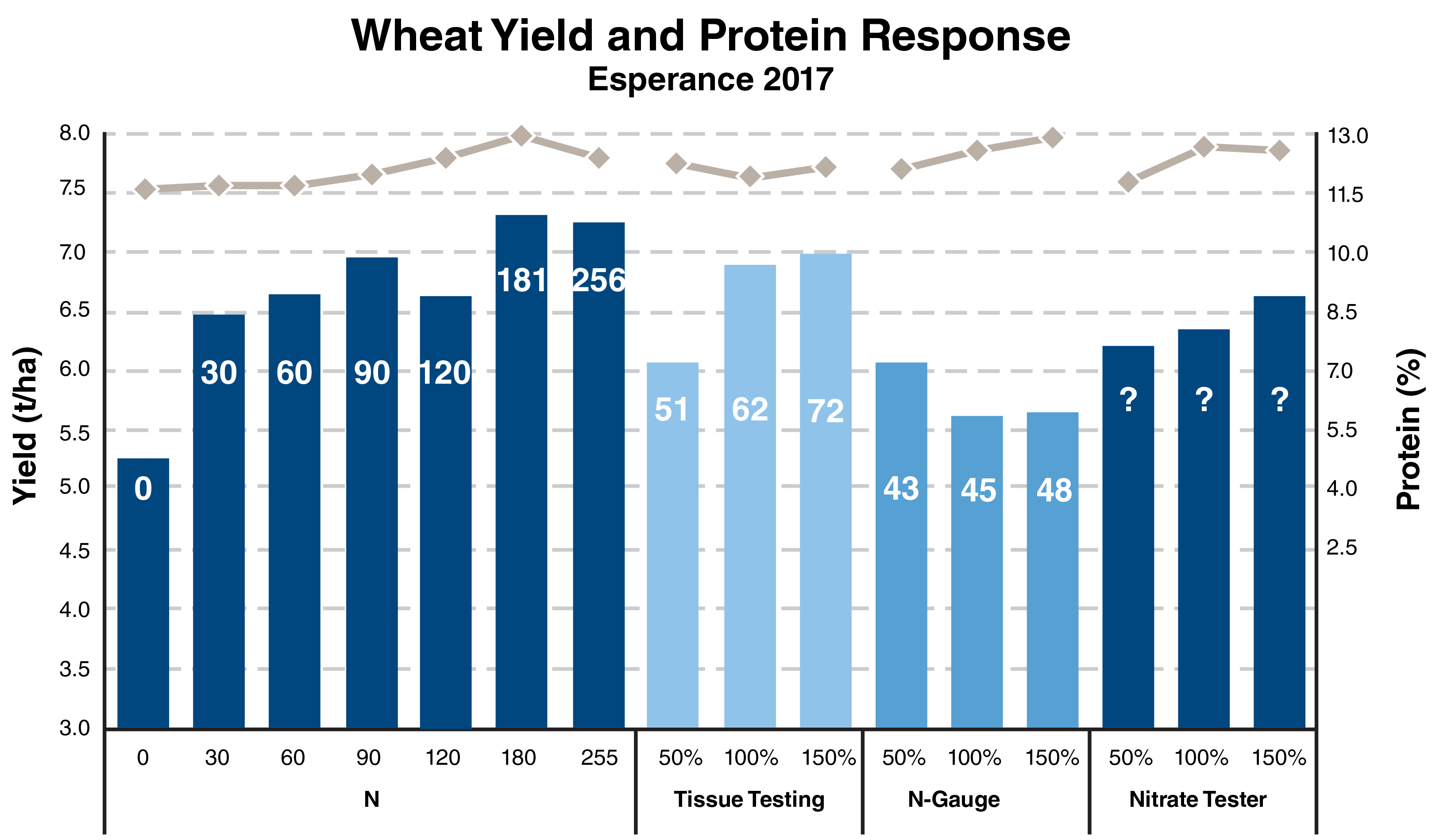
- Yields were very high across the trial, 5.28t/ha was achieved with no additional N applied.
Soil test results showed higher OC levels (1.58%, 0-10cm) and the area received adequate rainfall throughout the growing season. - DS Pascal wheat had a significant yield response to applied N. The N response curve suggested yields were maximised at ̴120kg/ha of N. Grain protein content was moderate (11.6%-12.9%) and increased with N application.
This variety is not commercial available so all treatments were graded as FED1. - N rich strips and N-calculator is a more accurate decision support tool when making in-season N decisions.
At this trial the N-calc did under predict yield and there was no yield improvement from 50% to 150% of the recommended rate. - Tissue testing is a very robust method for making in-season N decision but only shows if a crop is deficient. There is no process for gaining a specific top up application rate to counter act this deficiency.
- There was no significant difference seen between plots that received PGR and fungicide, with those that did not. The nitrate tester was conducted by Warakirri so the recommended rates used are unavailable.
- Gross margin calculation showed the greatest profit at $1620/ha from applying N72 or 150% of the recommended tissue testing rate.
- Based on response curve and gross margin calculations the recommended rate for applying N under these conditions is approx 70kgN/ha.
Goomalling 2017
PHOSPHORUS AND POTASSIUM RESPONSES
This trial emphasized the need for sub soil sampling for nutrients such as potassium. Some Western Australian soils have higher K levels at depth or accumulate applied K over time, in the subsoil.
At this site, K levels are deficient in the top-soil but increase to satisfactory levels to 30cm. Responses to K, both biologically and in gross margin, were limited to 10kg/ha K.
There were large responses to applied phosphorus.
Fir further details of this trial contact your local Area Manager or our field research team on research@summitfertz.com.au

RESULTS:
Considering the below average growing season rainfall, this trial generated respectable yields of between 2 and 3.6 t/ha.
There was a significant response to phosphorus but not to potassium under these conditions.
Soil test data suggested this trial would respond more to potassium than phosphorus with Colwell K levels of 25 to 52 ppm down to 30cm depth and phosphorus levels from 18 to 28 ppm with a PBI of under 50.
A response to potassium fertiliser is generally expected when Colwell K soil analysis results are below the nominal 50 mg/kg threshold.
Similarly, adequate soil P is considered for Colwell P levels above 15-20 mg/kg.
However, the importance of fresh P applied at sowing has consistently been demonstrated across many trials in the eastern wheatbelt.
Other trials have contrarily shown responses to K fertiliser when Colwell K levels are well above 50 mg/kg.
This highlights some issues of inconsistency in Colwell K soil analysis results and their use in predicting plant responses to K fertiliser application. Work on valid alternative soil K tests and crop response relationships is required.
Plant sampling taken on the 23rd August demonstrated a strong biomass response to P and a slight increase to 10 and 20 kg/ha of K.
Similarly at harvest, a consistent P response to 15 kg/ha was measured although the K response had diminished to be insignificant.
Notable is the performance of the NPKS compound fertiliser Vigour®,with lower total K than adjacent P treatments but contains all the plant nutrients in every granule for efficient plant uptake
The highest yielding treatment was 125 kg/ha of Vigour®,supplying 15P and 15K generating 3.64 t/ha.
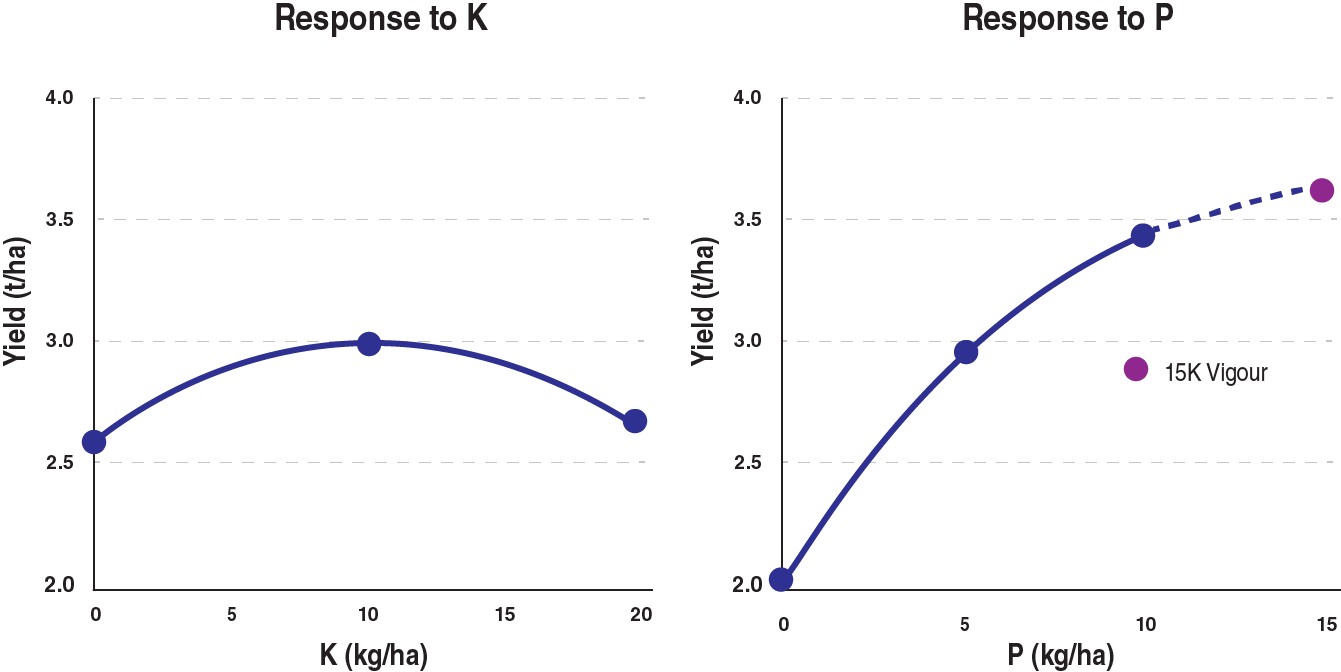
Average yield and gross margin response curves suggested phosphorus was optimised at 15 kg/ha and potassium at 10 kg/ha.
The slight response to 10 kg/ha of K was enough to cover the extra fertiliser cost whilst still increasing gross returns.
Under these conditions, despite the minimal K response there was no loss in returns relative to the nil treatment from the application of K up to 20 kg/ha.
CONCLUSIONS:
- There was a significant yield response to phosphorus but not to potassium under these conditions.
- The highest yield and returns were generated by 125 kg/ha of Vigour supplying 15P and 15K (3.64 t/ha).
- Average yield and gross margin were optimised at 15kg/ha of P and 10 kg/ha of K with no significant difference between method of K application.
- It is important to ensure K levels are not being mined by applying at least maintenance K fertiliser, therefore safeguarding future crops.
Grain Protein and Nitrogen Response in Cereal Varieties
Examining the yield response of wheat and barley varieties to N application. Testing the accuracy of the Nitrogen Calculator’s in-season N recommendations to achieve 10.5% and 12.5% grain protein at harvest.
High Nitrogen Rates and In-season Nitrogen Decisions in Wheat
Applying high rates of N to achieve elevated wheat yields whilst assessing the accuracy of N-rich strips and tissue testing to guide in-season N application.
Long Term Phosphorus Strategies
Investigates the long-term cumulative effect of building up, maintaining and drawing down P levels and the subsequent effect on yield of a cereal + legume rotation.
Many Peaks 2017
Phosphorus and Potassium on Pasture
AIM
To assess the most efficient way to allocate fertiliser spend in pasture near Manypeaks, WA
To see more detail of this trial contact your Area Manager or Summits Research Team

KEY MESSAGES
- A significant dry matter response was measured for nitrogen, but not for phosphorus or potassium.
- Nitrogen applied as urea in two applications of 100 kg/ha (92N, $100 /ha) generated the highest returns under these conditions.
- Phosphorus applied at $50 /ha with the addition of nitrogen produced the most dry matter.
- Summit will look to continue this trial over subsequent seasons to monitor the compounding effect of fertiliser treatments compared to where no fertiliser is applied.
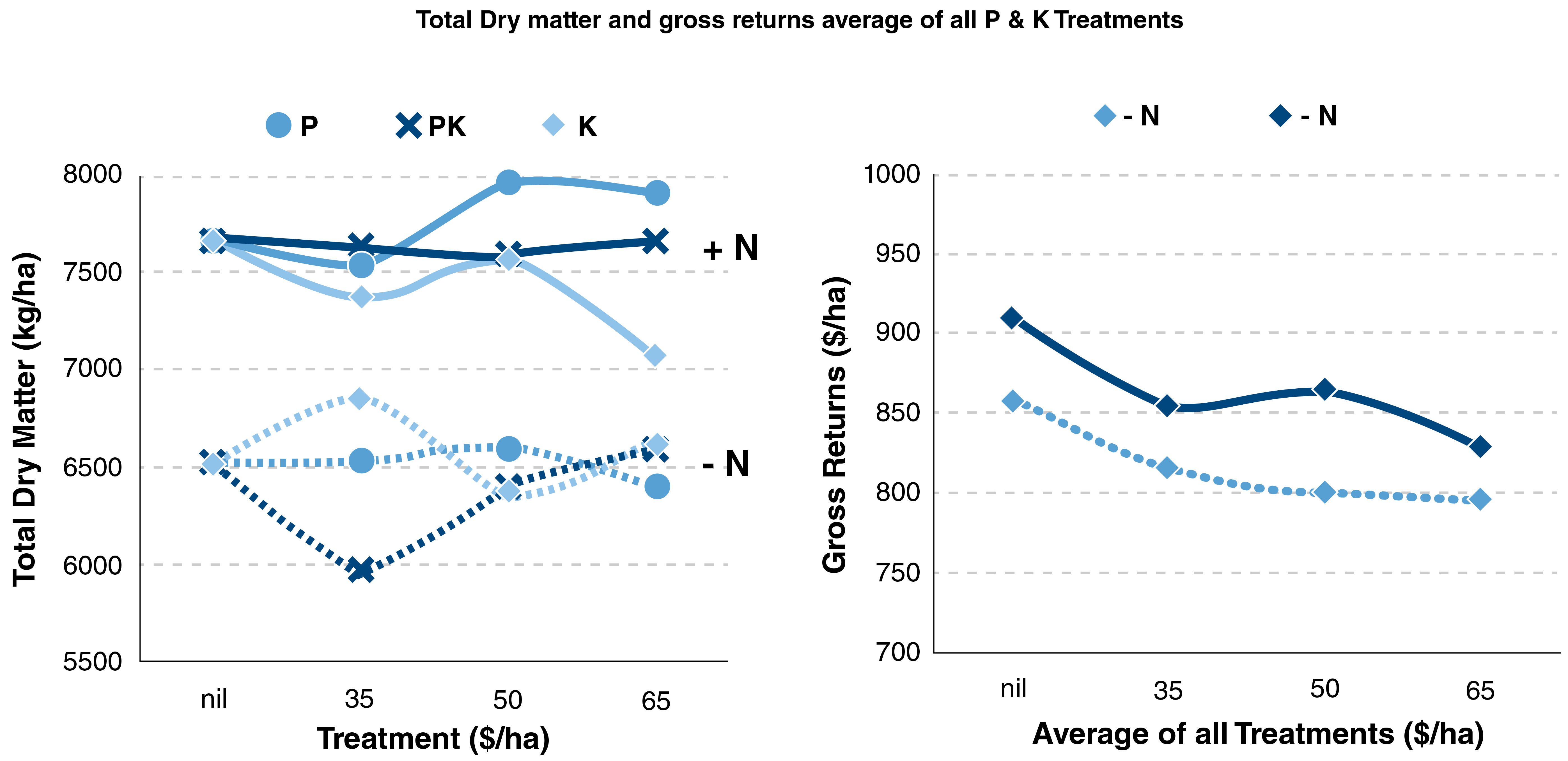
CONCLUSIONS
- There was a significant response to nitrogen but not to phosphorus or potassium under these conditions (p<0.05).
- $50 /ha of P with the addition of N produced the highest total dry matter for the growing season.
- Under these conditions, the addition of urea at 100 kg/ha in two applications (92N) generated a significant dry matter response, resulting in the highest returns.
- For the most profitable N application, a balance between application when the requirement for extra feed is greatest and when growth conditions are more favourable need to be weighed against each other. Lower response efficiencies during winter when soils are cold and wet may be offset by the increased value of the feed generated.
- Summit will look to continue applications into subsequent seasons to measure the compounding effects of varying fertiliser applications.
Mingenew 2017 Lupins
Phosphorus and potassium rates in lupins on sandy soil
AIM
To assess the value and to determine the optimal rates for applying P and K fertilizer to lupins on sandy soil in the Mingenew area. This will also help to improve the advice given to local farmers when making their fertilizer decisions.
For further details contract your local Area Manager or the Summit Research Team

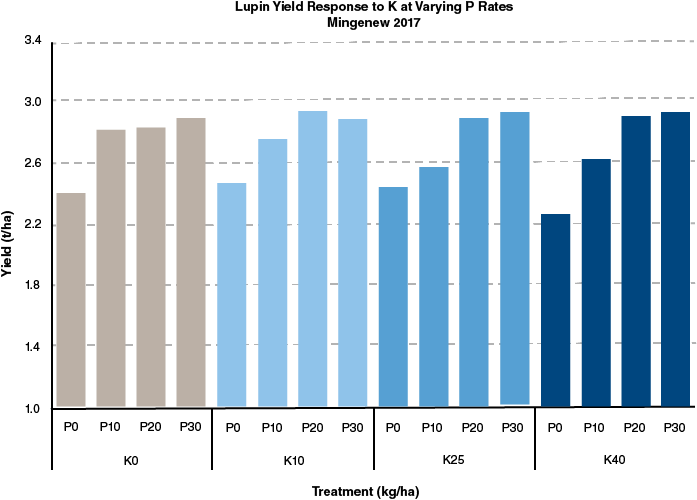
CONCLUSIONS
- NDVI data shows a strong and significant growth response to P application and an insignificant decreasing trend when K is applied.
- The harvest data demonstrated that there was a statistically significant yield response to P and no response to K.
The highest yield was 2.94 t/ha which received 20P and 10K. The lowest was 2.27 t/ha from 0P and 40K. P application saw a notable and beneficial increase in lupin yield, with a 12% increase from 10P, and a 21% increase from 20-30P when compared with 0P. - Even though plant biomass was considerably less at higher K rates earlier in the season, this decrease did not express as strongly in yield.
- The decrease in plant growth and yield with higher rates of K can be attributed to the sensitivity of lupins to the salt effect of MOP (KCL) in drying soils.
- Based on gross margin calculations and response curves the optimum rate for applying fertilizer to lupins under these conditions is 20 kg/ha of P and 10 kg/ha or less of K.
Mingenew 2017 N x Variety
Grain protein & nitrogen response in cereal varieties
AIM:
To assess the nitrogen response of wheat and barley varieties and the accuracy of the nitrogen calculators in season recommendation to achieve 10.5% and 12.5% grain protein on heavy red soil.
For further details contact your local Area Manager or our Summit Research Team

- Due to the lack of growing season rainfall, there was very little growth and minimal nitrogen response when NDVI was measured on the 20th July.
Subsequently, after above average rainfall in August, the N-calculator had underestimated yield and N requirements.
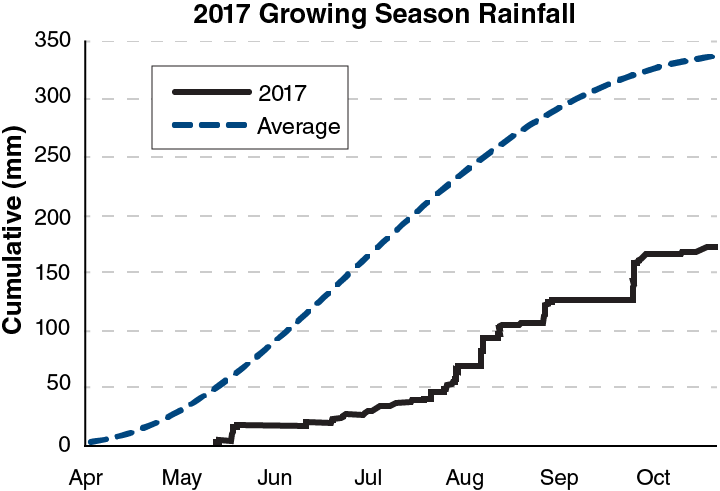
Summit’s In-Season Nitrogen Calculator aims to calculate a precise N rate to maximise the yield potential of a paddock where a crop is starting to run into N limitations, using NDVI as a real-time growth measurement.
It is designed to utilise comparisons between crop growth without N limitations beside paddock practice to determine optimal N application for yield and returns.
After above average rainfall in August and September, actual yields were between 1.75 and 3 t/ha where the N-Calc had predicted 1.12 to 1.89t/ha.
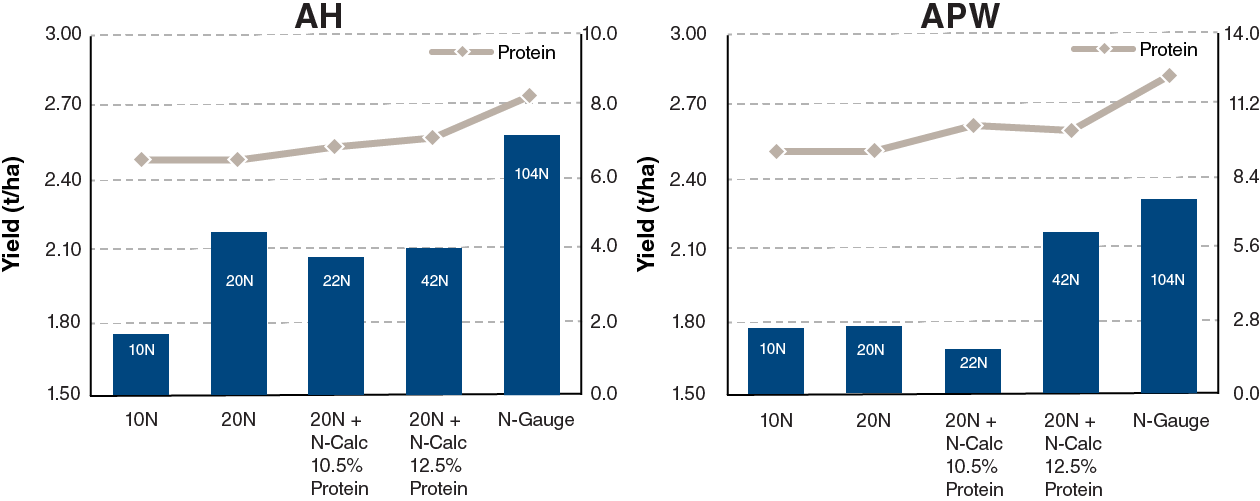
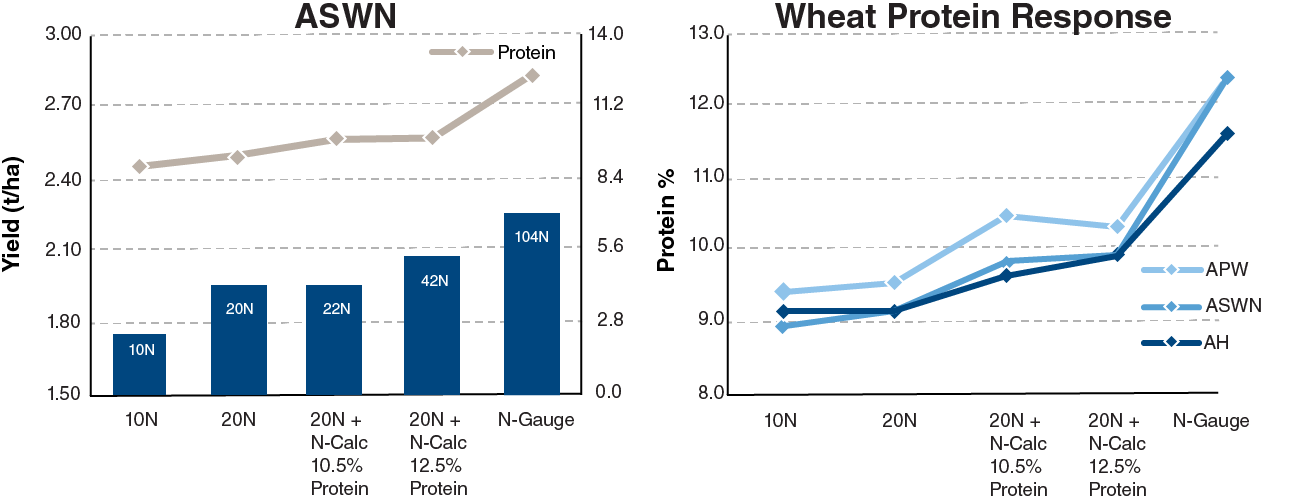
Notable also is the yield and protein response to the N-gauge treatments of 104 kg/ha of nitrogen upfront.
Under a normal growth pattern, upfront N would have been utilised to grow tillers, however limited rainfall until August meant N was remaining to be converted into protein.
BARLEY
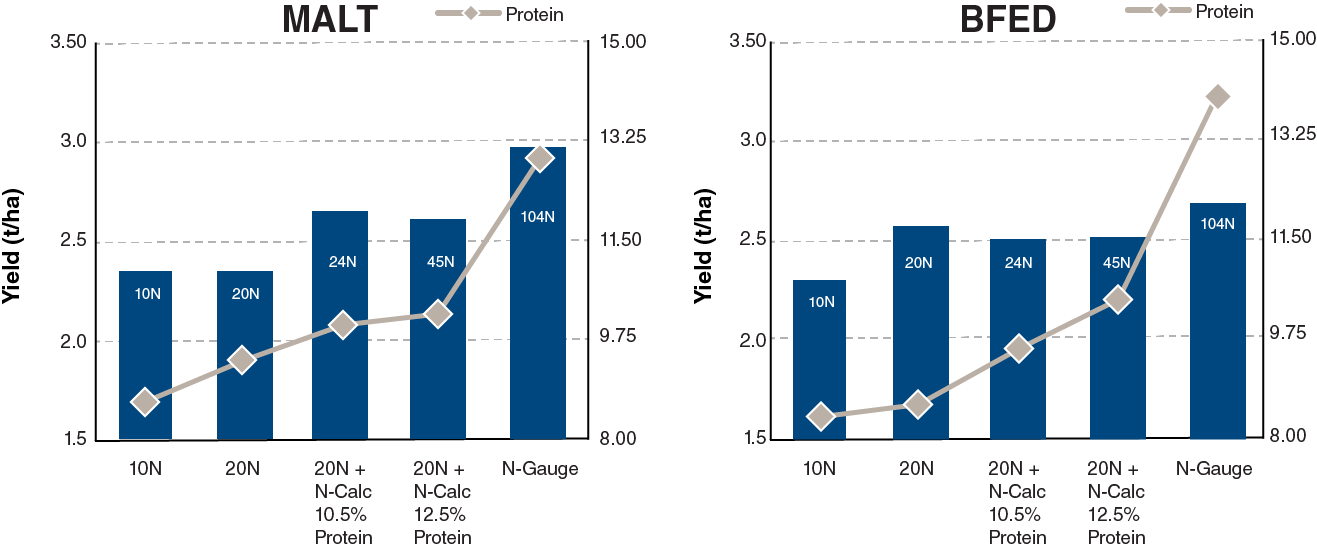
CONCLUSIONS:
- Due to the lack of growing season rainfall, there was very little growth and minimal nitrogen response when NDVI was measured on the 20th July.
Subsequently, after above average rainfall in August, the N-calculator had underestimated yield and N requirements. - Protein responded positively to nitrogen although N-calc top-ups were below the 10.5% and 12.5% protein targets, attributed to the underestimated yield prediction in July.
- There was a significant yield response to nitrogen rate, with barley varieties (2.31-2.97t/ha) yielding greater than wheat (1.74-2.59 t/ha).
- Gross returns were maximised by the higher yielding barley varieties and from ASWN wheat with the noodle price premium.
Moorine Rock 2017
Nitrogen, phosphorus and potassium in wheat
AIM:
Part of a trial series investigating how cereals respond to nitrogen (N), phosphorus (P) and potassium (K) fertilizer under different growing conditions across WA.
With the purpose of improving yields and the advice offered to local farmers when selecting their fertilizer regime.
For further details contact your local Area Manager or the Summit Research Team

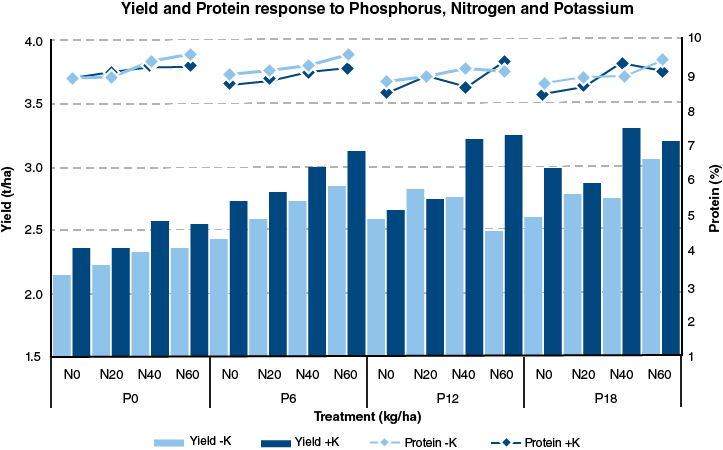
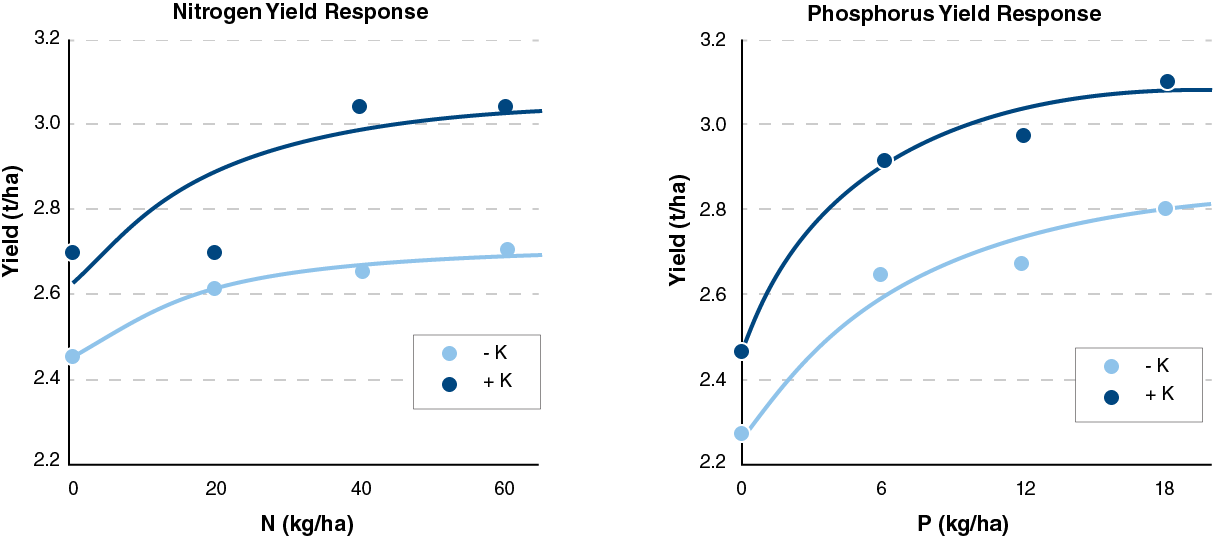
CONCLUSION
- NDVI data showed a strong growth response to increasing N and P rates, with greater growth when K was also incorporated.
- Harvest data indicated a positive yield response to applied N, P and K.
The largest tonnage was 3.31t/ha having 40kg/ha of N, 18kg/ha of P and 20kg/ha of K applied.
The smallest was 2.15t/ha receiving no fertilizer. - Grain protein was low (8.5%-9.6%) and increased with N application, but decreased with K, probably due to N dilution.
As grain yield increased Hectolitre weight were high (80.5kg/hL – 83.4kg/hL) and screenings were low (1.54%-3.30%). - The highest revenue was $919/ha from applying N60, P18 and K0. The lowest revenue was $665/ha which had N60, P12 and K0 applied.
- Based on gross margin calculations and response curves the optimal rate for applying fertilizer to wheat under 2017 conditions is N40, P18 and K20.