


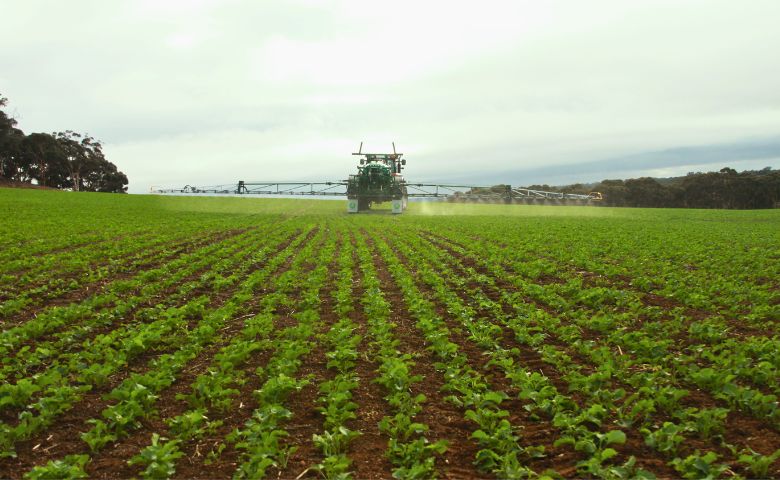
Plant testing a vital tool to maximise crop potential

A range of factors may be influencing crop nutrition this season, and plant tissue testing remains one of the most reliable tools available to help growers maximise crop potential.
Andrew Wallace, Area Manager with Summit Fertilizers based in Albany, supports growers from Gnowangerup to Jacup and across the eastern South Coast. He said improved crop yields in recent years had resulted in greater removal of nitrogen, phosphorus, potassium and trace elements from the soil, making it important to confirm nutrient availability within crops.
Andrew said lime applications ahead of canola had been favoured by growers for their immediate return on investment, making it important to monitor nutrient uptake in relation to soil pH levels.
“There has been strong investment in managing soil pH in recent years, and lime applications can influence crop nutrition. An understanding of manganese status, for example, can help guide decisions around trace element requirements,” he said.
“Plant testing provides valuable insight into copper, zinc and manganese nutrition. It is also important not to apply more nitrogen than required, as excessive nitrogen can affect copper uptake.”
Andrew said nitrogen use efficiency (NUE) was close to optimal last year, and plant testing could help growers make informed NUE decisions while maximising yield potential.
“While most of the State has received decile five rainfall, parts of the southern region are sitting at decile two, meaning nitrogen losses through June should be minimal. However, growers should ensure sufficient upfront nitrogen is available when crops begin to accelerate growth in August.”
“Once crops are established and upfront nitrogen has been applied, plant testing provides peace of mind as warmer conditions promote growth. Constraining crop growth in August is not ideal when seeking to optimise yield potential.”
He said that if NDVI data was being used to guide nitrogen decisions and discrepancies were identified, plant testing could provide valuable “ground-truthing” of nutrient uptake within the crop.
Summit Fertilizers area managers can undertake plant sampling for growers and assist with interpreting results.
Andrew said collecting samples early in the week was most beneficial, allowing them to be processed as quickly as possible by the independent Eurofins APAL laboratory.
Growers can view test results alongside NDVI overlays in the inSITE soil and plant analysis platform through the Summit Connect online portal, with Summit area managers available to assist with portal navigation. 
Andrew said growers could also align plant sampling locations with historical soil testing sites maintained within the platform, providing greater consistency when monitoring crop and soil performance over time.


