

Easing prices lower the investment risk for K
Across the state there is growing interest in soil potassium (K) nutrition, so we thought it timely to focus on the economics of applying K for the season ahead.
It is worth noting this article is aimed at fertilizer decision making on paddocks that are known to, or likely to respond well to applied K. Summit has done many K trials over the years and the best way to access that information is through your local Area Manager.
Always in the mind of growers is that any return on fertilizer investment is directly related to the value of what you are able to grow, less the cost of the fertilizer you are applying. In relative terms, fertilizer costs are quite reasonable at the moment.
Urea has dropped by 30% from recent historical highs of $1200/t, and potash is less than half the $1400/t it was just a few years ago.
As an example of the relative economics, we have re-calculated the values of a 2021 trial in Scepter wheat. The site was on a sandy soil southeast of Wyalkatchem.
Important factors compared were trial K rates of 0, 20 or 40kg/ha and early (applied at sowing) versus later applied (early-tillering) K treatments.
Returns on K
Good growing season rainfall supported this site with an overall trial yield, when averaged across all treatments, of 2.57t/ha.
Figure 1 shows Gross Margins comparing K treatments and using December 2021 fertilizer pricing and grain returns. It shows a clear trend of increasing GM with increasing K rates up to 40 kg/ha. Of note was that K
rate was much more important than timing on this responsive site. Recalculating the GM’s using December 2024 fertilizer pricing and the return on K investment is remarkably higher. So the message is, if you know you have areas that are K responsive, don’t skimp on the rates.
Putting out those extra kilos of MOP or SOP comes at a much lower cost/risk than it did just a few years ago.
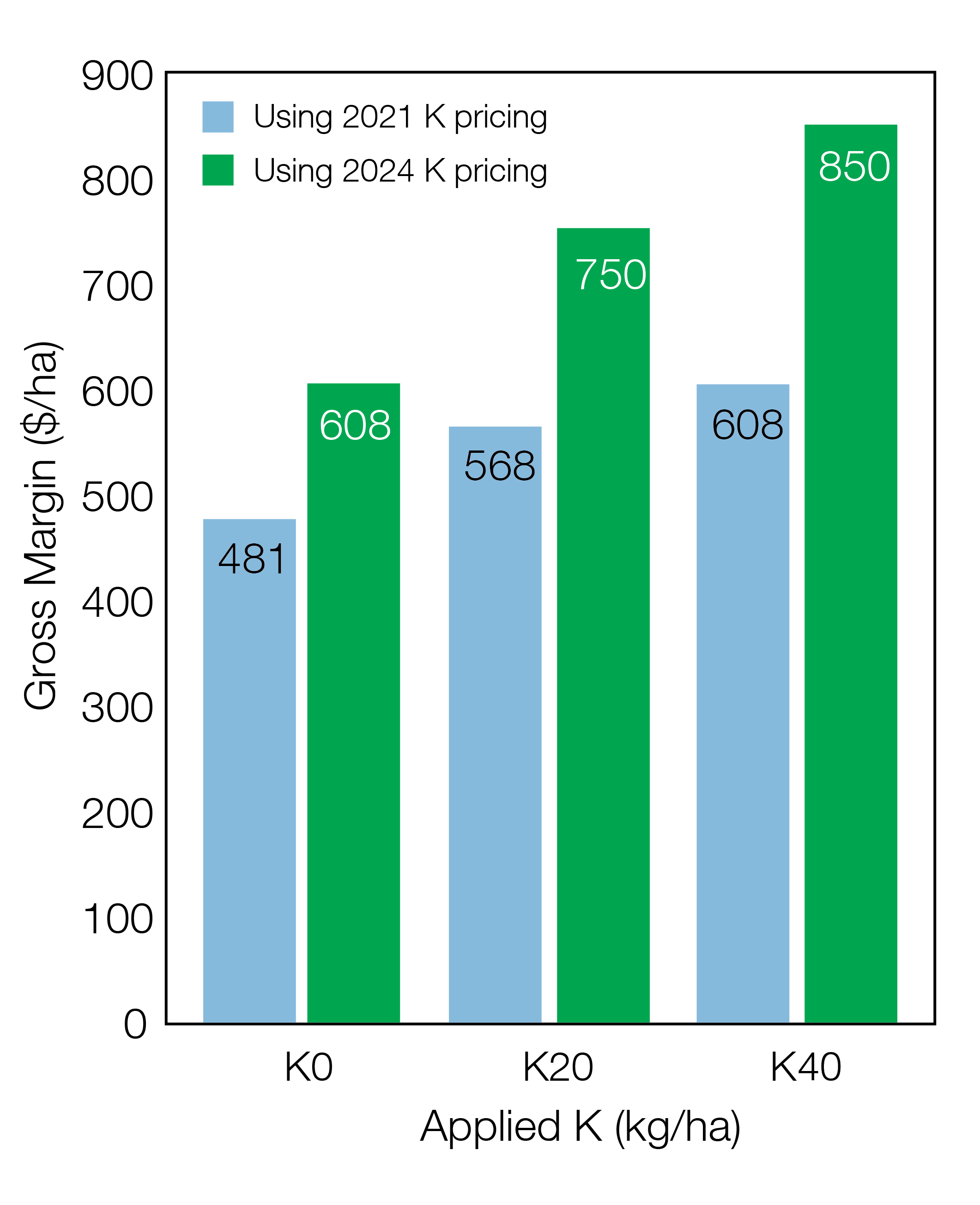
Figure 1. Comparing the return on K invest from SUM21.11 NxK rate and timing trial, when 2021 fertilizer prices (blue bars) are compared with more up to date December 2024 pricing (green bars).
Topsoil K rundown, eastern Wheatbelt
In the Eastern Wheatbelt in Kobus Marais’ area (Nungarin, Mukinbudin, Westonia, Merredin and Yilgarn)
Summit testing for potassium (K) in the topsoil has shown a rundown trend over the past decade. It is a situation not restricted to the Eastern Wheatbelt.

With intensive cropping and continuous removal of grain, seed and hay, growers should continue to keep an eye on soil K levels and removal, in-particular on lighter soil types. On very sandy soils it can be difficult to increase soil K. The best strategy on these soil types is to
apply K until you get to a stage where responses are less visible/common.
In-season Summit K Gauges can help assess your K status and inSITE plant analysis can also provide valuable insight. For more information, contact your Local Area Manager.