

Soil testing important as ever to aid better decisions
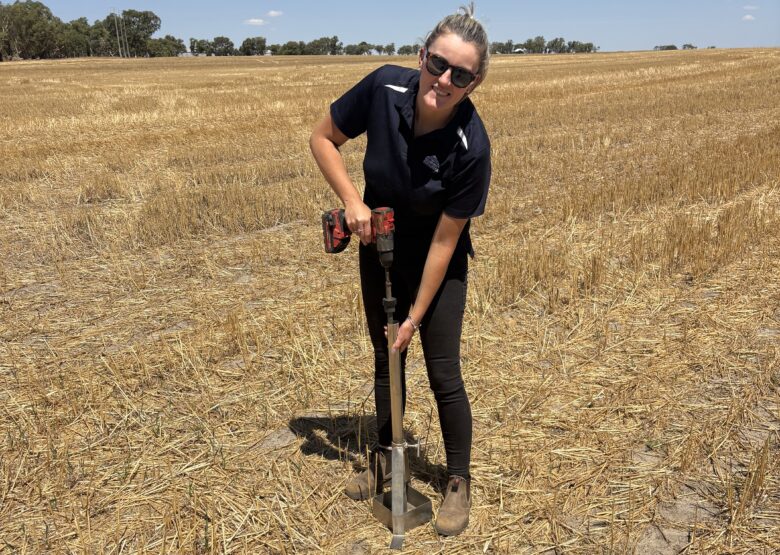
Alana Alexander, Central Midlands Area Manager with Summit Fertilizers, suspects more depth soil testing could be performed by WA growers to provide valuable information.
THE importance of soil testing to guide fertilizer management decisions is often highlighted this time of year and with producer margins so tight due to prevailing commodity prices, it has never been more critical heading into the 2026 season.
Summit Fertilizers Central Midlands Area Manager Alana Alexander said there was much to gain from building layers of data to assist better management decisions.
“Some farmers could be on a maintenance program with their soil testing and others could be considering whether it is perhaps time to test at depth,” said Alana, who suspected more depth testing could be performed by WA growers to provide valuable information.
“Accurate subsoil pH and aluminium data to depth could be the answer to those times when despite thinking everything was available to the plant to grow, what went in the bin at harvest didn’t match the investment.
“If all the information you have available is top soil data and you are making management decisions based on that, but there is a pH or Al problem in the subsoil, crops may not perform how anticipated.
“If you don’t know what’s down there, you can’t make better farm decisions and you don’t want to be spending a lot of money for it not to perform.”
She said soil testing information at depth was also invaluable before working land for soil amelioration.
“Before spending thousands of dollars ripping, flipping and tipping soil, it’s good to know what’s down there. It’s a significant cost and time investment to ameliorate soil, with labour, fuel and machine depreciation, so before making that decision, it’s beneficial to know what you will bring up to balance the risk versus reward.”
“Testing to depth accurately arms you with the data and knowledge to know what the soil will require for profitable production once a machine has been over it – and hence whether it’s worth bringing up what’s down there.
“One of the uses of the data from soil sampling is to create variable rate mapping. This can be utilised not only for different seeding application rates, but it can be used for lime, gypsum and applying different rates of potash through spreaders.”
Alana, who studied agricultural science at Massey University in New Zealand, completed a diploma in sustainable grain production from the University of New England in NSW and has tallied a decade of farm industry experience in the Moora region, said it would be ideal for growers to soil test a year ahead and use the data from last year to assist decisions for upcoming seasons.
“You want to be soil testing for the future, looking at the next four to five years ahead for your farming system.”
“With soil testing planning, there’s no rule of thumb – every property and farming system is different depending on where you are at with your soil testing program. It’s best to work out what’s best for your property and set a plan.
“Growers should be careful, however, not to get hyper-focused on bad areas and just use testing as a diagnostic tool. Higher production areas are at risk of being mined, especially when using single rate fertilizer applications across multiple soil types.”
Alana said while soil sampling was not the biggest cost, it was significant enough to ensure it was done with the highest precision and accuracy.
To maximise the investment in soil testing, she encouraged farmers to arrange contract soil sampling with Summit Fertilizers’ soil analysis partner, Precision SoilTech.
“Precision SoilTech has got the equipment to go to depth – down to 1 metre and even deeper – they do it day-in day-out, and they have the hygiene processes to ensure it is all done precisely and efficiently, providing the best possible information.”
With Summit Fertilizers, growers can login to their Summit Connect online portal, where they will find historical soil testing sites using the inSITE soil and plant analysis platform. This platform can be utilised to create soil testing plans using tools such as historical sites and NDVI maps.
Soil samples are processed at the independent Eurofins APAL laboratory and then it is highly beneficial for Summit Fertilizers area managers to analyse the data for growers before sitting down to plan better management decisions.
“There can be a lot of information that is underutilised and area managers can help break it down to understandable information for producers,” Alana said.
“We can help identify where changes can be made in fertilizer plans. It could be a case of looking at an area where a product could be used, or not over-utilising a product, which is especially important this year with the price of fertilizers.”
Considering the tight terms of trade for farmers, she suspected there would be a strong focus on using fertilizers more cost-effectively, including in ways that can avoid seasonal impacts on nutrition.